 Gabri
The best anti-cheat software is the one built for the job your game needs, because no vendor publishes catch rates you can compare side by side. What you can compare is design: who makes it, whether it runs a kernel driver, when it starts on your PC, what it asks of Windows and whether a ban can reach your hardware.
On November 18, 2026, I read the vendor, publisher or Steam store pages behind 12 anti-cheats: Riot Vanguard, Easy Anti-Cheat, BattlEye, EA Javelin Anticheat, Anti-Cheat Expert, Denuvo Anti-Cheat, VAC, FACEIT Anti-Cheat, KSS, NetEase Game Security, FairFight and XIGNCODE3. I also read the anti-cheat label on 15 Steam store pages the same day. This page compares them on those published facts, and it says plainly where a vendor publishes nothing.
If your PC itself is already banned, the hardware ban section further down is the part for you. If you only want to know which anti-cheat is best or least invasive, keep reading, because Saturn isn't your answer.
What Is the Best Anti-Cheat Software?
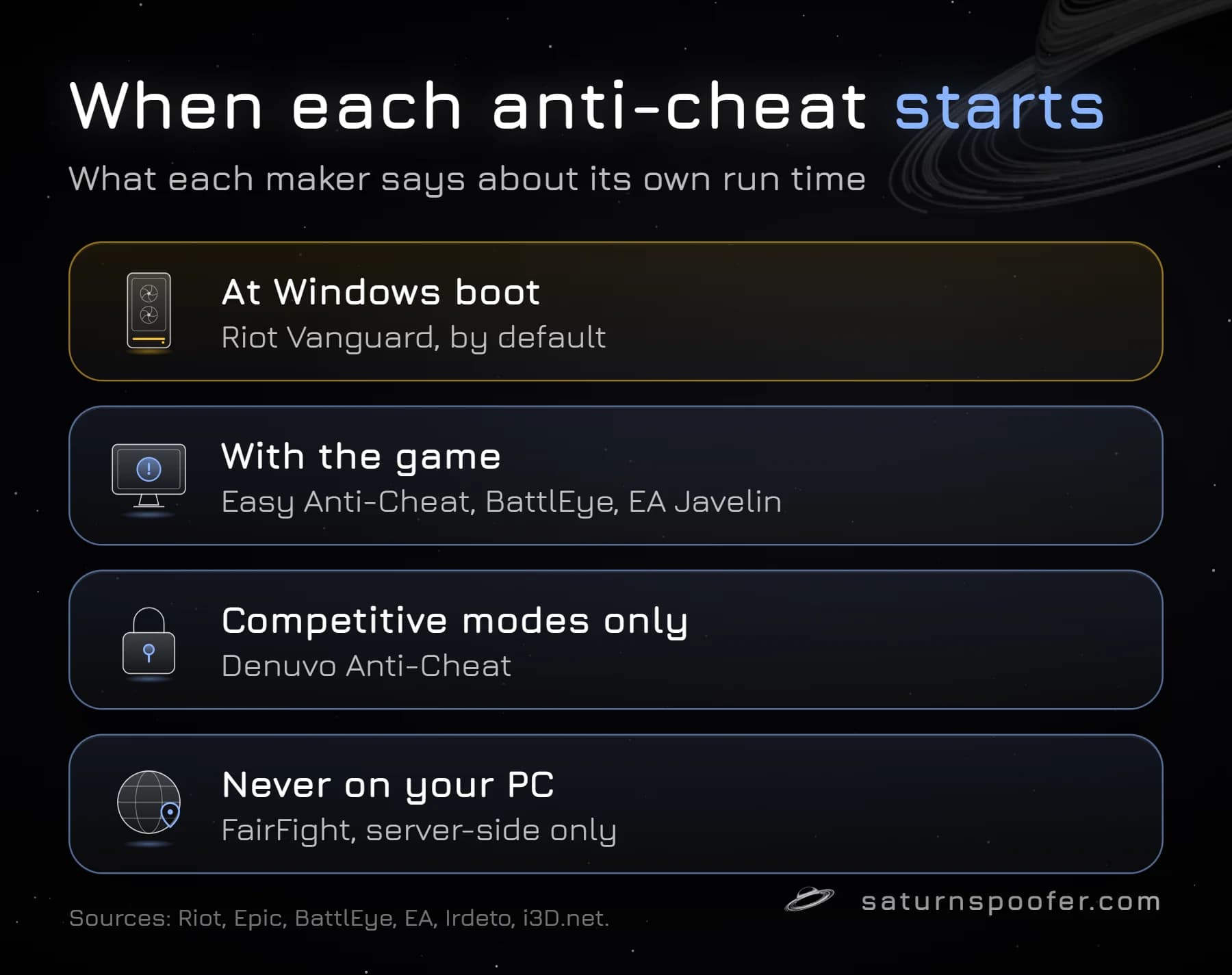
The best anti-cheat software depends on what you want it to be best at, because the vendors compete on design, not on published results. Riot Vanguard has the strictest default, a driver that starts with Windows. FairFight sits at the other end and installs nothing on your PC at all. Most of the rest, including Easy Anti-Cheat, BattlEye and Denuvo Anti-Cheat, start with the game and stop when it closes.
None of them publishes a catch rate.
Some numbers exist. They do not line up. EA says EA Javelin Anticheat has kept an accuracy rate of over 99% on the titles that use it, and the Delta Force security team says it issued over 170,000 bans in 2025 with Anti-Cheat Expert. One is an accuracy claim and one is a ban count, each measured by the vendor, on different games, in different years. Neither tells you which anti-cheat catches more cheaters, and any "best anti-cheat" ranking that claims to know has had to guess.
So this page judges each system on what it does to your PC and your account. For a player, that is the comparison that counts.
Anti-Cheat Software Compared
Anti-cheat software splits three ways by where it runs: in the Windows kernel, in normal user mode, or on the game's servers only. The table compares the 12 systems on who makes them, whether Steam or the vendor names a kernel driver, and when they start.
| Anti-cheat | Made by | Kernel driver | Starts |
|---|---|---|---|
| Riot Vanguard | Riot Games | Yes | At boot, or with the game on PCs that pass Pre-Check |
| Easy Anti-Cheat | Epic Games | Yes | With the game |
| BattlEye | BattlEye Innovations | Yes | With the game |
| EA Javelin Anticheat | Electronic Arts | Yes | With the game, plus Boot Protection on Battlefield 6 |
| Anti-Cheat Expert | Tencent | Yes | Not published |
| Denuvo Anti-Cheat | Irdeto | Yes | In competitive modes |
| KSS | Krafton | Yes (Steam label) | Not published |
| FACEIT Anti-Cheat | ESL FACEIT Group | Yes | Not published |
| VAC | Valve | Not labeled kernel-level | Not published |
| NetEase Game Security | NetEase | Not labeled kernel-level | Not published |
| XIGNCODE3 | Wellbia | Not published | Not published |
| FairFight | i3D.net | No, nothing on your PC | Server-side only |
Two things in that table come from Steam rather than the vendor. Valve told developers in October 2024 that a game installing a kernel-mode anti-cheat must declare it on its store page, so a "Kernel Level Anti-Cheat" label is the publisher's own statement. A plain "Anti-Cheat Software" label, as on Counter-Strike 2 and Marvel Rivals, only means the publisher did not declare a kernel driver. It does not prove the system runs in user mode, and I mark those rows "not labeled" for that reason.
The background on how kernel-level anti-cheat works, and why games moved their anti-cheat into the Windows kernel, is a topic of its own.
How the Major Anti-Cheats Differ
The six major anti-cheats all run a kernel driver on Windows. So the useful differences sit elsewhere: when the driver starts, what the game asks of your PC first, and who issues the ban. Each system below gets those three points and nothing else.
Riot Vanguard
Riot Vanguard starts first. Riot's support page, read on November 18, 2026, calls it "usually an on-boot application", and on June 24, 2026 Riot added an on-demand mode for Vanguard that waits for the game instead, only on PCs that pass Vanguard Pre-Check. Riot calls Secure Boot a universal requirement for Pre-Check and said 35% of players already met it, so most PCs keep Riot Vanguard's boot-time driver. Riot bans players itself. That includes hardware ID bans.
Easy Anti-Cheat
Easy Anti-Cheat waits for the game. The Easy Anti-Cheat support FAQ says "EAC does not run at boot or in the background" and that it collects "hardware identifiers to prevent ban evasion". Extra PC requirements are up to each developer: the same FAQ says games "may impose additional security requirements", for competitive modes, for high-risk accounts or for everyone. Epic sells the system to other studios, and each studio sets its own penalties, which is why how Easy Anti-Cheat works and how an EAC game bans you are two separate questions.
BattlEye
BattlEye also waits for the game, and its FAQ says it "is only ever active" during a BattlEye-protected session. None of the BattlEye pages I read asks for Secure Boot or TPM 2.0, but three of its Steam pages warn that the service must be removed by hand after an uninstall, a warning Rust and Hunt: Showdown 1896 carry for Easy Anti-Cheat too. Bans come from the studio, with BattlEye's kernel service storing hardware serials after a detection.
EA Javelin Anticheat
EA Javelin Anticheat asks the most of your hardware. Battlefield 6's Steam page lists "EA Javelin Anticheat Boot Protection - Requires both Secure Boot & TPM 2.0", and EA moved Apex Legends onto Javelin on September 29, 2026. EA's anticheat FAQ said on October 7, 2026 that it only runs while a protected game is running; the page returned an error on November 18. EA is publisher and anti-cheat maker at once, so EA's Javelin anti-cheat and EA's ban team answer to the same company.
Anti-Cheat Expert
Anti-Cheat Expert (ACE) is Tencent's system. Its English pages do not say when its driver loads or unloads. What it asks of the PC is clearer: a Delta Force security brief on ACE's own site, dated November 28, 2025, describes Secure Boot and TPM 2.0 being integrated because TPM "allows for significantly more accurate hardware bans". That puts Tencent's Anti-Cheat Expert next to Javelin on hardware asks.
Denuvo Anti-Cheat
Denuvo Anti-Cheat runs only in competitive modes, according to Irdeto's July 2020 myth-busting post, which says it is active "only when your game is running competitive game modes". Irdeto supplies detection, and Embark, the studio behind ARC Raiders and THE FINALS, writes its own ban rules, so the list of Denuvo Anti-Cheat games is also a list of separate ban policies.
Other Anti-Cheats Worth Knowing
Six more anti-cheats come up in "best anti-cheat" threads, and each one differs from the big six in a way that matters to you as a player:
- VAC. Valve's FAQ calls it "an automated system designed to detect cheats installed on users' computers", and Steam does not label it kernel-level on Counter-Strike 2. Valve's FAQ also states that a VAC ban is permanent, and that Steam Support cannot lift one.
- FACEIT Anti-Cheat. FACEIT protects its own Counter-Strike 2 matches with a kernel-level layer plus Human Input Detection, a machine-learning layer that judges in-game actions, and it says it blocks DMA cheats using IOMMU and other Windows security settings.
- KSS. On Steam, PUBG: BATTLEGROUNDS names KSS, short for Krafton Security Services, in its kernel-level anti-cheat field, so the system is Krafton's own for its own game.
- NetEase Game Security. Marvel Rivals lists it on Steam as anti-cheat software, without a kernel label.
- XIGNCODE3. Wellbia's site lists 290 games in service across PC, mobile and console, and more than 150 PC titles. Wellbia's homepage does not say whether the PC version uses a kernel driver.
- FairFight. i3D.net calls FairFight a server-side engine that "does not reside on the player's computer" and tests player actions against statistical markers. Penalties follow the publisher's own thresholds, from a warning to a suspension.
The design gap between these six is wider than between the big six. FairFight never touches your PC, VAC and NetEase carry no kernel label, and FACEIT runs its own kernel layer for its own matches.
Which Anti-Cheat Is the Most Invasive?
Riot Vanguard is the most invasive by default, because its driver starts with Windows, before any game is open. Riot's on-demand mode removes that for PCs that pass Pre-Check, but it is opt-in and depends on Secure Boot being on. EA Javelin Anticheat and Anti-Cheat Expert ask for the most hardware changes up front: Battlefield 6 requires Secure Boot and TPM 2.0, and ACE's Delta Force brief describes the same pair.
The least invasive options are the ones that stay off your PC until a match. Easy Anti-Cheat and BattlEye state in writing that they run only during play, Denuvo Anti-Cheat limits itself to competitive modes, and FairFight installs nothing at all. The trade is visibility: a server-side system like FairFight judges only the gameplay data the server receives, and it never sees a program running on your PC.
If kernel access is your real worry, the deciding question is when the driver runs.
A driver that loads for a match and unloads afterwards is a smaller ask than one that starts at boot.
Which Anti-Cheats Ban Your Hardware?
Four of the anti-cheats in this comparison have a device or hardware ban on the public record, written by the vendor or by a publisher that uses it. A hardware ban targets the PC's identifiers instead of only the account. A new account on that machine gets caught too. The table lists what each source says, in its own words where it gave any.
| Anti-cheat | What the source says | Source |
|---|---|---|
| Riot Vanguard | A hardware ID ban means "we've banned the physical components of that computer" | Riot Support |
| EA Javelin Anticheat | A lock, ban or suspension can sit on your EA Account, on a game, "or on your device" | EA Help |
| Anti-Cheat Expert | TPM "allows for significantly more accurate hardware bans" | ACE and Delta Force brief |
| Denuvo Anti-Cheat | Embark "can prevent the game from running on that system" in ARC Raiders | Embark, Sept 30, 2026 |
| Easy Anti-Cheat | Collects "hardware identifiers to prevent ban evasion" | EAC support FAQ |
| BattlEye | Stores "possibly hardware serial information for identification" after a detection | BattlEye privacy policy |
| VAC | A ban is permanent and bars VAC-secured servers; "system hardware configurations" will not trigger one | Steam Support |
| FairFight | Graduated penalties, from warning to suspension | i3D.net |
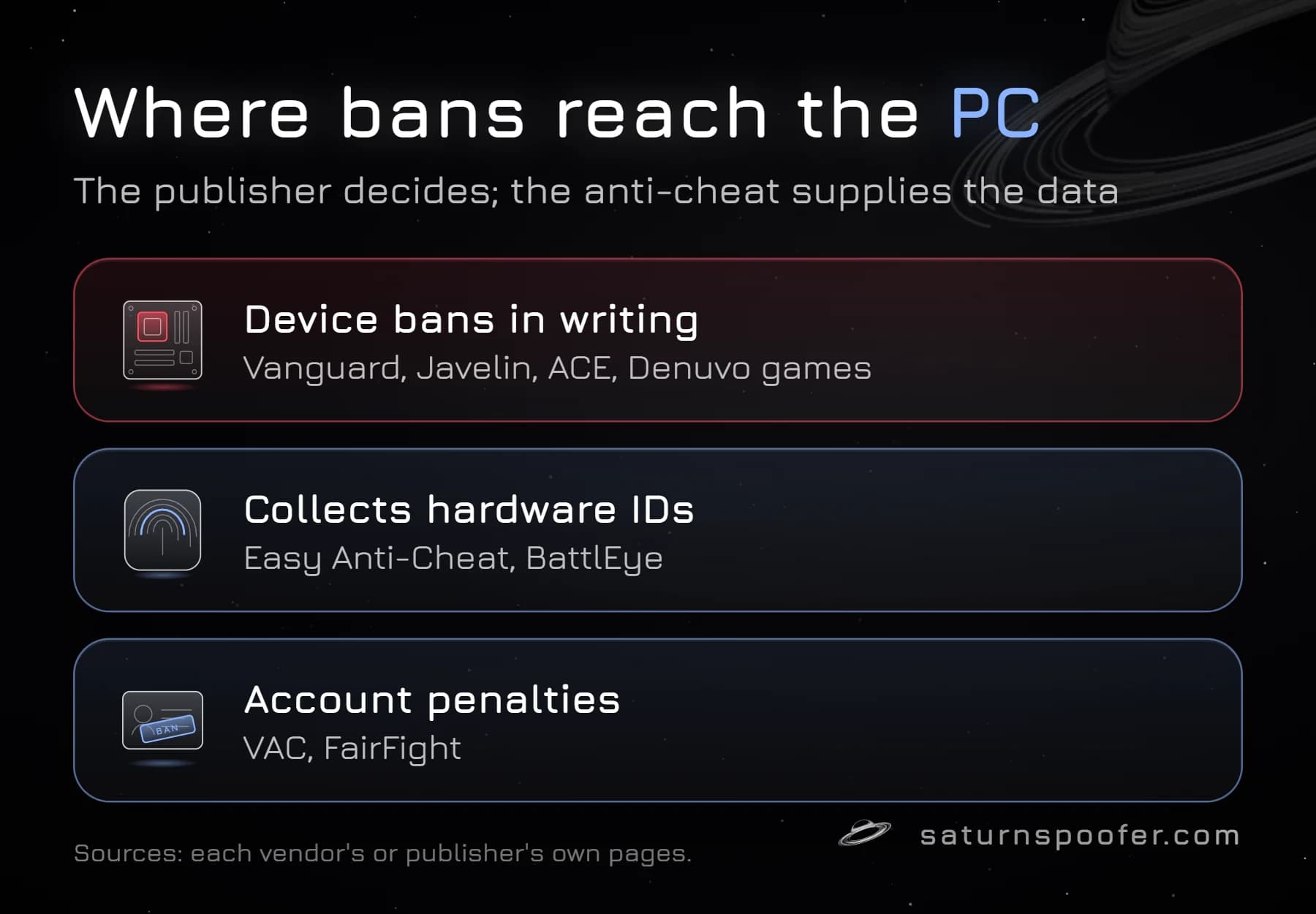
The pattern holds across the table. The anti-cheat collects the hardware data, and the game's publisher chooses whether a ban stops at the account or reaches the PC, so two games on the same anti-cheat can treat you differently. Easy Anti-Cheat and BattlEye collect identifiers. Each studio makes the call. A ban on a PC's hardware IDs is still the publisher's decision, made with the anti-cheat's data.
When a Spoofer Matters on This Page
A spoofer matters on this page in one case only: a game has banned your PC's hardware, not only your account. Saturn is an HWID spoofer for Windows, not a cheat. It replaces the identifiers a hardware ban is keyed to, from the motherboard, CPU and TPM to drive serials, the MAC address of the network adapter and the display's EDID, and the PC is cleared of that ban.
Saturn's licenses carry the names of 5 anti-cheats (Riot Vanguard, EAC, BattlEye including FiveM, Javelin and ACE), but the games list decides coverage, not the label. ARC Raiders, which runs Denuvo Anti-Cheat, sits under the EAC license, and PUBG, which runs KSS, under the BattlEye license. The Saturn games page lists 63 titles, and each license runs from the same single loader as every other Saturn license, with your license deciding which games it covers. You can check each license on the HWID spoofer for each anti-cheat pages.
Saturn works with memory integrity, Secure Boot and TPM 2.0 all switched on, so the Windows settings Vanguard, Javelin and ACE ask for can stay as they are. When an anti-cheat updates, we ship a fix within hours. Temporary mode gives you unlimited profiles, and your original IDs come back when you close it, while Permanent mode writes one profile for good. Every license comes with a 24-hour free trial, no card needed, only an email address for the key.
As of November 18, 2026, Saturn is currently undetected by every anti-cheat it supports, and the live status page is where that's tracked day to day. I'd keep one thing straight, though: that's Saturn's own footprint, not your cheat's, and an anti-cheat that catches the cheat still bans the account.
Where it falls short: an account ban stays where it is, and the anti-cheat can still see a cheat. A game missing from Saturn's list is not covered, and Saturn runs on Windows only.
Saturn is the wrong answer if:
- The ban sits on your account alone, or an appeal is still pending.
- Your game is not on Saturn's games list.
- You want to keep a cheating account alive.
- You only came to find out which anti-cheat is least invasive.
Pick One in 60 Seconds
| If you care most about | Look for | Watch out for |
|---|---|---|
| Nothing running outside the game | Easy Anti-Cheat, BattlEye or Denuvo games | Some leave a service behind after uninstall |
| No driver on your PC at all | Games that rely on FairFight alone | It judges server data only |
| Strict anti-cheat in ranked play | Vanguard, Javelin or FACEIT matches | Secure Boot and TPM 2.0 may need BIOS changes |
| A ban that already hit your PC | The publisher's ban notice first | A spoofer never lifts an account ban |
Anti-Cheat Software FAQ
What is the best anti-cheat software?
No anti-cheat is best on published evidence, because none of the 12 vendors compared here published detection rates you can compare when I checked in November 2026. On design, Riot Vanguard is the strictest by default, FairFight is the least invasive, and Easy Anti-Cheat and BattlEye sit between them, running only while you play.
Is BattlEye a good anti-cheat?
BattlEye is one of the longest-running anti-cheats in PC gaming, in use since 2004, and Steam lists it as the kernel-level anti-cheat on War Thunder, DayZ and Escape from Tarkov. Its FAQ says it is active only while you play a BattlEye game, and that it generally bans only for actual cheats or tools built to get around it.
Which anti-cheats start when Windows starts?
Riot Vanguard is the one anti-cheat in this comparison whose maker says it starts with Windows by default. Since June 24, 2026, PCs that pass Vanguard Pre-Check can switch it to on-demand mode instead, and Battlefield 6 adds an EA Javelin Boot Protection layer, which requires both Secure Boot and TPM 2.0.
Is VAC a kernel-level anti-cheat?
Steam does not label VAC as kernel-level on Counter-Strike 2, where it is listed as "Anti-Cheat Software". Valve describes VAC as an automated system that detects cheats installed on a computer and bans the account from VAC-secured servers.
Which anti-cheats work on Linux and Steam Deck?
Easy Anti-Cheat can, if the developer turns it on. Epic announced on September 23, 2021 that developers can activate Easy Anti-Cheat support for Linux through Wine or Proton in the Epic Online Services portal, so it varies game by game.
Can an anti-cheat ban your PC and not just your account?
Yes. Riot, EA, Embark with Denuvo Anti-Cheat, and the Delta Force team with Anti-Cheat Expert have all published that a ban can reach the device, and Easy Anti-Cheat and BattlEye collect the hardware identifiers that make it possible. Whether yours does depends on the game's publisher.
HOW I CHECKED THIS On November 18, 2026, I read Riot's What is Vanguard and HWID ban support pages and its June 24, 2026 on-demand post, the Easy Anti-Cheat homepage and support FAQ, Epic's September 23, 2021 Linux announcement, BattlEye's homepage, FAQ and privacy policy, EA's Apex Legends Javelin announcement, Secure Boot help page and banned accounts page, Anti-Cheat Expert's English homepage and its November 28, 2025 Delta Force brief, Irdeto's Denuvo Anti-Cheat page and myth-busting post, Embark's September 30, 2026 anti-cheat update, Valve's VAC FAQ, FACEIT's anti-cheat page, i3D.net's FairFight page, Wellbia's homepage, and the anti-cheat labels on 15 Steam store pages. EA's anticheat FAQ was read on October 7, 2026 and was offline on November 18. I did not install, run or test any anti-cheat, cheat or spoofer, so no line here comes from a test. UNVERIFIED: when Anti-Cheat Expert, KSS and NetEase Game Security load and unload, and whether XIGNCODE3 uses a kernel driver on PC.