EA Javelin Anticheat is the kernel-level anti-cheat and anti-tamper system that Electronic Arts writes and runs itself for its PC games. It first shipped as "EA anticheat" with FIFA 23 in September 2022 and took the Javelin name on April 24, 2025. EA's September 2026 progress report puts it in 20 titles, guarding 57.1 million players, with 26.7 million cheat attempts stopped over the previous twelve months.
Battlefield 6 is the game that put Javelin in front of most PC players, largely because it will not start without Secure Boot and TPM 2.0. Every fact here comes from EA's own posts and help pages or from the Steam store, including the parts EA keeps vague, like whether a Javelin ban can follow your PC.
What Is EA Javelin Anticheat?
EA Javelin Anticheat is EA's in-house PC anti-cheat, built and maintained by the company's Game Security and Anti-Cheat team rather than licensed from an outside vendor. EA describes it as both an anti-cheat and an anti-tamper layer: it looks for cheat software touching the game, and it stops the game itself from being tampered with.
The product has worn several names, which is why searches for "EA anticheat", "EAAC", "EA AntiCheat" and "Javelin" all land on the same thing. EA launched it as EA anticheat in 2022, then rebranded it in April 2025, saying the Javelin name was meant to suggest defense, strength and agility. Some Steam pages never caught up: Madden NFL 26 still lists "EA Anti Cheat (EAAC)" under its anti-cheat notes, while most other EA titles show "EA Javelin Anticheat".
Javelin is a PC-only system. Console versions of the same games are covered by other means; EA's Apex Legends team, for one, says it builds separate data models and server-side checks for console-specific cheats.
How Javelin Works on a Windows PC
EA Javelin Anticheat runs a kernel driver, the same privilege level as Windows itself, and EA's explanation is blunt: cheats moved into the kernel, so the anti-cheat had to follow. In EA's words, a cheat running in kernel space while the anti-cheat sits in user mode can hide everything it does. Microsoft's driver documentation shows why that level matters, since all kernel-mode code shares one address space and a crashing kernel-mode driver takes the whole operating system down with it.
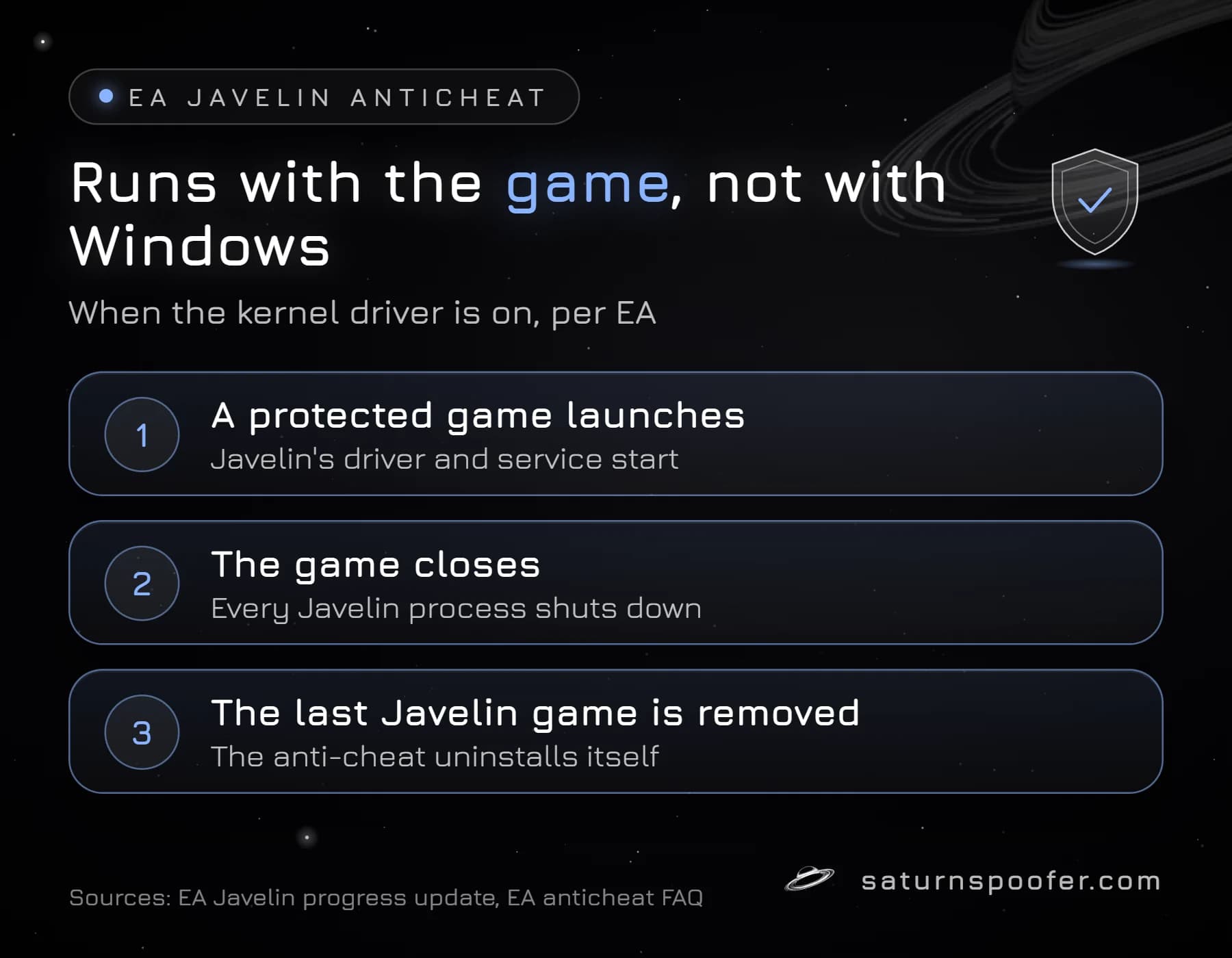
Javelin does not run all the time, though. EA says the anti-cheat starts only when a game with Javelin protection launches, and every one of its processes shuts down when that game closes. The lifecycle EA documents looks like this:
- The first Javelin-protected game you install sets up the anti-cheat automatically.
- Launching that game starts Javelin's driver and service; closing it stops them.
- Uninstalling your last Javelin game removes the anti-cheat from the PC on its own.
- You can remove Javelin by hand at any time, but protected games refuse to launch until it is back.
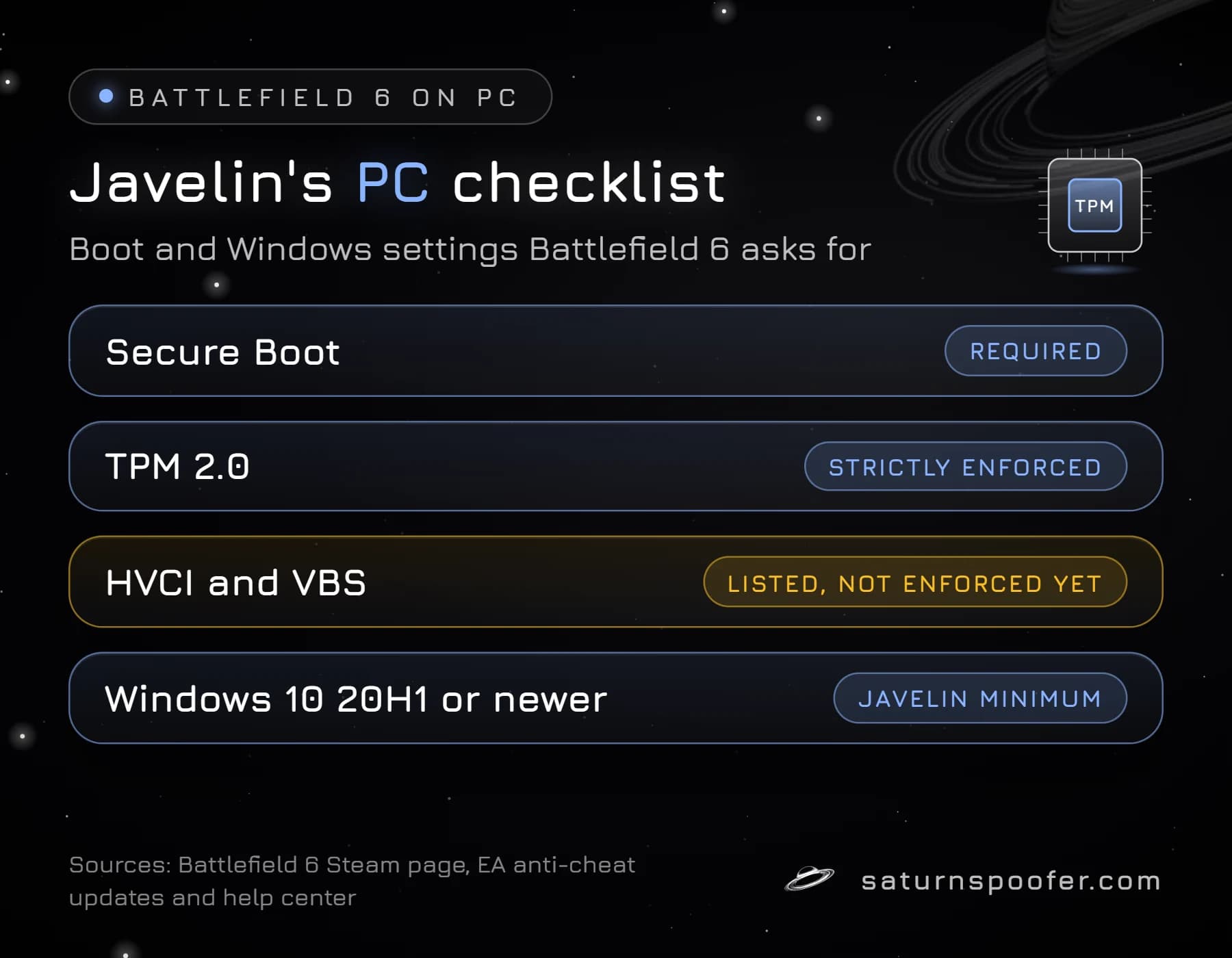
Javelin also needs a reasonably current Windows build. EA's help center sets the floor at the Windows 10 20H1 update, version 10.0.19041. While a game runs, Javelin closes it if it finds cheat tools, debuggers or other software EA has marked as conflicting, and it keeps a denylist of older drivers (several RGB and hardware-monitoring utilities among them) that must be updated or switched off before the game will start.
EA adds a less obvious reason for protecting single-player modes too. Cheat developers use offline modes to study a game and test tampered files before taking the result online, so Javelin guards those modes as well.
Which Games Use EA Javelin Anticheat?
EA Javelin Anticheat protects most of EA's big multiplayer PC releases, across the Battlefield, EA SPORTS FC, Madden NFL, F1, EA SPORTS WRC and Plants vs. Zombies franchises. EA's posts name franchises rather than a full title list, so the table below comes from each game's Steam store page, which states the anti-cheat in a dedicated notes block.
| Game | Steam anti-cheat note | Extra requirement |
|---|---|---|
| Battlefield 6 | EA Javelin Anticheat | Secure Boot and TPM 2.0 |
| Battlefield 2042 | EA Javelin Anticheat | None listed |
| EA SPORTS FC 26 | EA Javelin Anticheat | None listed |
| EA SPORTS FC 25 | EA Javelin Anticheat | None listed |
| Madden NFL 26 | EA Anti Cheat (EAAC) | None listed |
| F1 25 | EA Javelin Anticheat | None listed |
| EA SPORTS WRC | EA Javelin Anticheat | None listed |
| skate. | EA Javelin Anticheat | None listed |
| PvZ Garden Warfare 2 | EA Javelin Anticheat | None listed |
Every game in that table carries Steam's "Uses Kernel Level Anti-Cheat" label. EA's own update adds Battlefield Labs and EA SPORTS College Football 27 to the list of recent Javelin launches.
Apex Legends is the newest arrival and the one most search results still get wrong. Respawn's game used Epic's Easy Anti-Cheat on PC for years, and EA moved it to Javelin on September 29, 2026, citing better visibility into new threats. Apex does not ask for Secure Boot, at least for now, and its Steam page still showed Easy Anti-Cheat in early October 2026, so the store label lags behind the switch.
Not every EA release gets Javelin. EA says each studio decides per project, and single-player games or titles without ranked ladders may use lighter user-mode protection or none at all.
Battlefield 6, Secure Boot and TPM 2.0
Battlefield 6 is the strictest Javelin game on PC: its Steam page lists "Boot Protection - Requires both Secure Boot & TPM 2.0", and its system requirements also name HVCI and VBS. EA's help center describes Secure Boot as the Windows 10 and 11 feature that makes a PC load only safe software during startup, and says it lets Javelin-protected games detect and remove bad actors.
Some gaming news coverage after Battlefield 6 was revealed got this backward and said players would have to load Javelin during startup. It doesn't. Secure Boot is a firmware setting in the PC's UEFI, and the anti-cheat still starts with the game and stops when it closes. Secure Boot only controls what is allowed to load underneath Windows before Javelin ever gets a look.
EA's numbers show how hard it leaned on the requirement:
- Configurable Secure Boot rules started with Battlefield 2042, and EA says over 4.8 million players switched Secure Boot on during the year covered by its 2026 report.
- In the Battlefield 6 open beta, Secure Boot adoption rose from 62.5% to 92.5%, and Javelin blocked over 1.2 million cheat attempts.
- Over launch weekend, Javelin stopped more than 367,000 attempts, and EA counted 2.39 million blocked by its first Season 1 update.
- EA measured about 98% of launch-week matches as free of cheaters, using its Match Infection Rate metric.
TPM 2.0 came next. EA's 2026 report calls it a new security baseline for next-generation titles, and its Season 3 update said strict TPM enforcement was coming after 98.76% of Battlefield 6 players were already on compliant hardware. EA added that most of the remaining 1.24% were using emulators, faking their hardware compliance, or tied to botting or cheating. A TPM chip also gives each PC a durable hardware identity, the same property other anti-cheats use for TPM-based hardware bans.
EA admits none of this is airtight. Its anti-cheat team wrote that Secure Boot "isn't a silver bullet," calling it a barrier that makes each detection harder for cheat developers to get around. Javelin has since added detection for DMA cheat cards, hardware that reads game memory from a second device, along with blocks on malicious input devices and macro tools.
What Happens When Javelin Catches a Cheater
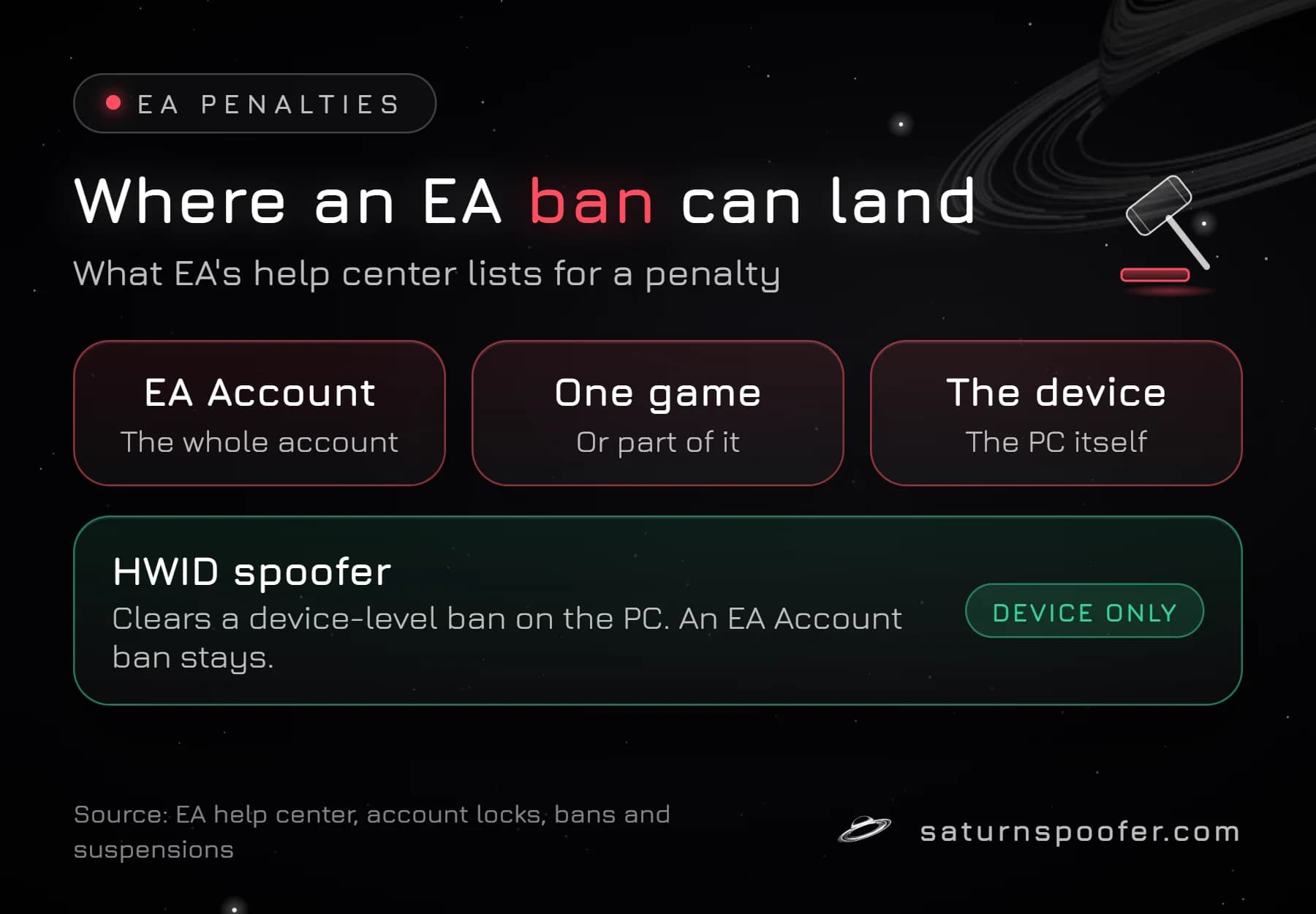
EA Javelin Anticheat feeds a range of penalties, and the first one is often silent: the game closes, or the attempt is blocked before it does anything. EA's help center lists three levels of action against EA Accounts:
- A lock, a temporary block EA applies after too many failed logins or other suspicious account activity.
- A suspension, which removes access to a game or the account for a set time.
- A ban, which removes access to a game, part of a game or the whole EA Account for an extended period or permanently.
EA says Javelin and its studio partners had permanently banned thousands of cheater accounts across 14 games by April 2025. Battlefield 6 adds its own layers: ban waves, timed so cheat makers cannot quickly rework a cheat around a fresh detection, plus rules that act at once when a flagged account crosses set thresholds. Since Season 3, EA also applies a VAC ban to confirmed Battlefield 6 cheaters, so other players can identify them.
Players who think a penalty is wrong appeal through EA's Penalty History tool, where a moderation team reviews the case. EA says it accepts slower enforcement in exchange for fewer false positives, and it keeps the details of its review process private to avoid helping cheat developers.
Does EA Javelin Anticheat Ban Your Hardware?
EA has not published a hardware ID ban policy for Javelin, and it does not list which hardware identifiers Javelin reads. What EA does document points in that direction, though. EA's help article on locks and bans says a penalty may apply to an EA Account, to a single game, or even to the device itself. Its Season 3 Battlefield 6 update says EA can act on "the accounts and devices" behind illicit botting services. And its privacy FAQ says Javelin turns the data it collects into hashed unique identifiers.
Read together, those pages say a Javelin game can penalize the machine and not only the login, even though EA keeps the mechanics private. That is the one situation where Saturn fits. Saturn contains no cheat features; it is a hardware ID spoofer for Windows, and its Javelin HWID spoofer license changes what the PC reports for its motherboard (board and SMBIOS values), processor, TPM, memory serials, each NVMe, SSD or HDD drive, graphics card, the display's EDID, network MAC, USB devices and UEFI variables, plus dozens of other unique IDs. That clears a device-level ban on the PC. A penalty on the EA Account is a separate record, and the spoofer leaves it exactly where it was.
Saturn runs in two modes. Temporary mode masks the IDs for as long as it is open, so closing it brings the original, banned values straight back, and it allows unlimited profiles. Permanent mode writes new IDs that stay, clearing the PC under one HWID profile; a later ban on that profile means buying a fresh one. The same loader serves Javelin and the other supported systems (Vanguard, EAC, BattlEye, FiveM and ACE), with the license deciding which are switched on. Trying it costs nothing for 24 hours: the trial wants an email address, and no card.
Is EA Javelin Anticheat Safe? Privacy and Security
EA Javelin Anticheat is designed to look only at what touches EA's games, and EA says the rest of the PC is off limits. According to EA's technical FAQ on the anti-cheat, Javelin does not collect browsing history, personal files or information about applications unrelated to EA games. If a process tries to interact with a protected game, Javelin can see and respond to it.
For the data it does gather, EA says it runs the values through hashing to create unique identifiers and discards the originals. EA adds that independent security and privacy firms reviewed Javelin, that its engineers run security and penetration tests against it, and that anyone who finds a flaw can report it through EA's Coordinated Vulnerability Disclosure process.
The general risk with any kernel anti-cheat is the one Microsoft spells out for kernel drivers: code at that level is not isolated, so a bug can crash Windows or open a hole. EA's answer is that it owns the whole stack and can patch issues quickly, and its September 2026 report lists compatibility fixes for AMD and NVIDIA driver features and launch times cut in half. Native ARM64 support is next on EA's roadmap.
Javelin vs Easy Anti-Cheat, BattlEye and Vanguard
EA Javelin Anticheat differs from the other big names mainly in who owns it. Easy Anti-Cheat belongs to Epic Games and the BattlEye anti-cheat comes from a separate firm, BattlEye Innovations; both protect games from many different studios. Javelin, like Riot Vanguard, is written by the publisher for its own games only. Javelin belongs to the group of anti-cheats that run in the kernel, alongside Vanguard, Easy Anti-Cheat and BattlEye.
EA's reason for building its own came from experience. Its security lead said third-party anti-cheats, some from direct competitors, left EA unable to share game code or data and limited the privacy controls it could add. The same argument came back in September 2026 when Apex Legends left Easy Anti-Cheat.
Timing is the other difference. Riot's support pages call Vanguard "usually an on-boot application" (a newer Pre-Check option lets it start on demand on PCs that meet Riot's security requirements), which is part of how Vanguard works. Javelin loads with a protected game and stops when that game closes.
EA Javelin Anticheat FAQ
Is EA anticheat the same as EA Javelin Anticheat?
Yes. EA anticheat, EAAC and EA Javelin Anticheat are one product. EA renamed its in-house anti-cheat to EA Javelin Anticheat in April 2025, and older help pages and some Steam listings still use the earlier names.
Does Javelin run in the background all the time?
No. EA says Javelin starts with a protected game and shuts down every anti-cheat process when the game closes. Battlefield 6's Secure Boot requirement is a firmware setting, so it does not mean Javelin runs from startup.
Does EA Javelin Anticheat work on Linux or Steam Deck?
No. Steam's compatibility check marks Battlefield 6 as unsupported on SteamOS, and EA said EA SPORTS WRC stopped running on Steam Deck once EA anticheat was added. Javelin games need Windows 10 20H1 or newer.
Is EA Javelin Anticheat on consoles?
No. EA Javelin Anticheat is a PC anti-cheat. On consoles EA points to other layers, such as the server-side detection the Apex Legends team aims at console-specific cheats, and EA says Javelin also protects console players who meet PC opponents through cross-play.
Does Javelin affect game performance?
EA says the impact is negligible, based on internal and independent performance testing. Its 2026 report claims launch times dropped by half and the anti-tamper layer got 20% faster.
Why does Javelin block some apps and drivers?
EA keeps a denylist of software and drivers it treats as a security risk, often older versions of hardware utilities. Updating the program usually restores compatibility, and if the program itself is blocked, it has to be closed while a Javelin game runs.