Easy Anti-Cheat (EAC) is an anti-cheat service for online PC games, owned by Epic Games since Epic bought its Finnish developer, Kamu, in October 2018. EAC starts with a protected game, blocks the common ways of tampering with it, and flags accounts that use cheats so the game's publisher can ban them. PCGamingWiki's list counted 222 games shipping with Easy Anti-Cheat in October 2026, plus 26 that used it in the past, which makes it one of the most widely used anti-cheats on PC.
Most players meet EAC as a splash screen or a Windows prompt the first time a game such as Fortnite, Rust or Elden Ring starts. That prompt installs a Windows service with kernel access. Most questions about EAC follow from it: what the service does, what it collects, and whether an EAC ban can follow the PC rather than only the account.
Who Makes Easy Anti-Cheat
Easy Anti-Cheat is made by Epic Games, the company behind Fortnite and Unreal Engine, and it ships as part of Epic Online Services (EOS), Epic's free toolkit for multiplayer games. EAC did not start at Epic. Two Finnish developers released it in 2006 as a tool for Counter-Strike 1.6 leagues and tournaments, according to PCGamingWiki's history of the product.
- 2006: EasyAntiCheat launches for Counter-Strike 1.6 competitive play.
- 2013: the team incorporates and starts licensing EAC to studios.
- November 2017: the company is renamed Kamu.
- October 2018: Epic Games acquires Kamu and, with it, Easy Anti-Cheat.
- 2021: Epic makes EAC free for every developer through Epic Online Services, then adds Linux, Mac and Steam Deck support that September.
Today the anti-cheat has a free tier and paid tiers. Epic's developer documentation says the core service costs studios nothing, while game-specific detection work by Epic's analysts, machine-learning models for aim-assist cheats and tools for repeat cheaters are part of a paid enterprise agreement. That split matters to players: two games can both show the EAC logo and still get very different levels of attention from Epic's team.
How Easy Anti-Cheat Works
Easy Anti-Cheat works by starting the game inside a protected mode and then checking, from a server or from other players, that the protection stayed active for the whole match. Epic describes two jobs: cheat prevention, which passively blocks simple tricks such as reading and writing the game's memory, and cheat detection, which spots more advanced manipulation and marks the account so the developer can act on it.
The Launch Sequence
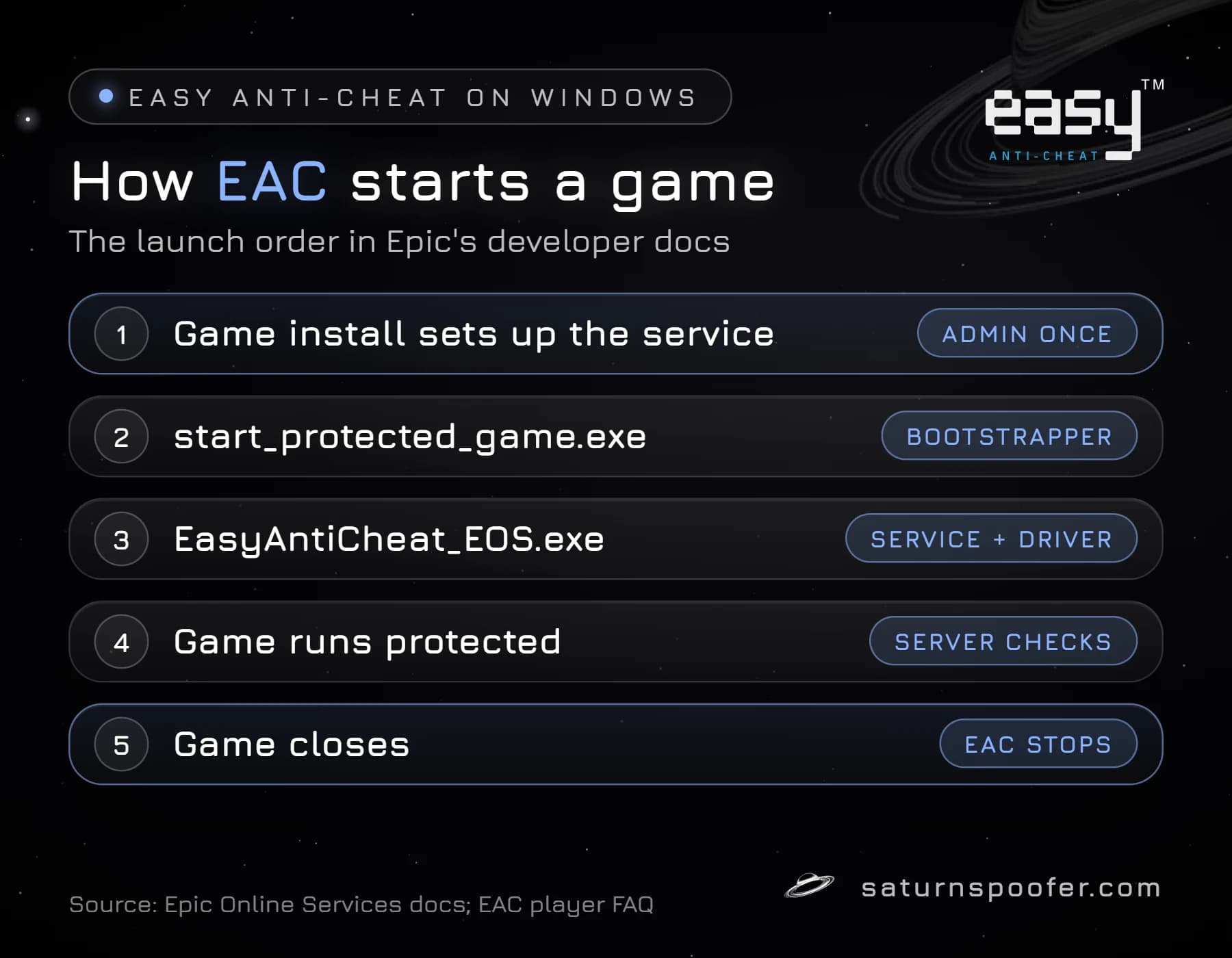
On Windows, EAC is three small programs that a game installs alongside itself. Epic's developer documentation names them, and the order they run in explains most of what players see on screen.
- The game's installer sets up the Easy Anti-Cheat Windows service, which needs administrator rights once, at install time.
- When you press Play, a bootstrapper called start_protected_game.exe runs first and prepares the anti-cheat.
- The bootstrapper starts the EAC service (EasyAntiCheat_EOS.exe), which loads the EAC driver and its other parts.
- The game process starts with protection already active, and the game server or your peers confirm it is there.
- When you close the game, the service stops on its own.
Epic's player FAQ adds that one shared EAC service serves every EAC game on the PC, and that the service is removed when the last game using it is uninstalled. The older standalone version of the service ran as EasyAntiCheat.exe, which is why both names turn up in Task Manager and in guides.
Prevention and Detection
Easy Anti-Cheat's prevention layer stops the cheap attacks: another program opening the game's memory, a modified game file, or an untrusted system file loaded into the game. The detection layer looks for cheats that get past that, using heuristics, analysis of gameplay and player reports, which the EAC homepage lists as its main signals. Epic tells developers that sanctions require the game to have player reporting built in, and that offline or solo play cannot be protected in a useful way.
Epic is also open about the limits. Its documentation says Epic may write detections for common cheating tools on the free tier but does not promise them for every game, and EAC's own FAQ explains that there is always a window between a new cheat appearing and the moment it gets detected and blocked. That gap is why cheaters still show up in EAC games.
Extra Security Settings a Game Can Require
Easy Anti-Cheat lets each developer decide whether players must turn on extra Windows and firmware protections. According to EAC's support pages, a game can demand them for every player, only for ranked or competitive modes, or only for accounts it considers high risk. The three settings EAC names are:
- Secure Boot, which blocks code that tries to load during the PC's startup, a trick some cheats use.
- A TPM (Trusted Platform Module), a chip EAC uses to check that Secure Boot is on, in a way cheats find hard to fake.
- IOMMU, also called Intel VT-d or AMD-Vi, which limits what PCIe cards can read from memory and helps stop PCIe boards built for direct memory access cheating, which copy game memory to a second computer.
Is Easy Anti-Cheat Kernel Level?
Yes, Easy Anti-Cheat is a kernel-level anti-cheat on Windows. Epic's EAC player support FAQ says EAC needs kernel access because sophisticated cheats hide inside drivers, memory and hardware where ordinary programs cannot see them, so the anti-cheat has to work at the same level. Steam's store pages say the same thing in their notices: Rust, for example, is marked as using kernel level anti-cheat, with Easy Anti-Cheat named as the system.
Microsoft's driver documentation explains what that means. Windows runs normal apps in user mode, where each program gets its own private memory and a crash only takes down that app. Kernel mode is where core Windows parts and many drivers run, all sharing one address space. Code there sees much more of Windows, and one faulty driver is enough to bring the whole PC down. That access is what puts EAC on the short list of kernel anti-cheats used in PC games today, together with Riot Vanguard, BattlEye, EA Javelin and Tencent's ACE.
The detail that separates EAC from Riot Vanguard is timing. Epic states that Easy Anti-Cheat does not run at boot or in the background: the EAC driver loads when a protected game starts and unloads when it closes. Vanguard, by default, loads its driver when Windows starts.
What Games Use Easy Anti-Cheat
Easy Anti-Cheat runs in more than 200 games, from Epic's own Fortnite and Fall Guys to Rust, Elden Ring, Dead by Daylight and the Halo collection on PC. Epic's EAC site says the service protects 200+ games and 35M+ players every month, and PCGamingWiki's list is the most complete public count. Some big names have also left EAC, so older lists online are often wrong about which games still use it.
| Game | Anti-cheat today | EAC status |
|---|---|---|
| Fortnite | Easy Anti-Cheat | Required |
| Rust | Easy Anti-Cheat | Current |
| Elden Ring | Easy Anti-Cheat | Current |
| Dead by Daylight | Easy Anti-Cheat | Current |
| Halo Infinite | Easy Anti-Cheat | Current |
| Lost Ark | Easy Anti-Cheat | Current |
| Hunt: Showdown 1896 | Easy Anti-Cheat | Current |
| Apex Legends | EA Javelin | Former |
| ARC Raiders | Denuvo Anti-Cheat | Former |
Two of the departures are recent. EA announced that Apex Legends would switch its PC anti-cheat from Easy Anti-Cheat to EA Javelin Anticheat effective September 29, 2026, after years on EAC. ARC Raiders launched with EAC, and Embark began moving players to Denuvo Anti-Cheat in May 2026; Embark's switch to Denuvo Anti-Cheat covers what that changed for bans. PCGamingWiki also lists Far Cry 5, Battlefield 2042 and Ghost Recon Wildlands among former EAC titles.
What Data Does Easy Anti-Cheat Collect?
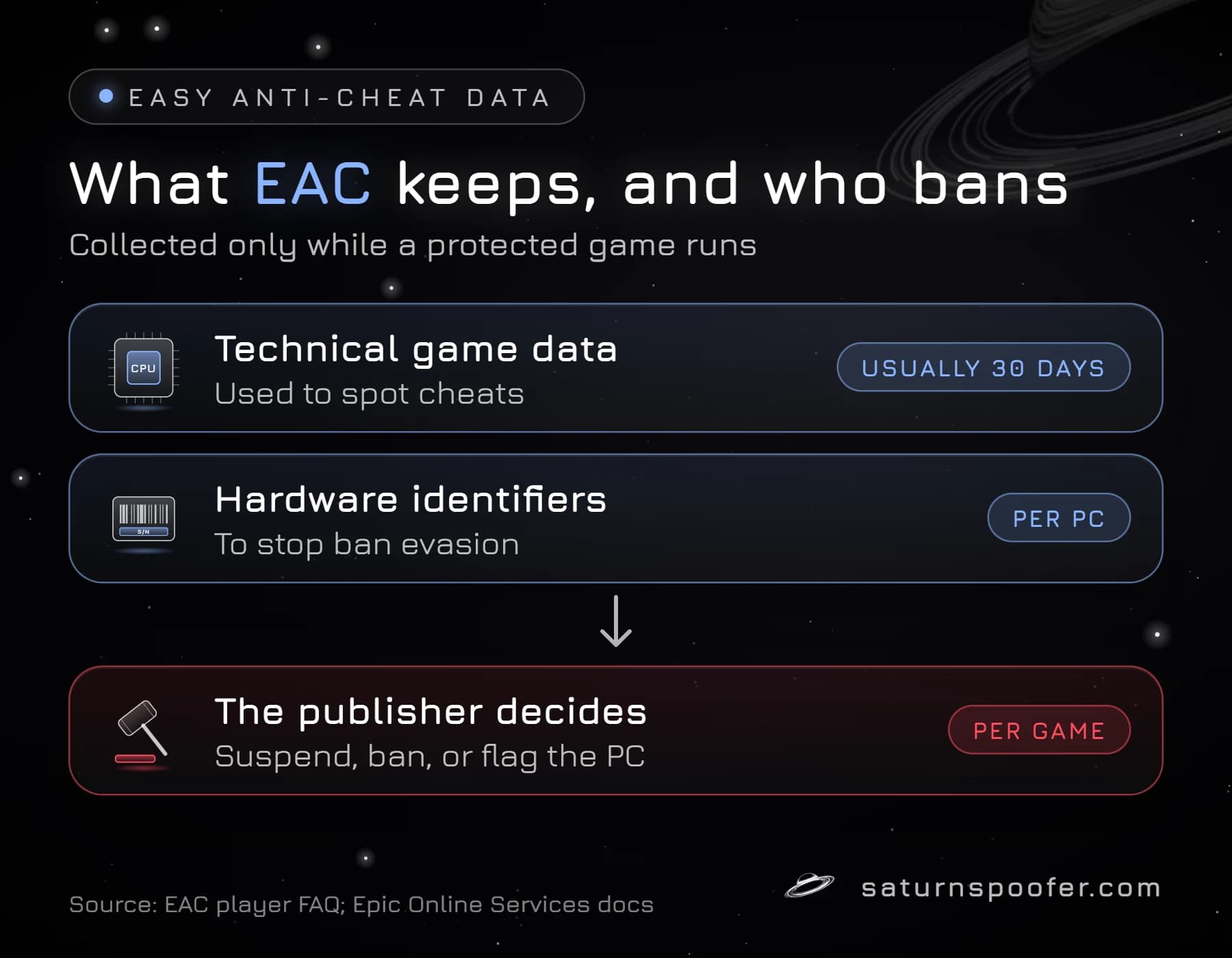
Easy Anti-Cheat collects limited technical data while a protected game is running, plus hardware identifiers. Epic's player FAQ states that EAC gathers that technical data to identify cheats and collects "hardware identifiers to prevent ban evasion." Epic does not publish which identifiers it reads. In general, hardware identifiers are the serial numbers and IDs that parts like disks, motherboards and network adapters report to Windows, the same identifiers that make up a PC's HWID.
Epic also gives a retention rule: data used for cheat detections is generally deleted within 30 days unless it is part of a specific investigation, and all collected data is deleted once it is no longer needed for cheat prevention. Because EAC only runs while the game is open, it is not collecting anything while you browse, work or play a game that does not use it.
Is Easy Anti-Cheat Safe?
Easy Anti-Cheat is legitimate software from Epic Games, and it is safe in the sense that matters most: it comes from a known company, installs with the game you chose, and removes itself when the last EAC game is gone. The questions people raise on Reddit and Steam are about trust and access, not malware.
Any kernel driver has deep access, and Microsoft's own docs note that a faulty kernel driver can crash the whole system. Epic's answer, in its EAC FAQ, is that running in the kernel does not add much privacy or security risk compared with software that already has administrator rights, and that its software is regularly audited by outside vendors. EAC also works against one real risk: its FAQ says it asks players to close software with known-vulnerable kernel drivers, often RGB lighting or hardware-monitoring tools, because cheaters abuse those drivers.
Get EAC only through the game or its launcher, never from a site offering a standalone download. Expect it to stop overlays, mod tools or automation software that touch the game the way cheats do; EAC says that block lasts only while the game runs.
Performance is the other common worry. Epic says EAC is built to have minimal impact on FPS on modern PCs, though older CPUs or limited RAM can feel it more.
How Easy Anti-Cheat Bans Work
Easy Anti-Cheat does not ban players on its own terms: EAC detects the cheat and flags the account, then the game's publisher decides whether to suspend or ban it. That rule from Epic's FAQ explains why the same detection can mean a short suspension in one game and a permanent ban in another. Bans are often delayed on purpose, so a ban can arrive well after the match, even while you are offline, and Epic does not tell players which cheat was detected.
Rust shows the strict end. Facepunch's support article says Rust's EAC bans are all permanent, that tickets and appeals will not remove one, and that any new accounts used to get around the ban can be banned too. On Steam, an EAC ban also puts a game ban status on the Steam profile, with the same weight as a VAC ban. Other publishers run their own appeal paths, and EAC accepts appeals at easy.ac for bans players believe were false detections.
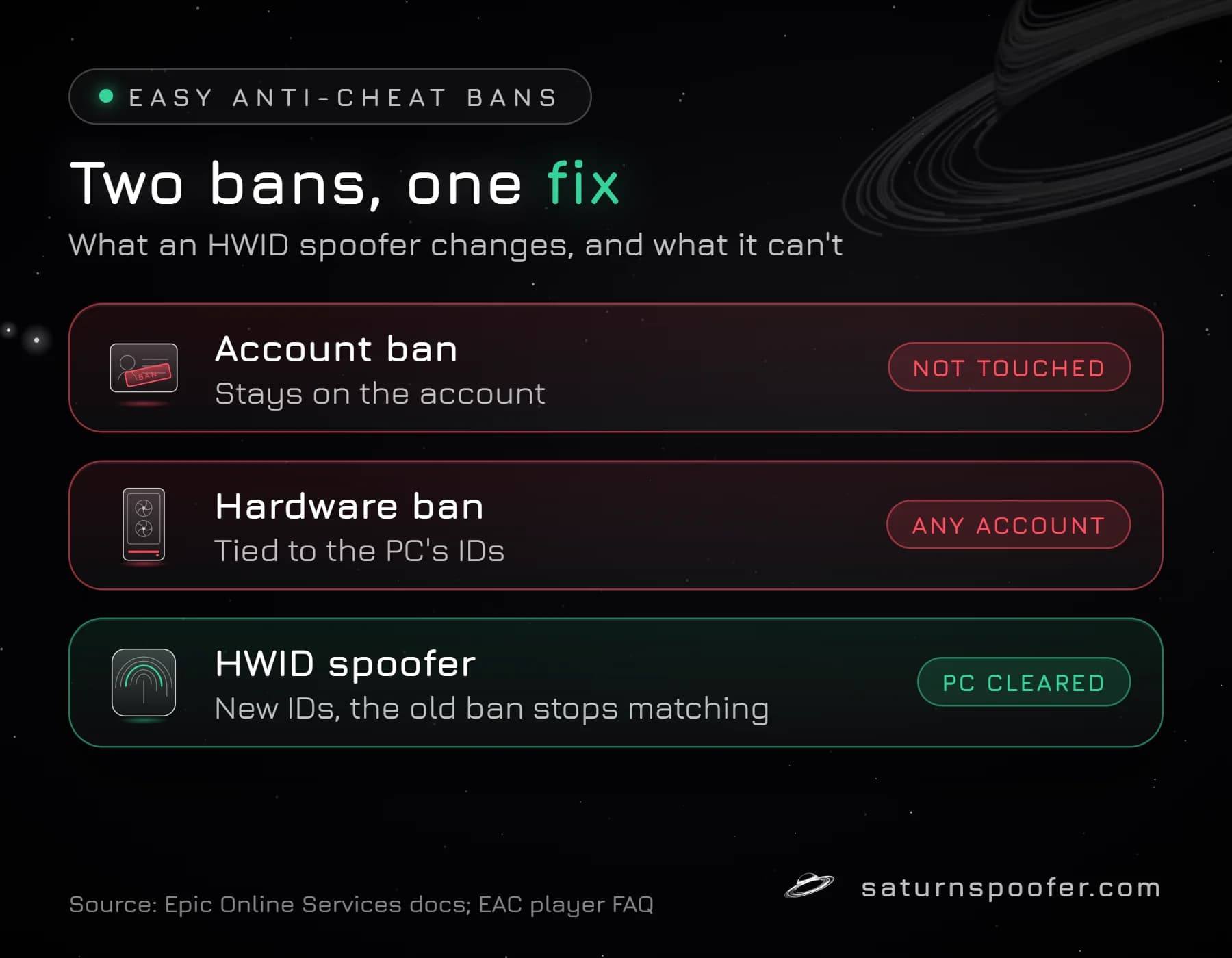
Some bans go further than the account. Epic's developer documentation lists "tooling to manage recurring cheaters who create new accounts on the same machine" as a paid EAC feature, and the hardware identifiers EAC collects are what make that possible. Whether a game uses it is the publisher's choice, so the rules behind Fortnite's hardware bans do not carry over to Rust or any other EAC title. The broader pattern of hardware ID bans across Vanguard, BattlEye and EAC games follows the same logic: the account is banned, and in some games the PC's identifiers are flagged as well.
That second layer is where Saturn fits. Saturn, a Windows HWID spoofer and not a cheat, replaces the IDs a machine hands to software, such as disk, motherboard, CPU, TPM, GPU, RAM, monitor EDID, MAC address and USB serials, so a hardware ban stored against the old identifiers no longer matches that machine. It does nothing about account bans, which stay on the account. Saturn's EAC HWID spoofer is the Easy Anti-Cheat license of a single loader that also covers Vanguard, BattlEye, FiveM, EA Javelin and ACE. Temporary mode spoofs only while it runs and restores the original IDs when closed, and its profiles are unlimited. Permanent mode changes the IDs on the machine itself and includes one HWID profile. The free trial lasts 24 hours, asks for an email, and takes no payment card.
Easy Anti-Cheat on Linux, Mac and Steam Deck
Easy Anti-Cheat supports Windows, Mac, Linux and Steam Deck, but each developer has to switch Linux support on. Epic announced Linux and Mac support, including the Wine and Proton layers that Steam Deck uses, in September 2021, and its documentation says developers turn it on per game in the EOS Developer Portal. That is why one EAC game runs on a Steam Deck and another refuses to start.
Consoles are a different case. Epic does not offer EAC client protection on PlayStation, Xbox or Switch, because console hardware security already blocks the arbitrary code most cheats need. EAC instead lets PC and console players share a match in crossplay while only the PC side runs the anti-cheat. Epic's docs also note that EAC's client protection does not support virtual machines, which is why some EAC games will not run inside a VM.
Easy Anti-Cheat FAQ
Is Easy Anti-Cheat made by Epic Games?
Easy Anti-Cheat is owned and run by Epic Games, but Epic did not create it. EAC was built in Finland in 2006, run by the company later named Kamu, and acquired by Epic in October 2018. It is now part of Epic Online Services.
Does Easy Anti-Cheat run all the time?
No. Easy Anti-Cheat starts only when you launch a protected game and stops when you close it. Epic states that EAC does not run at boot or in the background, so with no EAC game open, the EAC service and driver are not active.
Is Easy Anti-Cheat a virus?
No. Easy Anti-Cheat is anti-cheat software from Epic Games that installs with games that require it. An EAC copy that came with a game from Steam, the Epic Games Store or another official launcher is the real thing.
Can I uninstall Easy Anti-Cheat?
Yes, but every game that uses it will stop working online until it is reinstalled. The EAC service is shared by all EAC games on a PC, and Epic's FAQ says it is removed automatically when the last EAC game is uninstalled.
Does Easy Anti-Cheat ban your hardware?
Easy Anti-Cheat bans accounts, and the publisher decides how far a ban goes. EAC collects hardware identifiers to stop banned players from coming back on new accounts, and Epic sells tooling for repeat cheaters on the same machine, so in some games a ban also follows the PC.
Is EAC the same as BattlEye?
No. Epic Games owns Easy Anti-Cheat, while BattlEye is a separate anti-cheat from BattlEye Innovations, used in games like Escape from Tarkov and DayZ. Both run a kernel driver on Windows, and each game's developer picks which one it ships.
Does Apex Legends still use Easy Anti-Cheat?
No. EA switched Apex Legends on PC from Easy Anti-Cheat to EA Javelin Anticheat effective September 29, 2026, and PC players were moved over automatically after updating the game.
Does Easy Anti-Cheat work on Steam Deck?
Easy Anti-Cheat can work on Steam Deck and Linux through Proton, but only if the game's developer has enabled Linux support for EAC. Epic added that option in 2021, and each studio decides whether to turn it on.