Anti-Cheat Expert (ACE) is Tencent's anti-cheat and game security service, a kernel-level system that ships inside PC games such as Delta Force, Arena Breakout: Infinite and Wuthering Waves and inside mobile hits such as Honor of Kings. ACE started in 2005 as an anti-bot tool for a single MMO and now sells to outside studios too. Steam marks the PC titles that carry it with the line "Uses Kernel Level Anti-Cheat: Anti-Cheat Expert (ACE)" on their store pages.
The name confuses people because "anti cheat expert" reads like a job title, and Steam's file detection uses a third spelling, AntiCheatExpert. All three point at the same product. It is also busy: in the week ending September 27, 2026, Delta Force alone reported 709 ten-year PC bans and 10,573 devices blocked for one year.
What Is ACE Anti-Cheat?
ACE anti-cheat is the player-facing name for Anti-Cheat Expert, a bundle of security services that a studio builds into its game client and servers. On Windows, ACE installs a kernel driver and background processes alongside each game that uses it. On phones, ACE is an SDK compiled into the app that checks for modified clients, speed changers and virtual environments.
Anti-Cheat Expert describes itself on Anti-Cheat Expert's own site as a "one-stop game security solution" with more than 20 years of history. The product list goes past cheat detection:
- PC and mobile anti-cheat (detection and bans)
- Client hardening: code encryption, anti-debugging and anti-tampering
- Action against gold-farming studios and bot accounts
- Economy risk management and content moderation
- Cheat analysis and vulnerability discovery for studios
Most players only ever meet the first item, the part that decides whether a match is fair and whether an account survives.
Who Makes Anti-Cheat Expert?
Anti-Cheat Expert is made by Tencent. Wikipedia dates the first version to 2005, when it guarded the MMO Free Fantasy Online against bots, and the current Anti-Cheat Expert brand name to 2021. Tencent Cloud's product page credits the mobile version to "Tencent Cloud's mobile security team in collaboration with Tencent's game security team" and says a studio can add it with 2 to 3 API calls.
The legal entity is less obvious. ACE's privacy policy names Aceville Pte. Ltd., a Singapore company inside Tencent's group, as the developer, and it lists Singapore as the server location. Tencent Games, ACE's parent, appears on the member list of the Fair Play Alliance, an industry group of studios that works on cheating and player behavior.
Tencent also sells ACE to other publishers. Its About page names partners such as Garena, Riot and Nexon, its PC case studies name the shooter CrossFire, and Steam lists ACE in games from Kuro Games, Infold Games and Shanghai Bokura.
How ACE Works on a Windows PC
ACE works on Windows by loading a kernel-mode driver, which puts it in the privilege tier Windows keeps for its own core code. Microsoft's driver documentation explains the trade-off: user-mode apps each get a private address space, while all kernel-mode code shares one, so a kernel driver can see far more of the machine, and a faulty one can crash all of Windows instead of one program.
That kernel position makes ACE a ring 0 anti-cheat, in the same tier as Easy Anti-Cheat, BattlEye, Riot Vanguard and EA Javelin. Arena Breakout: Infinite's team gave the reason in a September 2025 Steam post: ACE needs the kernel to catch cheats working at the same depth, with VT-based evasion and DMA attacks given as examples.
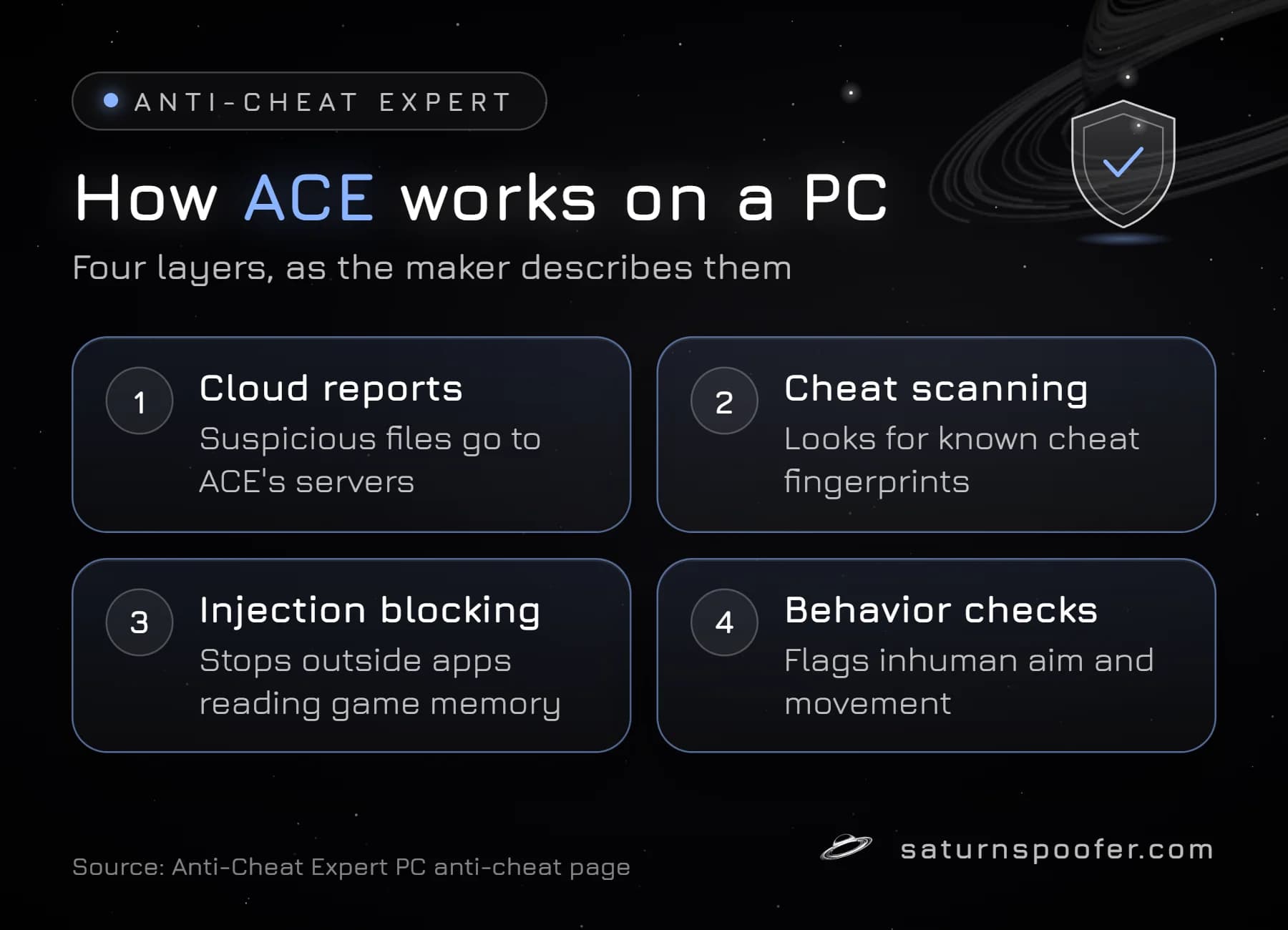
The maker's PC product page breaks the work into four layers:
- Cloud sample reporting. The client reports suspicious files, behaviors and traces, and ACE's back end flags the accounts behind them.
- Cheat feature scanning. The system scans the player's environment for the fingerprints of known cheat programs.
- Cross-process injection blocking. ACE refuses outside programs that try to open the game process to read or write its memory.
- Behavior checks. Server-side models look at in-game actions for inhuman aim, reactions and movement, which works even against cheats ACE has never seen.
Tencent Cloud's PC privacy document for the service is more specific than any marketing page. The data it lists includes suspicious DLL and SYS file paths, driver signatures, kernel driver file hashes, running processes, window titles, registry scans, Windows system callbacks, in-game screenshots and memory samples taken during play. It also lists hashed device information: device type, CPU model, disk, graphics card, motherboard and MAC address. Tencent says it uses that hashed hardware list to help identify suspicious machine environments.
Which Games Use Anti-Cheat Expert?
Anti-Cheat Expert protects a long list of Tencent games plus a growing number of third-party PC releases. The safest source for a PC title is its Steam store page, because Valve has required games with kernel-level anti-cheat to name it there since October 2024. The table below only lists games where a primary source confirms ACE.
| Game | Platform | Proof |
|---|---|---|
| Delta Force | PC, mobile, console | Steam store page |
| Arena Breakout: Infinite | PC | Steam store page |
| Wuthering Waves | PC | Steam store page |
| Infinity Nikki | PC | Steam store page |
| Blue Protocol: Star Resonance | PC | Steam store page |
| Honor of Kings | Mobile | Tencent Cloud |
| CrossFire | PC | ACE case study |
Wikipedia's list adds titles such as Arknights: Endfield, Strinova, Goddess of Victory: Nikke, Mecha Break and Punishing: Gray Raven. Treat those as reported until the game's own store page or publisher says so. To check a game yourself, look for the "Uses Kernel Level Anti-Cheat" notice on its Steam store page, where the system is named.
Is ACE Anti-Cheat Safe?
ACE anti-cheat is legitimate software from a major publisher, not malware, but it carries the same risks as every kernel driver. Three documented facts frame the safety question better than forum guesses.
First, kernel code is powerful by design. Microsoft's own documentation says a kernel-mode driver is not isolated from the operating system, so a bug in it can corrupt system data or crash Windows. That applies to ACE, EAC, BattlEye and Vanguard alike.
Second, ACE has shipped at least one security flaw. CVE-2024-22830, published in the U.S. National Vulnerability Database in May 2024, describes missing access control in the ACE-BASE.sys driver (version 1.0.2202.6217) that let a local attacker escalate from a normal user to System. A driver installed alongside popular games is an attractive target for attackers, which is the core argument critics make against every anti-cheat of this type.
Third, the data question has a clear owner. ACE's privacy policy says that for players it is "solely a data processor"; the game's developer is the data controller and decides what is collected. Arena Breakout: Infinite's team, for example, says ACE only gathers what its anti-cheat functions need, encrypts it in transit and processes it in Singapore data centers. Tencent Cloud's document sets retention too: account and screenshot data with no cheating found is deleted after 7 days, and the raw anti-cheat scan data after up to 30 days.
Put plainly, ACE is as safe as the studio running it and as its current driver build. Keep ACE games updated and remove the ones you no longer play.
Why ACE Can Run After You Close a Game
ACE can stay on your PC after you exit a game because one ACE install is shared by every ACE game on the machine. Arena Breakout: Infinite's FAQ says uninstalling that game removes ACE completely, with one stated exception: if another ACE game is still installed, the system stays to serve it.
That shared design explains most of the "ACE is still running" threads that sit high in Google's results. Delta Force's launch drew the same complaint, and its developers answered that the anti-cheat runs only while the game is active. Player reports and developer statements disagree on when ACE stops, so the reliable way to clear ACE from a PC is to uninstall every game that uses it through Windows' normal app list.
The same FAQ admits a second side effect. Kernel anti-cheats from different makers can flag each other, because neither can verify the other's access, so ACE may clash with Easy Anti-Cheat or Vanguard if both are loaded at once.
What Happens When ACE Catches a Cheater
When ACE flags a cheater, the game's security team decides the penalty, and in ACE games that penalty often lands on the machine too, not only on the account. ACE supplies the evidence and the tooling, while the publisher writes the rules and the ban lengths.
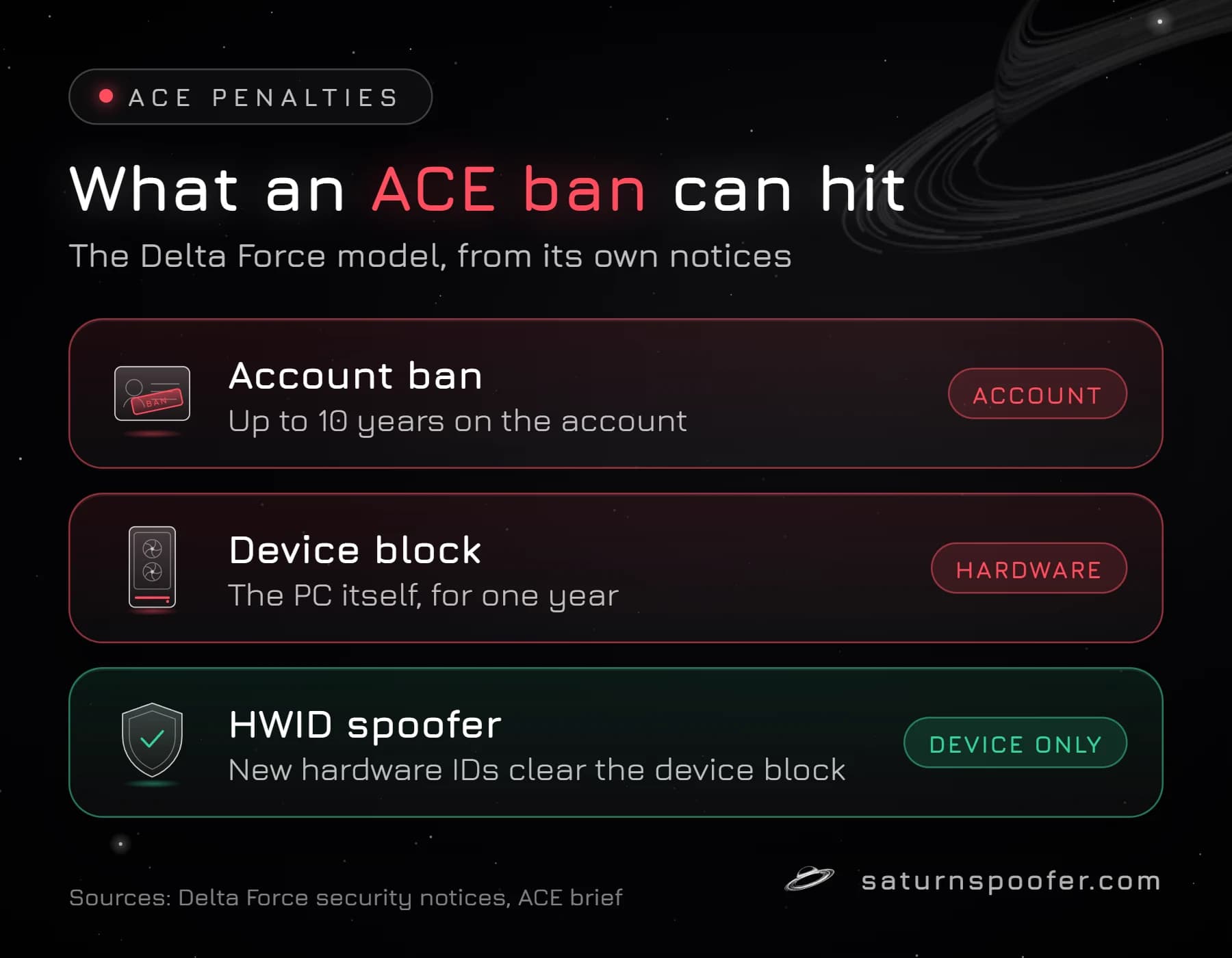
Delta Force shows the scale. Its G.T.I. Security team posts a weekly penalty notice on Steam, and the notice for September 21 to 27, 2026 lists:
- 709 PC accounts banned for 10 years, 103 of them tied to DMA bans, live interceptions or freezes
- 10,573 PC devices blocked for one year
- 1,366 cheating attempts stopped in real time and 8,990 players forced offline
- 1,396 mobile players banned for 10 years
The device line is the hardware part. A blocked device stays blocked even if the cheater makes a fresh account. ACE's Delta Force security brief goes further: it says requiring Secure Boot plus TPM 2.0 allows "significantly more accurate hardware bans," the mechanism behind a TPM-anchored ban that survives a clean Windows install. Delta Force's DMA Shield, built with ACE on Windows' Kernel DMA Protection, now sends DMA hardware cheats empty or junk memory, and its brief says a detected card's hardware signature can be flagged for a ban.
Other ACE games follow the same model with their own numbers; the ten-year account and device bans in Arena Breakout are covered in detail in Arena Breakout: Infinite's ten-year device bans, so they are not repeated here.
This is where Saturn comes in, and only here. Saturn sells an HWID spoofer for Windows PCs; it is not cheat software, and it does nothing to hide cheats from ACE. If an ACE game has blocked your PC, the ACE HWID spoofer gives the machine new hardware identifiers, covering UEFI variables, USB devices, the network MAC, monitor EDID, the graphics card, memory and drive serials, motherboard and SMBIOS data, plus processor and TPM IDs, so the device block no longer matches that computer. The account ban is a separate penalty and stays on the account. Temporary mode applies the new IDs while it runs, with unlimited profiles, and the old IDs return when you close it; permanent mode rewrites them once on a single profile. ACE support sits inside the same single loader as Saturn's other anti-cheats, the license you hold decides which ones are active, and the ACE titles covered today are Delta Force, Arena Breakout: Infinite and Arena Breakout. Saturn offers a free 24-hour trial with email signup and no card details.
How ACE Compares With Other Kernel Anti-Cheats
ACE does the same core job as the other big kernel anti-cheats, and the differences are mostly about who owns it, when it loads and which games carry it.
| Anti-cheat | Owner | Known for |
|---|---|---|
| Anti-Cheat Expert | Tencent | Tencent and partner games, PC and mobile |
| Easy Anti-Cheat | Epic Games | Fortnite and many third-party games |
| BattlEye | BattlEye Innovations | Escape from Tarkov, DayZ, Arma |
| Riot Vanguard | Riot Games | Valorant, League of Legends |
| EA Javelin | Electronic Arts | Battlefield 6, Apex Legends |
Two differences matter most to players. ACE also ships a mobile SDK, so the same brand guards a phone game and its PC port. And unlike Riot's driver, which loads at boot (one of the details behind what Vanguard bans players for), ACE starts with its games. Delta Force players also reported ACE clashing with Easy Anti-Cheat at launch, which matches the conflict warning in Arena Breakout: Infinite's FAQ.
ACE Anti-Cheat FAQ
Is Anti-Cheat Expert spyware?
Anti-Cheat Expert is a commercial anti-cheat from Tencent, not spyware in the malware sense, but it is invasive by design. Its PC data list covers running processes, driver files, window titles, registry scans and in-game screenshots, the kind of data kernel anti-cheats use to spot cheats, and the game's developer, not ACE, controls that data.
Can you uninstall ACE anti-cheat?
Yes. ACE installs with each game that uses it and leaves when the last of those games is uninstalled. If ACE is still present after that, Arena Breakout: Infinite's FAQ points to another installed ACE game as the reason.
Does ACE work on Steam Deck or Linux?
ACE support on Linux depends on the game. GamingOnLinux reports that several ACE titles run on the Steam Deck while blocking desktop Linux, and that a few, such as Wuthering Waves and Blue Protocol: Star Resonance, also run on regular Linux systems.
Is ACE the same on mobile and PC?
ACE uses one brand for two different products. The mobile version is an SDK inside the app that fights modifiers, speed hacks and virtual machines, while the PC version adds the kernel driver and the scanning described above.
Does ACE ban your hardware or just your account?
ACE games can do both, and the publisher sets the rule. Delta Force pairs 10-year account bans with one-year device blocks, and ACE's own brief links TPM 2.0 to more accurate hardware bans.
Is AntiCheatExpert the same thing as ACE?
Yes. AntiCheatExpert is how SteamDB's file detection and the maker's web domain spell the product, Anti-Cheat Expert is the brand, and ACE is the short form most games and players use.