Rust does issue hardware bans, but Facepunch Studios keeps them for repeat offenders. A first cheating ban from Easy Anti-Cheat locks your Steam account, not your PC, and Facepunch's Ban Second Chances policy, first published on June 23, 2025, lets a one-time offender buy Rust again on a new account once 8 months have passed without reoffending. The same page says hardware-banned players are not eligible, which tells you in plain words that a Rust ban can follow the machine.
The scale is large. Facepunch says it has permanently banned more than one million accounts since 2013. Below: how those bans are layered, when one turns into a hardware ban, how to tell which one you have, how long each lasts, and what an HWID spoofer can and can't change.
How Rust Bans Work: EAC, Facepunch and Steam
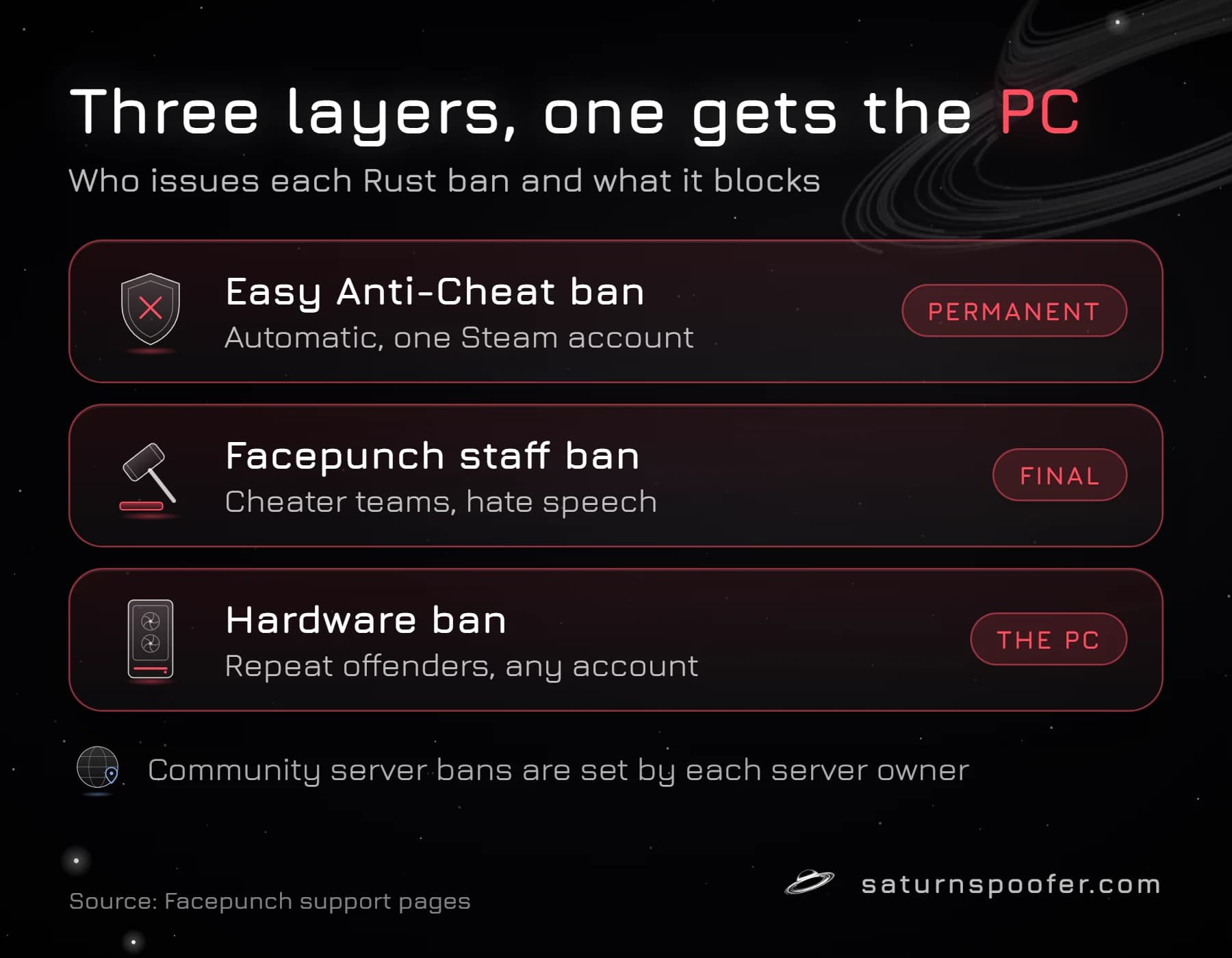
Rust bans come from three places, and each one leaves a different mark. Rust runs Epic's anti-cheat service, Easy Anti-Cheat, and Steam's store page lists it as a kernel-mode anti-cheat that stays installed until you remove it by hand. When Easy Anti-Cheat detects a cheat, the account is banned from every EAC-secured Rust server.
- Easy Anti-Cheat bans are automatic. You see "EAC banned" when you try to join a secured server, and the account can't be used on official or secured servers again.
- Facepunch game bans are placed by staff. Facepunch's support pages list bans for knowingly playing with cheaters and for racist or homophobic language, and both are described as final and permanent.
- Hardware bans sit above both. Facepunch issues them to players who have been banned more than once, and once one is in place, fresh accounts on that computer are blocked too.
Community servers sit outside all of this. A server owner can ban you from one server or a group of servers, and Facepunch's second-chance page says those bans are handled by the server owners, not by Facepunch. Steam also lists Rust as Valve Anti-Cheat enabled, and Facepunch's terms of service send VAC ban questions to Steam support rather than to the Rust team.
When Does Rust Issue a Hardware Ban?
Rust issues a hardware ban when a player who was already banned comes back and gets caught again. Facepunch's wording is short: hardware bans "are only issued to repeat offenders," and anyone who has one should not spend money trying the second-chance route.
That gives the order of events for most players:
- A first detection by Easy Anti-Cheat bans the account. The PC itself is still usable with a different account, in theory.
- Coming back on a new account inside 8 months counts as ban evasion. Facepunch says a player who does this is likely to be detected and banned again.
- A second ban marks the player as a repeat offender, the group Facepunch names as the only one that receives hardware bans.
Facepunch doesn't list the identifiers it records when it hardware-bans a PC, and Easy Anti-Cheat doesn't publish them either. As a general pattern, anti-cheats that keep hardware identifiers read values such as disk and SSD serials, motherboard and SMBIOS identifiers, and network adapter MAC addresses. Treat any list that claims to know Rust's exact set as a guess.
Rust Account Ban vs Hardware Ban
A Rust account ban follows one Steam account, while a Rust hardware ban follows the computer. The table puts the documented differences side by side.
| Question | EAC account ban | Hardware ban |
|---|---|---|
| Who gets it | Any detected cheater | Repeat offenders |
| What it blocks | One Steam account | The PC, on any account |
| Steam profile | Game Ban shown | Game Ban on each banned account |
| Length | Permanent | Permanent |
| Second chance | After 8 months, new account | Not eligible |
The Steam profile line matters. Facepunch's EAC Banned article says a ban from an EAC-secured game bought on Steam adds a Game Ban status to the profile, with the same effect as a VAC ban status. Games can't be moved off a banned account, in-game items can't be transferred, and the account can still buy other games. Riot and Epic document hardware bans in other games in their own ways, but Rust's version is tied to repeat offenses rather than to a single detection.
How to Tell Which Rust Ban You Have
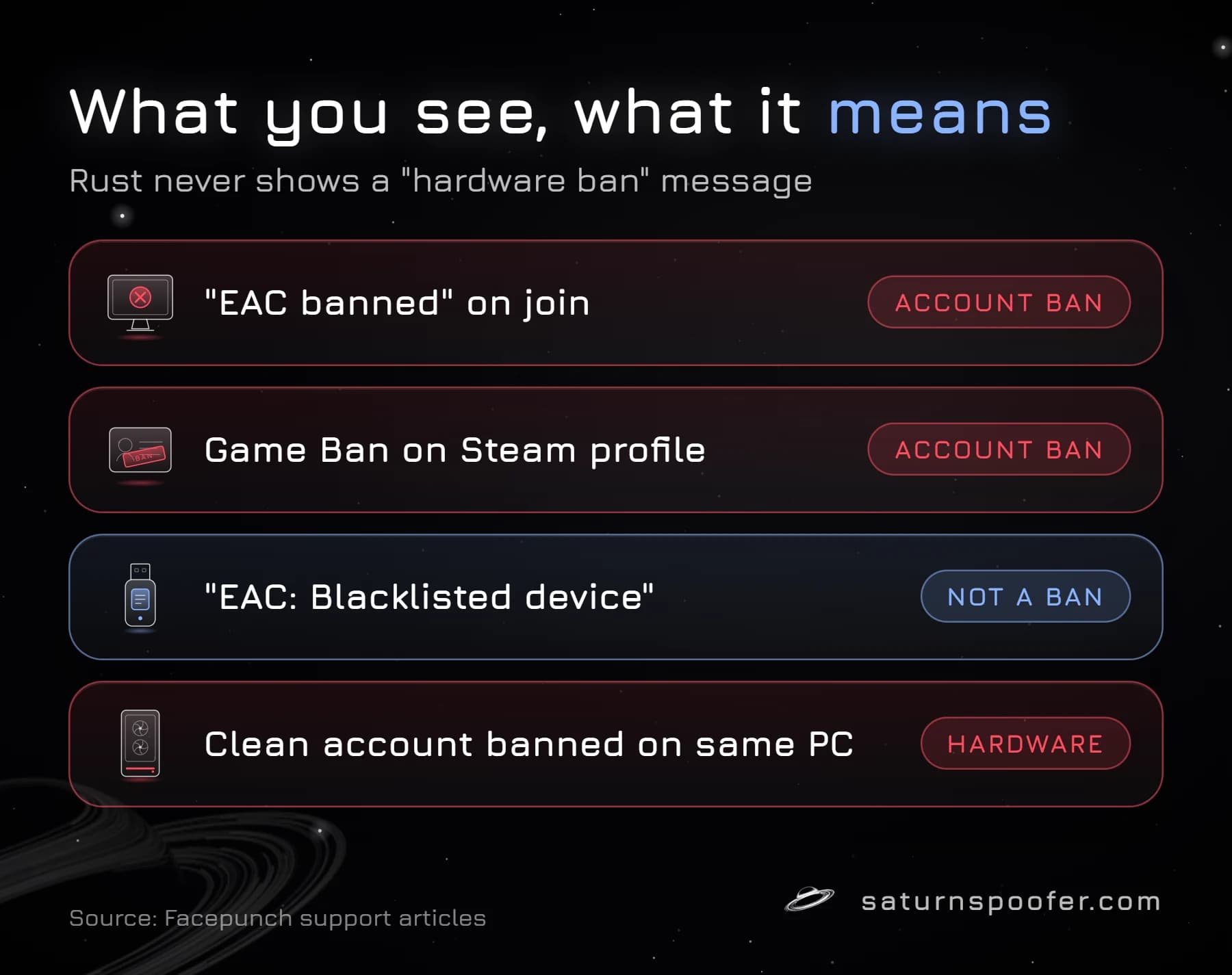
Rust doesn't send a message that says "hardware ban," so you work it out from what you see. These are the signs, from the most common to the most serious:
- "EAC banned" when joining a server. This is an Easy Anti-Cheat account ban. Facepunch's EAC Banned article says the account can't be used to play anymore on secured servers.
- A Game Ban on your Steam profile. It appears on the account that was banned and confirms an EAC ban.
- A ban that landed days after you played. Easy Anti-Cheat issues bans on a delay. The ban is set for a future date, and you don't need to be online for it to take effect.
- A "banned by the server" or kick message on one community server. That is a community server ban, set by the owner, and it doesn't touch official servers.
- "EAC: Blacklisted device." This is not a ban. Since December 11, 2019, Rust has blocked Bloody and A4Tech mice, and unplugging the mouse lets you play.
- A different account banned on the same PC after the 8-month window. If you had a single old ban, waited out the 8 months and a clean new account is banned again on the same computer, the ban is following the hardware.
The last sign is the only one that points at the PC itself, and it usually comes after a second offense. Facepunch doesn't confirm individual cases. Its support article says the details of a ban won't be shared, because that information would help cheat developers.
How Long a Rust Ban Lasts and the 8-Month Rule
Every Easy Anti-Cheat ban on Rust is permanent. Facepunch states that EAC "will not lift EAC bans on request," and that a support ticket or appeal won't remove one. The exception is a mistaken wave: if a round of EAC bans turns out to be wrong, Facepunch says the servers reverse them automatically.
Manual Facepunch game bans are permanent too. The pages on playing with cheaters and on hate speech both say the bans will not expire and that appeals to support are rejected automatically.
The 8-month rule is how most players get back, and it has firm limits:
- You were banned more than 8 months ago.
- Since then you have not cheated again or tried to dodge the ban.
- You buy Rust again on a new account. The old account stays banned, and Facepunch says it is not lifting bans or wiping records.
- Repeat cheaters, community server bans and hardware bans are excluded.
- A second offense after returning means another ban with no appeal.
If you think your ban was a mistake, the route depends on who issued it. The Facepunch terms of service point EAC bans to Easy Anti-Cheat's appeal form and VAC bans to Steam support. The steps for how to appeal a Rust ban, including the reference ID the EAC form asks for, have their own walkthrough.
TPM, Secure Boot and Rust's Secure Servers
Rust started requiring TPM and Secure Boot on select servers in March 2026. Facepunch's help center says this first phase applies only to servers that show a "secure" tag in the browser, and that a second phase will make it a global requirement, with the timeline announced in the monthly devblog.
Easy Anti-Cheat describes these as additional security requirements that the developer controls. They can apply to certain game modes, to accounts considered high risk, or to every player. For bans, the TPM matters because it holds a key tied to the chip, which gives an anti-cheat a firmer identity to attach a ban tied to the TPM to than a disk serial alone. Facepunch hasn't said that it bans by TPM, so this is a direction to watch rather than a confirmed Rust rule.
Older PCs are affected too. Facepunch says computers made before about 2016 may not support TPM 2.0 and Secure Boot at all, which will limit which Rust servers they can join once the global phase starts.
What an HWID Spoofer Can and Can't Clear
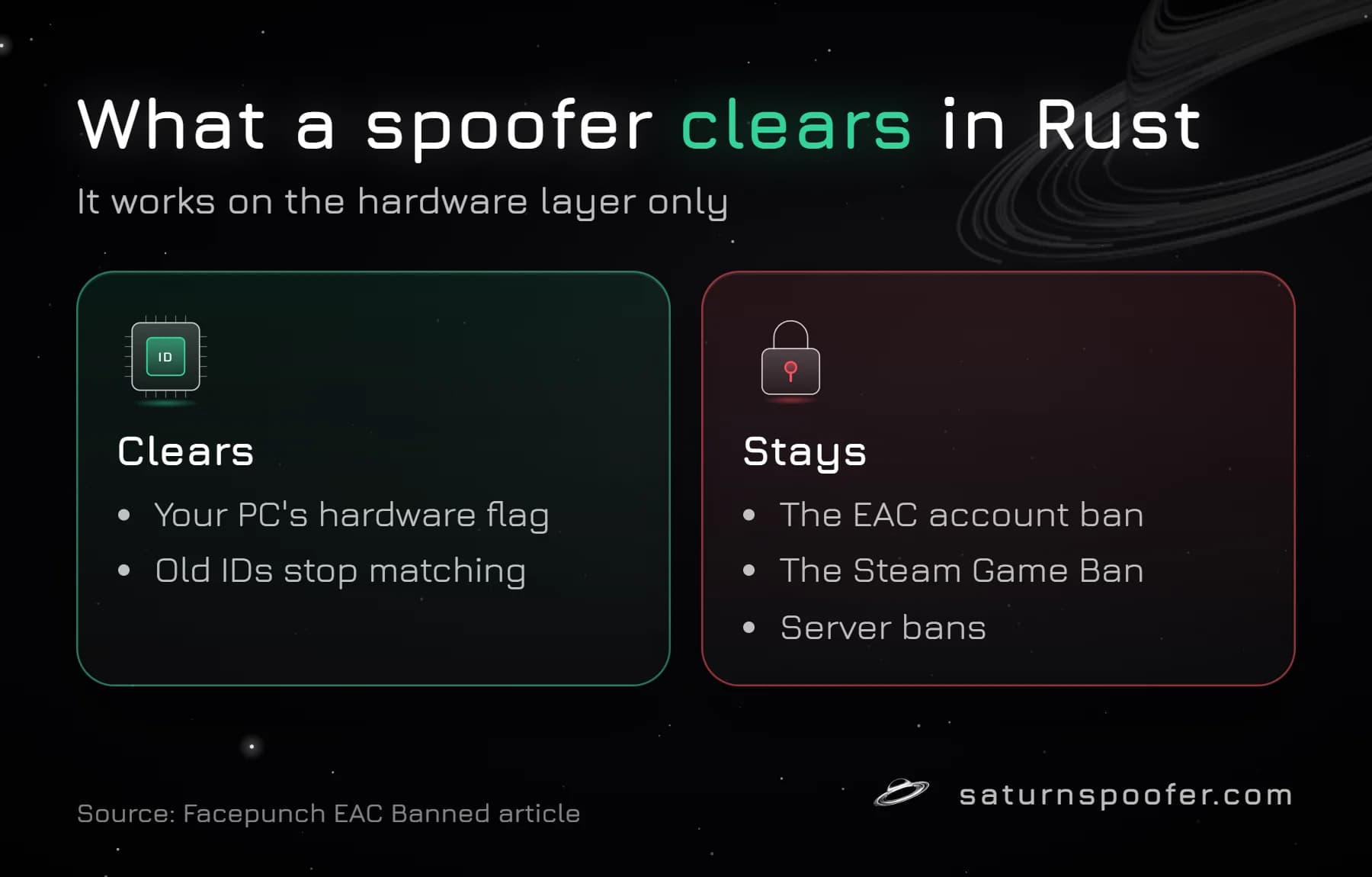
An HWID spoofer swaps the serials and IDs Windows hands to programs like Easy Anti-Cheat, so a Rust hardware flag recorded against the old values has nothing to match on that PC. It works on the hardware layer and nothing else.
For most banned Rust players, the list of what it can't clear matters more:
- The Easy Anti-Cheat ban on your original account stays.
- The Game Ban on that Steam profile stays.
- Facepunch's rules still apply. Its EAC article says accounts used to get around a ban can be banned as well, and a new account inside the 8 months is still ban evasion in Facepunch's eyes.
- Community server bans are separate and stay with each server.
So if all you have is one EAC account ban, a spoofer is the wrong tool. The 8-month route is the one Facepunch offers, and it doesn't involve the hardware at all.
Where the hardware flag on your PC is the problem, Saturn's Rust HWID spoofer covers Rust under its Easy Anti-Cheat license. It changes the drive serials, the board and SMBIOS records, the processor, the TPM, graphics card, RAM, display EDID, every network adapter's MAC, attached USB hardware and UEFI firmware entries, and dozens more one-of-a-kind values. You pick a temporary or permanent spoof. In temporary mode the Rust hardware flag stops matching only while Saturn is open, and closing it restores the banned IDs. Permanent mode rewrites them once, so the PC stays cleared on a single profile. There's a free 24-hour trial with no card needed, just an email address.
Rust HWID Ban FAQ
Does Rust IP ban you?
Facepunch doesn't document IP bans for Rust. Its published ban types are Easy Anti-Cheat account bans, manual game bans and hardware bans for repeat offenders. Community server owners run their own ban lists and can choose what to block.
Can you appeal a Rust EAC ban?
Yes, through Easy Anti-Cheat's appeal form, but Facepunch says a ticket or appeal will not remove a valid EAC ban. For staff bans over playing with cheaters or hate speech, Facepunch support says appeals are rejected automatically.
Will a new Rust account get banned?
A new account made within 8 months of an EAC ban is likely to be detected and banned again, according to Facepunch. After 8 months, a player with one ban and no evasion can buy Rust on a new account, but a hardware-banned player can't.
Is a Rust ban removed if my account was hacked?
No. Facepunch says an EAC ban stays on the account no matter who was using it when the cheat was detected, and its terms make account security the owner's responsibility.
Can I still play Rust after an EAC ban?
Yes, in a limited way. A banned account can still play single-player, join insecure servers that don't run Easy Anti-Cheat, and play over a LAN. Official and EAC-secured servers stay closed to it.
Is a Rust server ban a hardware ban?
No. A community server ban comes from the server owner and only covers that server or network. It doesn't add a Steam Game Ban, and Facepunch treats it as outside its own enforcement.