A Fortnite ban is a sanction Epic Games places on an account that breaks the Community Rules, the Epic Games Terms of Service or the rules of a tournament. Epic's help center sets the limits in two short lines: "Temporary bans can last up to 365 days. Permanent bans in Fortnite are indefinite." Cheating sits on its own ladder. Under the anti-cheat update Epic published on February 27, 2025, cheaters lose matchmaking for one year on a first offense and get banned for life on a second.
Every ban comes with an email that names the rule. The email is short, though, and the rules behind it are spread over four separate Epic pages, which is why so many players end up asking Reddit what happened.
What Is a Fortnite Ban?
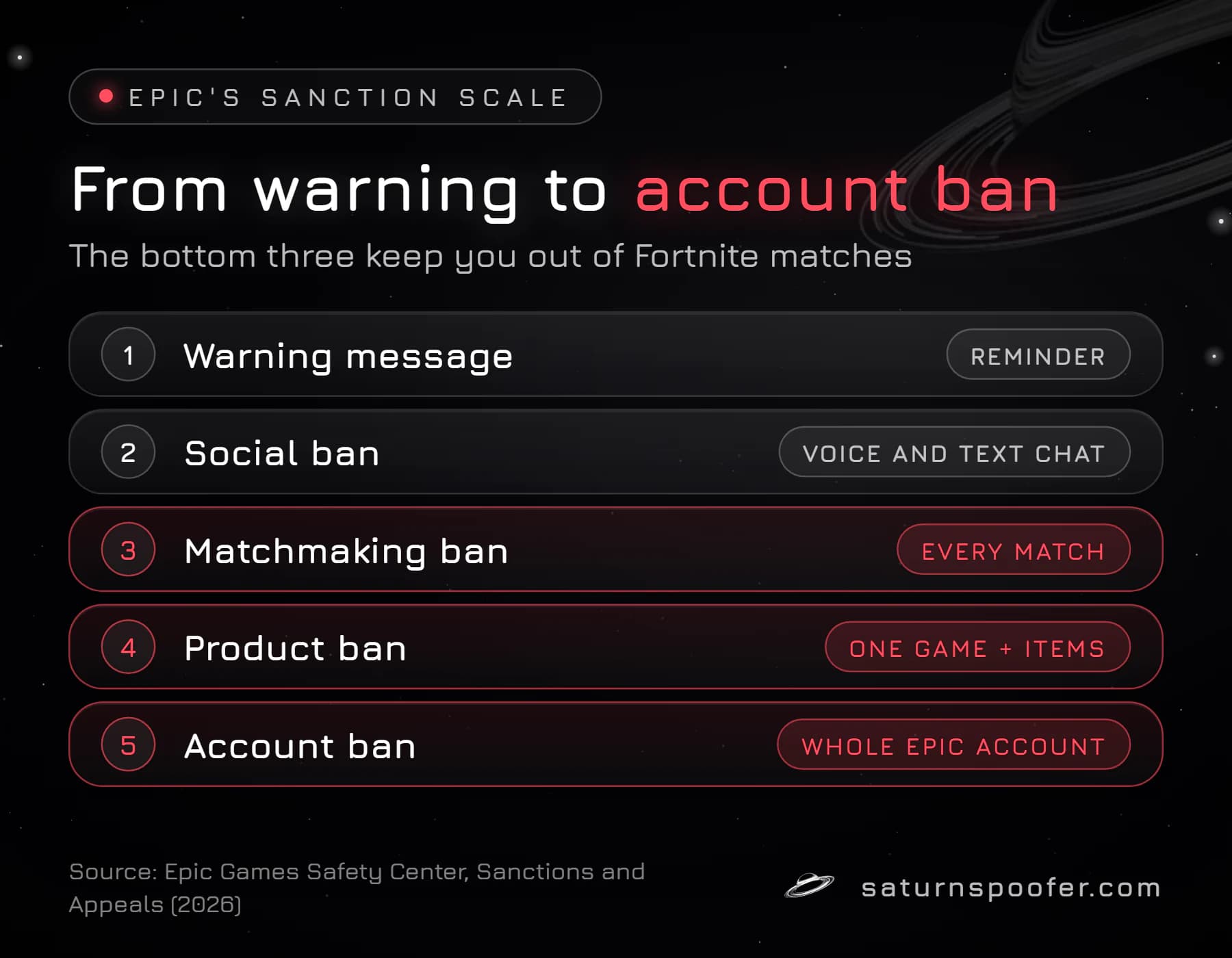
A Fortnite ban is Epic's name for any sanction that removes part or all of a player's access to Fortnite for a set time or for good. Epic treats a ban as one step on a wider sanction scale that starts with a warning message and ends with an account ban that disables the whole Epic account.
Epic's own pages add three details:
- A ban is either temporary, with a fixed end date, or permanent, with none.
- Epic emails the banned player to say which ban it is, how long it runs and which Community Rule was broken.
- Being banned from Fortnite does not lock the rest of an Epic Games Store library; only a full account ban does that.
The Ban Types Epic Uses in Fortnite
Epic Games lists seven sanctions across its Safety Center and its Fortnite help article, and three of them keep a player out of Fortnite matches. The matchmaking ban is the one most players meet, because it is the sanction Epic now gives for a first cheating offense.
| Sanction | What it blocks | Length |
|---|---|---|
| Warning message | Nothing, it is a reminder of the rules | None |
| Social ban | Voice and text chat | Temporary or permanent |
| Matchmaking ban | Every Fortnite experience, including UEFN playtesting; login and chat still work | Temporary or permanent |
| Product ban | One game or service, plus its items and balances | Temporary or permanent |
| Account ban | The whole Epic account and everything on it | Permanent |
LEGO Fortnite Odyssey adds two world sanctions. A world lock keeps everyone, the owner included, out of a world that breaks the rules, and a multiplayer ban leaves the owner alone inside it to fix the content.
Every sanction on that list sits on the Epic account, not on the PC. A hardware ID ban works on the machine instead: it ties the ban to the serial numbers of the parts inside the computer, so a fresh Epic account on the same PC can be caught by it too. Epic's help pages do not set out a hardware ban policy for Fortnite, although its Hardware Identifiers Warning names hardware bans, which is why the two are worth keeping apart.
Why Do Players Get Banned From Fortnite?
Players get banned from Fortnite for breaking a rule in one of three rulebooks: Epic's Community Rules, the Epic Games Terms of Service, or the rules of a Fortnite tournament. The Community Rules name the behavior that gets accounts actioned most often:
- Cheating and trolling. Cheat software, teaming, griefing, and exploiting bugs or glitches, plus promoting known cheats or exploits.
- Cheating hardware. Epic's February 2025 update states that Cronus devices, and any other device that gives a competitive edge, lead to a cheating ban.
- Bullying, harassment and hate. Abusive, threatening or discriminatory chat and behavior toward other players.
- Personal information and impersonation. Sharing someone's real name, location or alternate accounts, or posing as a streamer, an official or an Epic employee.
- Scams and account trading. Phishing for account details, and buying, selling or sharing an Epic account, which the Terms of Service forbid.
- Dangerous, illegal or harmful content. Gambling, threats, doxing, swatting and any content that endangers minors.
Epic catches cheating with more than player reports. The same 2025 update says Epic runs Easy Anti-Cheat's kernel driver while Fortnite is open, blocks game-breaking exploits, and uses statistical analysis and machine learning to flag suspicious play. Epic sets the sanction case by case, weighing how serious the violation was and how many sanctions the account already has.
Banned From Fortnite for No Reason?
A Fortnite ban that feels random nearly always has a cause on the account, even when the player did not see it happen. Epic's anti-cheat update is blunt on this point: "We ban accounts for cheating based on technical evidence" and not on suspicion. The ban email names the rule, and that rule is the first clue.
The causes players miss most often:
- Someone else used the account: a friend, a buyer or seller in an account trade, or a hacker. Epic sanctions the Epic account rather than the person at the keyboard, and the owner of that account is the one left holding the ban. Cold comfort if a younger sibling did it, but that is how the system is built.
- The account was shared or bought. Buying, selling or sharing an Epic account breaks the Terms of Service by itself, whatever happened in matches.
- A device or program you forgot about. A Cronus adapter or any other device that gives an edge counts as cheating under Epic's 2025 rules, and so does cheat software that Easy Anti-Cheat detects on the PC.
- An exploit that looked harmless. The Community Rules list exploiting bugs and glitches under the same heading as cheating, so a glitch that half the lobby was using still counts.
- Old sanctions. Epic counts the sanctions an account already has, so a minor offense on an account with a history can draw a much longer ban than the same offense on a clean one.
Chargebacks are a separate case. Epic's current chargeback policy removes the disputed items and, after two or more chargebacks, blocks the account from purchases across Epic products for up to one year. That is a purchase block, not a ban from playing, and Epic restored accounts it had banned for chargebacks under its older policy.
How Long Do Fortnite Bans Last?
Fortnite bans last up to 365 days when they are temporary, and permanent Fortnite bans never expire. Epic's help pages give no minimum length and no fixed table for most offenses. The length on your ban email is the one that applies, and it reflects the severity of the violation and the account's sanction history. Forum posts that quote a standard 30-day ban are not quoting Epic.
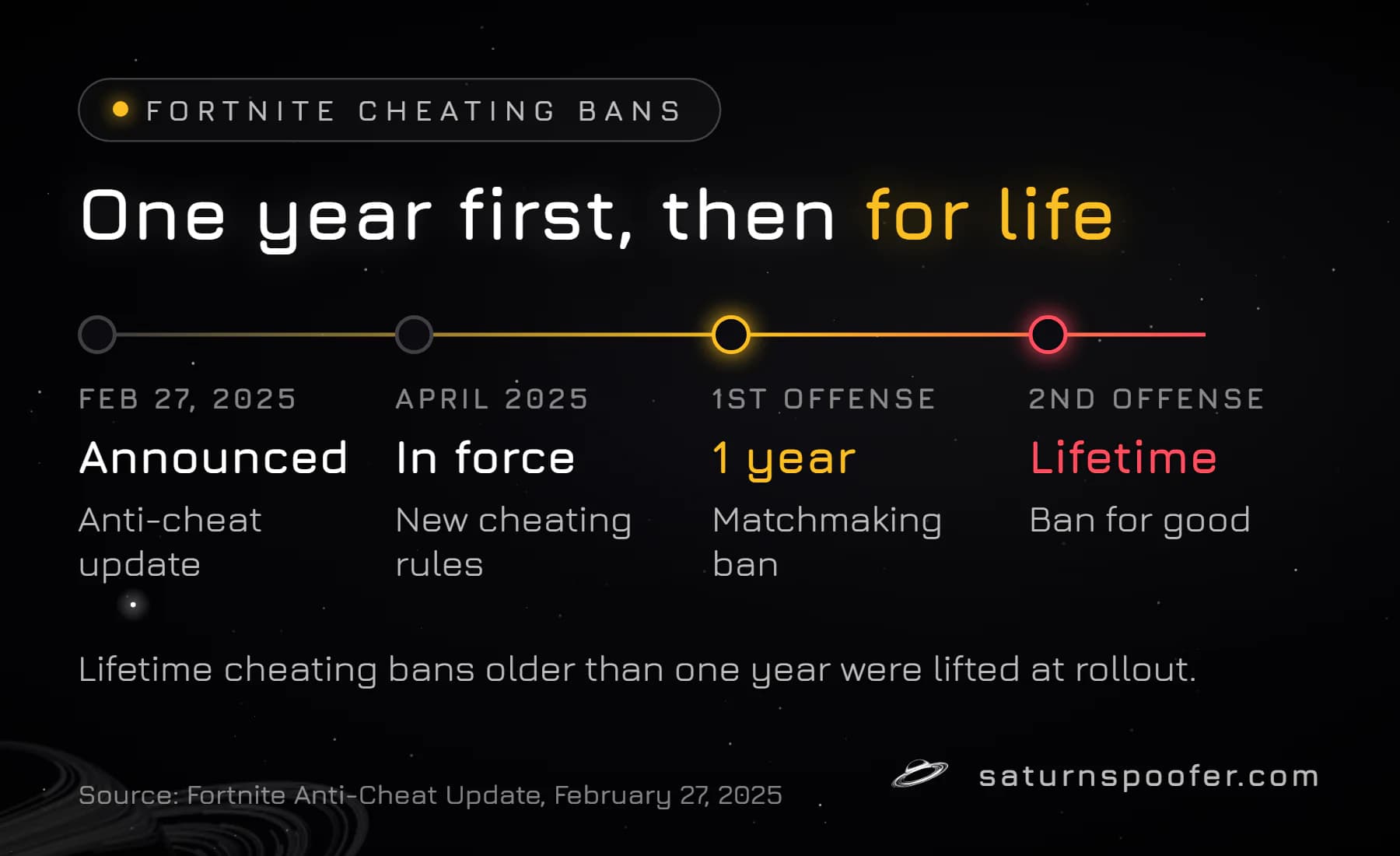
Cheating is the one offense with a published schedule. Epic announced it on February 27, 2025 and applied it from April 2025: "one-year matchmaking ban for first-time cheating offenses", then "A second offense will result in a lifetime ban." The Fortnite Anti-Cheat Update of February 27, 2025 sets out who falls where:
| Who | First offense | Second offense |
|---|---|---|
| Players who used cheats | One-year matchmaking ban | Lifetime ban |
| Cheaters in tournaments | One-year matchmaking ban, lifetime tournament ban, possible loss of winnings | Lifetime ban |
| People who sold cheats | Lifetime ban | Lifetime ban |
During that first year, a cheater can still log in and use voice and text chat, but cannot matchmake into any experience or spectate other players. Epic also lifted lifetime cheating bans that had already been in place for more than a year when the change rolled out.
What a Fortnite Ban Does to Your Account, V-Bucks and Skins
A temporary Fortnite ban leaves V-Bucks, skins and every other item untouched, and all of it is there again when the ban ends. A permanent Fortnite ban is different. Epic's help article on items after a ban says a permanently banned account may lose its V-Bucks, cosmetics, purchased games and Epic account balance, with no refund for purchases made before the ban.
Epic also warns that when one player owns several accounts, action may be taken against all of them. A second account is not a safe place to keep a locker.
After a Fortnite Ban: Check, Appeal, Hardware and IP
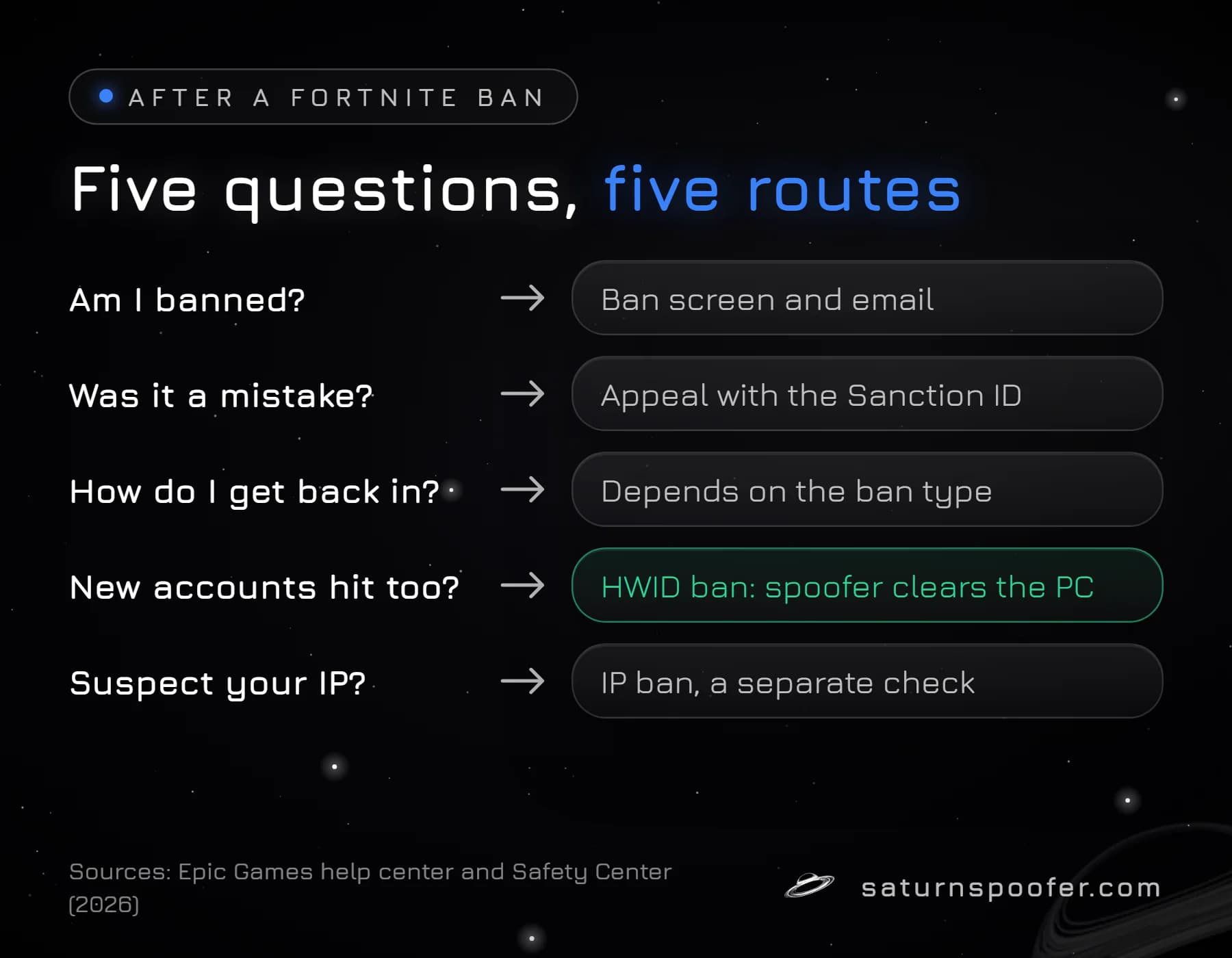
Almost every player hit by a Fortnite ban ends up with the same five follow-up questions. Each gets a full walkthrough of its own; the short answers come first.
Confirming the Ban
Epic confirms a sanction by email, and that email carries the Sanction ID you will need for anything that follows. The in-game Fortnite ban screen and your status in Epic's Safety Center show which sanction you have and how long it runs. Never type your Epic login into a third-party "ban checker".
Appealing It
Epic handles every Fortnite ban appeal through its Sanctions and Appeals Portal. Each eligible sanction gets a single appeal, and a human moderator decides it. Epic Player Support cannot file one for you, and a second try on the same sanction is not allowed.
Getting Back In
The route back depends on the ban type: a temporary ban ends on its date, a mistaken one can be lifted on appeal, and a hacked account starts with Epic's account recovery. Which steps help you get unbanned from Fortnite, and which ones waste your time, depends on that ban type and on whether Epic still holds the account.
When the Ban Follows Your PC
A ban that keeps catching new Epic accounts on the same computer points to a Fortnite HWID ban rather than an account ban. Epic warns that it can detect software that masks or alters hardware IDs, and that it may permanently ban an account using such software. The fix for the hardware side sits on the PC, because an HWID spoofer clears the HWID ban from that machine: Saturn's Fortnite spoofer covers Easy Anti-Cheat and changes identifiers such as the motherboard, disk and TPM serials and the MAC address. A spoofer never lifts a ban on the Epic account itself, because that sanction sits on the Epic account and not on the PC, which is the split at the heart of how HWID spoofers work.
When the Ban Follows Your Connection
Some players suspect their IP address after a ban, especially after playing on a VPN. A Fortnite IP ban is a different question from the account sanctions above, with its own causes and its own fixes.
Fortnite Ban FAQ
Is a 24 hour Fortnite ban permanent?
No. A Fortnite ban with a set length is a temporary ban, and it ends when the timer runs out. Epic states that temporary bans leave items on the account and give access back once the ban period ends.
How do you get banned from Fortnite?
Accounts get banned from Fortnite for cheating, using exploits or cheating devices, harassment, hate speech, sharing personal information, scams, and buying, selling or sharing Epic accounts. Tournament players can also be banned for breaking the rules of a specific event.
Can you still play other games when banned from Fortnite?
Yes, for a Fortnite ban. Epic's help center confirms that other Epic Games Store titles stay playable during a Fortnite ban. A full Epic account ban is the exception, because it disables the account and every game on it.
Can Epic ban all of my accounts?
Yes. Epic's Safety Center says that if a player has multiple accounts, Epic may take action against all of them, so a product or account ban can reach alternate accounts too.
Does a Fortnite ban show the reason?
Yes. The ban email from Epic spells out the sanction type, its length and the broken Community Rule, plus the Sanction ID an appeal needs.