Valorant Cheats Setup & Settings: Aimbot, Triggerbot and ESP Explained
What every Valorant cheat and hack setting does, the trade-off behind it, and what Riot Vanguard is documented to catch. No values, no downloads, and the one thing every Valorant cheat setup should include: Saturn.
What Valorant Cheats Are and What Their Settings Control
Valorant cheats are third-party programs that aim, shoot or reveal information for a player in Riot's tactical shooter, and every setting in a Valorant cheat menu runs against Riot Vanguard, the kernel-level anti-cheat Valorant has shipped with since 2020. Riot said on September 20, 2024 that Vanguard had banned more than 3.6 million Valorant accounts for cheating in four years. On February 4, 2025, its anti-cheat team added that the median cheater in 2024 got through 6 games before the ban landed.
This page explains what each Valorant cheat setting does, the trade-off it makes, and what Riot has published about catching it. Valorant hacks, Valorant cheats and Valorant aimbots all describe the same kind of software, so the settings below apply to all three. There are no recommended values here, no setup steps and no download links. The page also covers the part every cheat menu leaves out: a Valorant ban can land on the PC itself, which is why Saturn belongs on any machine that runs one.
One thing that is not a cheat in this sense is the Cheats tab in a Valorant custom game. It is a practice option built into the game (ghost mode, infinite credits, infinite abilities) and it only works in custom matches.
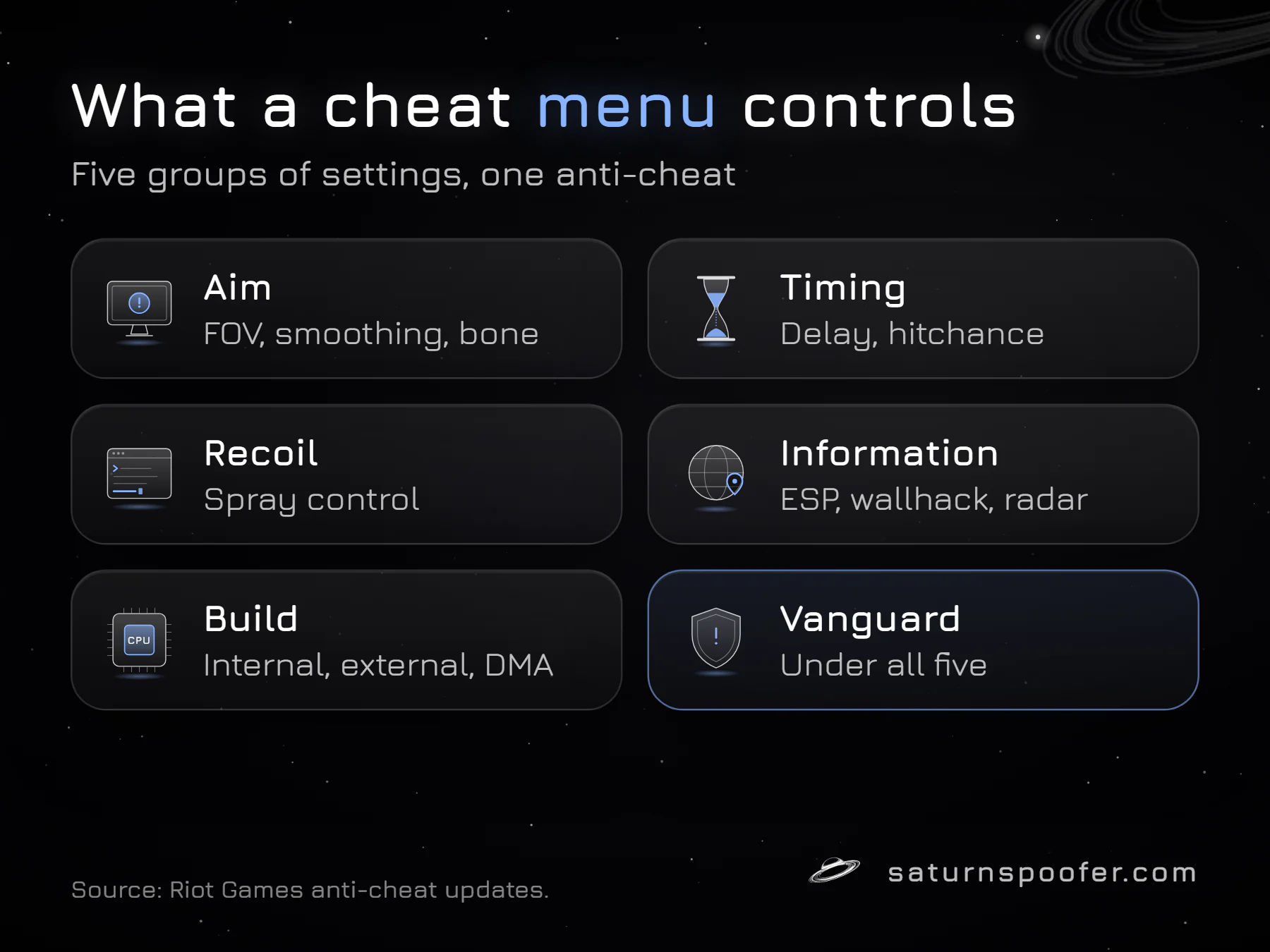
A Valorant cheat menu groups its settings into five families:
- Aim: aimbot FOV, smoothing, target bone and aim key.
- Timing: triggerbot delay and hitchance.
- Weapon control: recoil control.
- Information: ESP layers, wallhack, radar and visibility checks.
- Disguise and build: humanization, plus whether the cheat is internal, external or DMA.
Running Valorant Cheats on your PC? Start With Saturn
A Valorant cheat ban can lock the PC itself, not just the account. Saturn changes the hardware IDs Riot Vanguard reads from that PC. Saturn is an HWID spoofer, not a cheat. It does not hide cheats from Vanguard or prevent bans.
- Temporary mode: spoofed while Saturn runs, unlimited profiles, original IDs back on close
- Permanent mode: IDs changed for good on one profile
- One Vanguard licence covers Valorant and League of Legends from one loader
- 24-hour free trial, no card, email required
Valorant Aimbot Settings: FOV, Smoothing, Target Bone and Aim Key
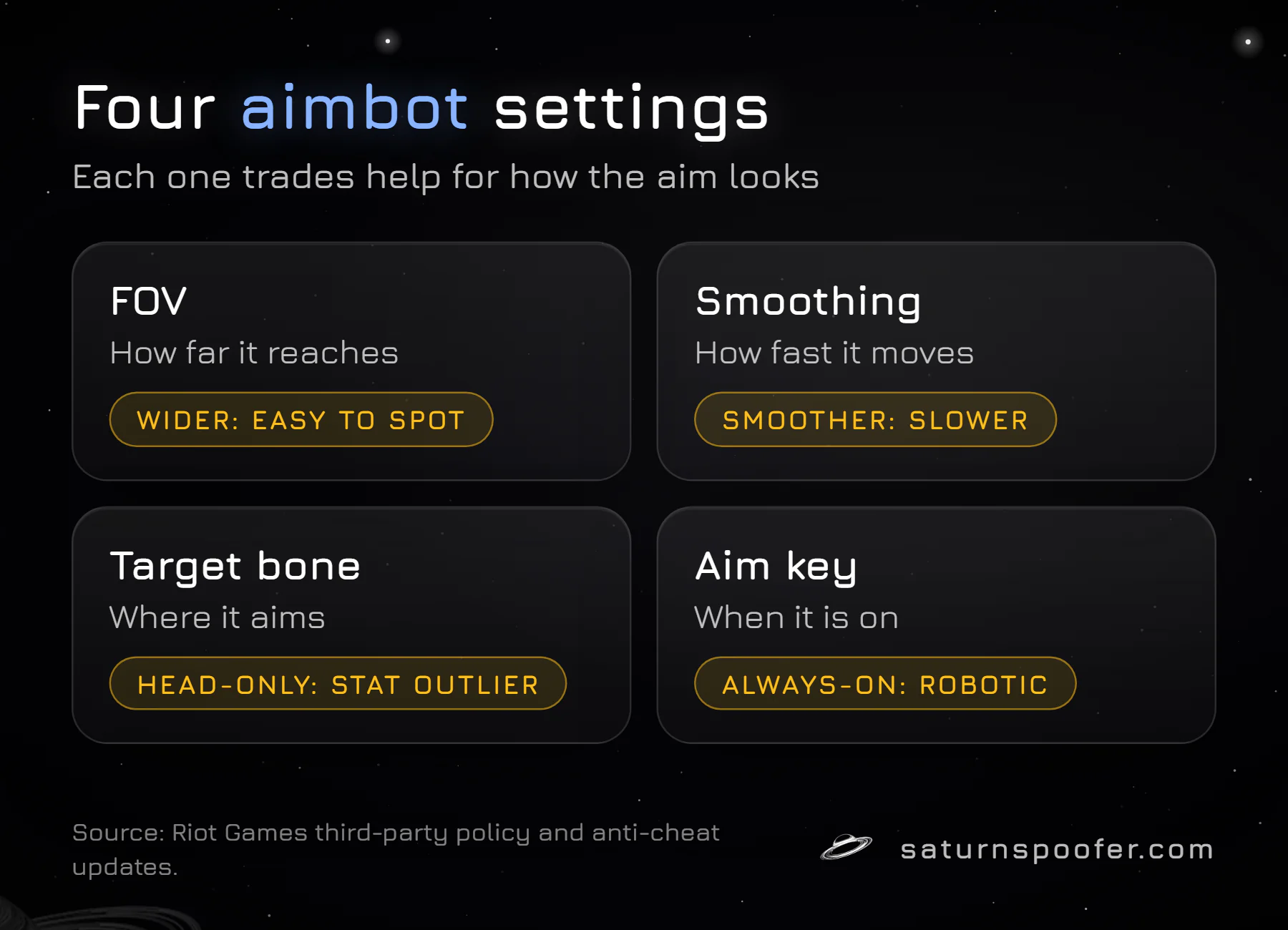
A Valorant aimbot is a group of settings that moves the crosshair onto an enemy for the player. Its four core settings decide where it looks, how fast it moves, what it aims at and when it switches on. All four shape how the aim looks to other players and to Riot's reviewers.
Aimbot FOV
Aimbot FOV (field of view) is the radius around the crosshair inside which a Valorant aimbot will pick a target. A wide FOV pulls the view toward enemies the player wasn't looking at; a narrow one only acts when the crosshair is already close. Narrow gives less help. Wide drags the camera in a way opponents and replays can see, and Riot says its server-side behavioral detection for Valorant works from in-game performance data alone.
Smoothing
Smoothing spreads an aimbot's movement over more frames, so the crosshair travels to the target instead of snapping to it. Higher smoothing looks closer to a human flick and costs the speed that made the aimbot worth running.
Target Bone and Hitbox
Target bone, or hitbox, picks the part of the enemy model a Valorant aimbot aims at: head, neck, chest or the nearest bone. Head-only pushes headshot share past a player's normal range, and Riot's third-party policy says it reviews each suspect's playstyle and performance history along with player reports.
Aim Key and Activation Mode
The aim key and activation mode set when a Valorant aimbot is active: while a key is held, toggled on, or always on. Always-on gives the most help and the most robotic pattern. Fine for Deathmatch, obvious anywhere else.
Valorant Triggerbot Settings: Delay and Hitchance
A Valorant triggerbot is a setting group that fires the weapon the moment the crosshair sits on an enemy, without moving the aim. Riot's anti-cheat team wrote in February 2025 that even a simple triggerbot is a huge advantage in a tactical shooter like Valorant.
Trigger Delay
Trigger delay is the wait between the crosshair landing on a target and the shot. No delay fires faster than any human can react; a longer one looks more human and gives back part of the edge.
Hitchance
Hitchance is a threshold: the triggerbot only fires when it calculates the shot will connect. A high threshold fires less and cleaner, a low one fires more and misses more, and every shot lands in the performance data Riot's behavioral system reads.
Screen-Reading and Memory-Reading Triggerbots
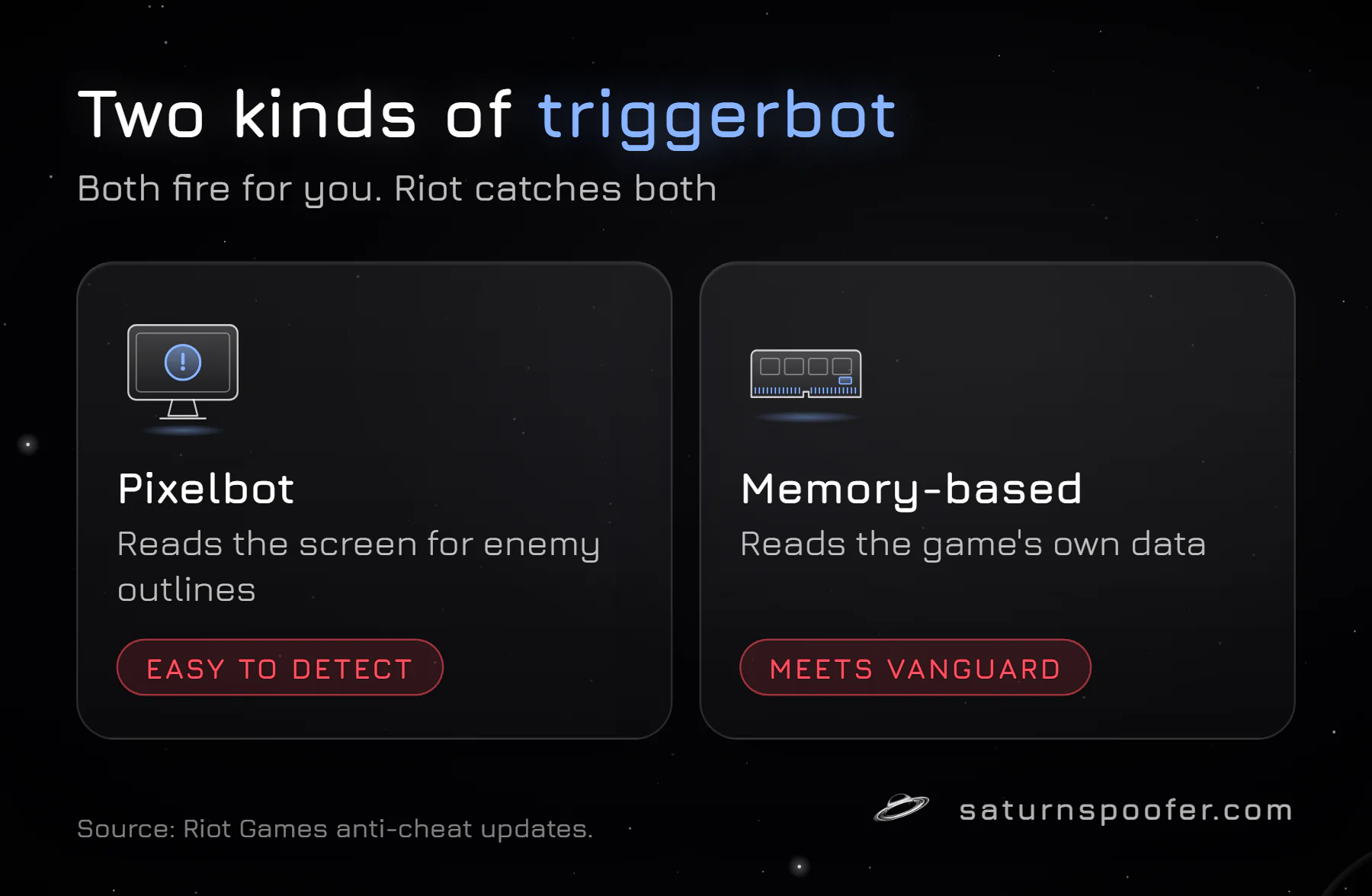
Valorant triggerbots come in two kinds. Pixelbots read the screen for enemy outline colors, either as a script on the PC or as a hardware microcontroller, and memory-based triggerbots read the game's own data. Riot's June 24, 2026 anti-cheat update says pixelbots hit especially hard in Valorant because of the game's low time-to-kill. Its February 2025 update says pixelbots are as easy to detect as they are to install and that most get shut down quickly. Riot doesn't even count bans for local Python colorbots in its monthly ban charts, because there are too many of them.
Recoil Control Settings in Valorant Cheats
Recoil control (RCS) is a Valorant cheat setting that pulls the mouse down against a weapon's recoil so a spray stays on target. Its main setting is strength: how much of the recoil it cancels. Full strength turns a rifle spray into a straight line that no hand reproduces, while partial strength leaves some climb in. Recoil control matters less in Valorant than in shooters built around long sprays, because most duels end in a few bullets.
Riot's Community Pact defines scripting as third-party software or hardware that takes automated actions for the player, and lists scripting under cheating. A recoil script running in a cheat menu, on a mouse or on an adapter falls under the same rule.
Valorant ESP Settings: Boxes, Skeleton, Health and the Spike
Valorant ESP (extra-sensory perception) is a group of visual settings that draw information the game client holds but does not show. Riot's third-party policy names exposing intentionally hidden information as an unfair advantage it acts against. ESP is toggled layer by layer, because every layer at once is unreadable in a fast round.
Boxes, Skeleton and Snaplines
Box ESP draws a 2D or 3D frame around each enemy. Skeleton ESP draws the bone structure, which shows stance and where an enemy is looking. Snaplines draw a line from the screen edge or center to every enemy. More layers mean more information and more clutter.
Health, Shield and Weapon ESP
Health and shield bars show how much damage an enemy can take, and weapon ESP shows what each enemy holds, which in Valorant's round economy tells a player which fights to take. That advantage shows up as positioning and timing, the things reviewers and player reports pick up.
Spike and Utility ESP
Spike ESP marks the Spike carrier, a dropped Spike or the planted Spike. Utility ESP marks agent abilities placed on the map. Both can only mark what the client already knows about. That limit has a name in Valorant.
Valorant Wallhack Settings and Fog of War
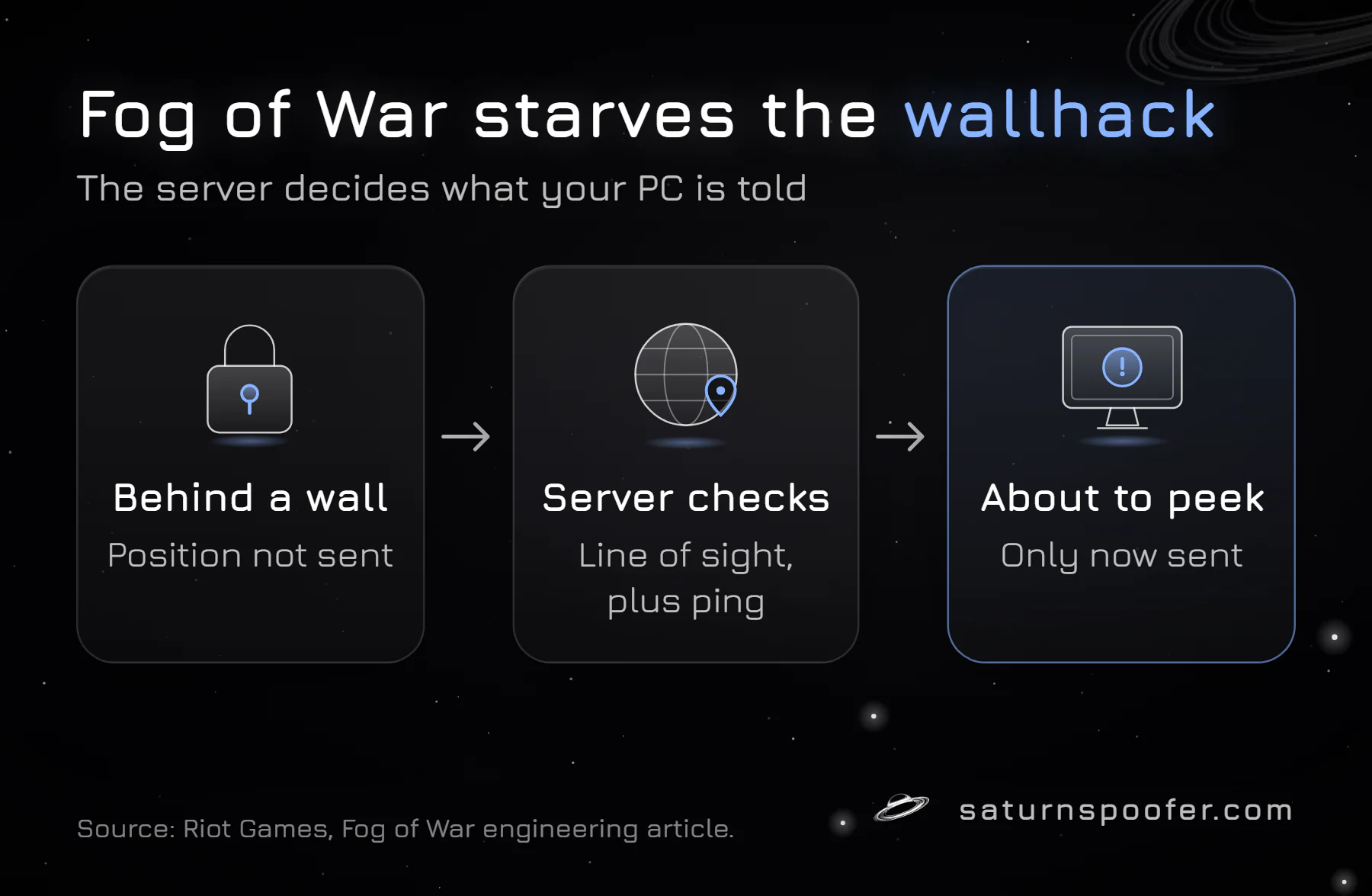
A Valorant wallhack is the ESP setting that draws enemies through walls, and Valorant limits it at the server with a system Riot calls Fog of War. Riot's engineering write-up explains that the game server checks line of sight for every player and does not send an enemy's position to a client until that enemy is close to becoming visible, with a look-ahead window that covers ping. Riot says this drastically cuts the time enemy positions are available to players, and with it the value of a wallhack.
In practice, a Valorant wallhack or ESP setting can only draw what the server has already sent. That means enemies about to come around a corner, not all five players across the map. Wallhack settings that promise a full-map view describe a different game.
Radar and Visibility Check Settings
Radar
A Valorant radar hack draws enemies as dots on a separate minimap overlay, with no boxes or skeletons on the player models. It runs on the same data as ESP, so Fog of War limits it the same way. Riot's third-party policy lists tools that alter a player's field of intelligence among the advantages it acts against.
Visibility Check
A visibility check (vis check) is a filter that limits an aimbot, triggerbot or ESP layer to enemies with a clear line of sight. With it off, an aimbot can track an enemy through a wall, which is the clearest pattern in a replay or a report. With it on, the cheat gives less help.
Humanization Settings and Why They Do Not Hide a Cheat
Humanization settings add randomness to a Valorant cheat's output: curved aim paths instead of straight lines, random trigger delays, deliberate misses and varied reaction times. They target one detection layer, the in-game performance data Riot's server-side system and its reviewers read.
They do nothing about the other layers. The program that reads the game or the screen still has to run on a PC with Riot Vanguard, whose driver starts with Windows so it can spot the vulnerable drivers cheats load through before the game launches. Riot also places Vanguard Restrictions on accounts that look too cheaty, which require hardware security settings before the account can keep playing. And Riot's own figure covers every cheater, careful or not: a median of 6 games in 2024.
Internal, External and DMA Valorant Cheats
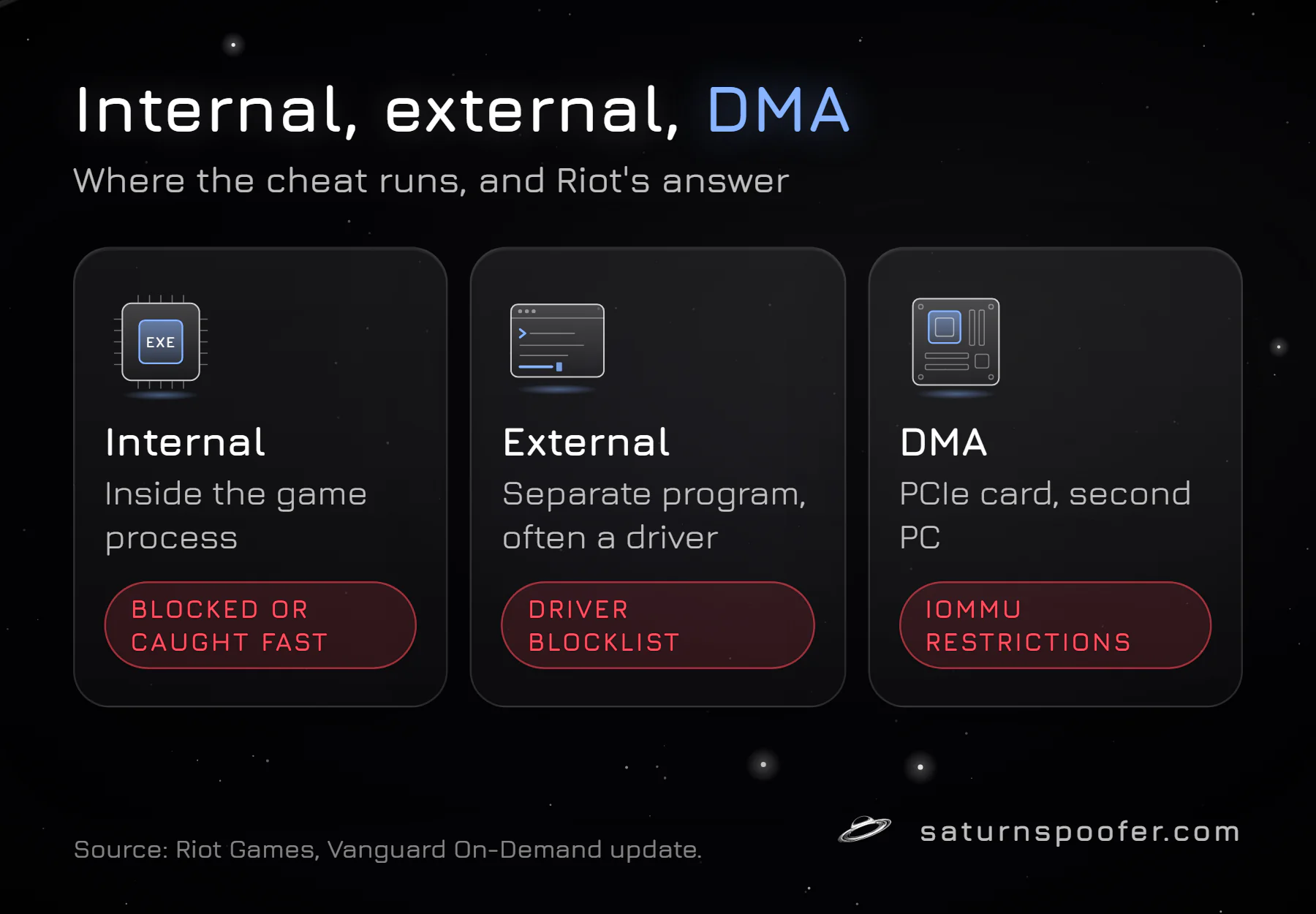
Build type sits under every other setting: it decides where a Valorant cheat runs and how it gets its data. Riot's June 24, 2026 anti-cheat update splits Valorant and League of Legends cheating by exactly this.
Internal Cheats
An internal Valorant cheat loads its code into the game process. Riot says Vanguard turns the game client into a protected process, so internal cheats are either blocked outright or caught quickly, and they make up less than about 10% of matches with a cheater on Riot's PC games.
External Cheats
An external Valorant cheat runs as a separate program and reads the game from outside, usually with help from a kernel driver. Riot says kernel-level cheating is still the most popular method on its PC games, and that Vanguard keeps a local blocklist of the vulnerable drivers cheaters favor; if one appears, Vanguard unloads, which tells Riot the system is no longer secure.
DMA Cheats
A DMA cheat uses a PCIe card to copy game memory to a second PC, mostly for wallhacks. Riot wrote on June 24, 2026 that it had spent the past year putting full IOMMU restrictions on high-ranked Valorant cheaters using DMA, which leaves their cards unable to read game memory. The same cards turn up in other shooters, where DMA cheats run into each game's own anti-cheat.
How Valorant Cheat Settings Differ by Mode
Cheat menus often ship per-mode profiles. Riot Vanguard doesn't care which queue you're in: Riot requires it to stay active while you play, and its account rule for cheating names no mode.
Competitive and Premier
Ranked play is where Riot measures cheating, as the share of ranked games with a cheater, and where it pays players back: Ranked Rollback restores the rank rating lost to a cheater once that cheater is banned. Queuing with a cheater on purpose to climb is its own offense, which Riot calls hitchhiking and bans.
Unrated, Swiftplay and Deathmatch
Lower stakes for the other nine players. Same rule for the account. Riot's support page says cheating with aimbots, auto-clickers or other unauthorized tools gets the account permanently banned, whatever the queue.
The Setting-to-Signal Map for Valorant Cheats
The Setting-to-Signal Map below lines up each Valorant cheat setting with what it changes, the trade-off, and the Riot-documented layer that sees its effect.
| Setting | What it changes | Trade-off | Riot layer that sees it |
|---|---|---|---|
| Aimbot FOV | How far from the crosshair the aimbot reaches | More reach, more visible camera pulls | Behavioral data, reports, manual review |
| Smoothing | How fast the aim travels | More natural, slower | Behavioral data; Vanguard still sees the program |
| Target bone | Where shots land | Head-only inflates headshot share | Performance history, manual review |
| Aim key | When the aimbot is on | Always-on is the most robotic | Behavioral data |
| Trigger delay and hitchance | When the shot fires | Faster or surer, less human | Pixelbot and cheat detection, behavioral data |
| Recoil control | Spray pattern | Straight sprays no hand makes | Scripting rules, behavioral data |
| ESP, wallhack, radar | Information on screen | Clutter; limited to what the server sends | Fog of War, reports, manual review |
| Visibility check | Whether walls block the cheat | Off means tracking through walls | Reports, replays, manual review |
| Humanization | Randomness in output | Less help, same program | Vanguard on the PC, Vanguard Restrictions |
| Build type | Where the cheat runs | Internal is blocked fastest; DMA needs extra hardware | Vanguard driver, IOMMU restrictions |
How Vanguard and Riot Review Catch Valorant Cheaters
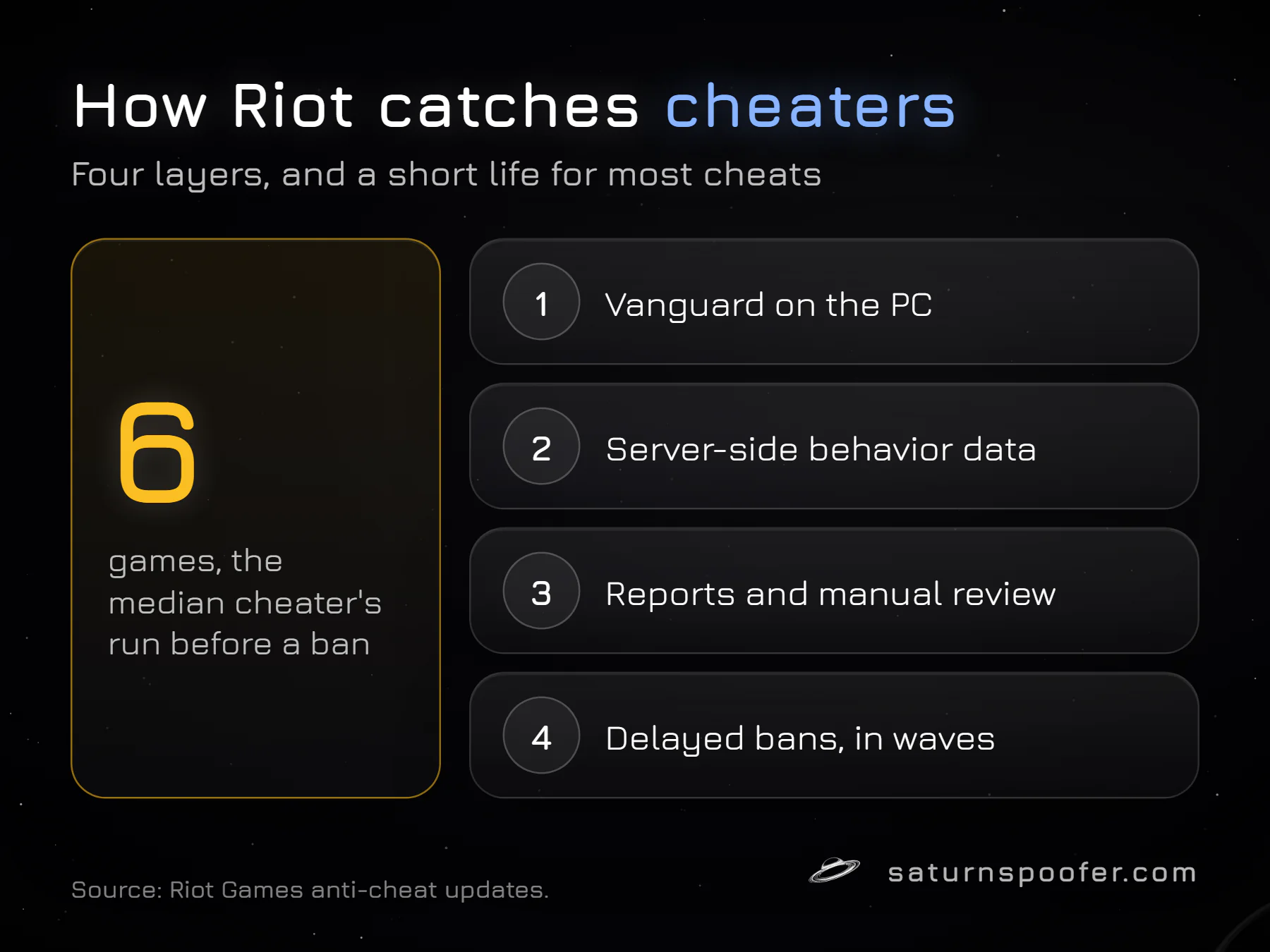
Riot Vanguard catches Valorant cheaters in layers, and Riot has described each one in its own posts. Cheating is only one of the Vanguard ban reasons, but for cheat settings four layers matter.
Vanguard on the PC
Vanguard's kernel driver starts with Windows, guards the game process and watches for the vulnerable drivers cheats load through, and Valorant requires Secure Boot on Windows 11 to shut out boot-level cheats. Riot says this is why internal cheats barely work and why kernel cheats are its main target.
Server-Side Behavioral Detection
Riot runs a server-side system for Valorant that bans on in-game performance data alone. Riot says it mostly catches ragehackers, players who cheat as hard as they can in the few games before their ban.
Player Reports and Manual Review
Reports feed a review queue, and some bans are delivered by hand by Vanguard specialists. Riot says it uses reports to find the next generation of cheats faster.
Delayed Bans
Riot often spots a cheat and waits before banning, so cheat makers can't tell which build or setting got caught. That is why Valorant cheat bans tend to arrive in Valorant ban waves. Riot reported a record on the weekend of January 10 to 13, 2025, with almost 7 suspensions every minute, and says ranked games with a cheater were back under 1% globally afterwards, according to its February 2025 anti-cheat update.
What a Valorant Cheat Ban Does to Your Account and Your PC
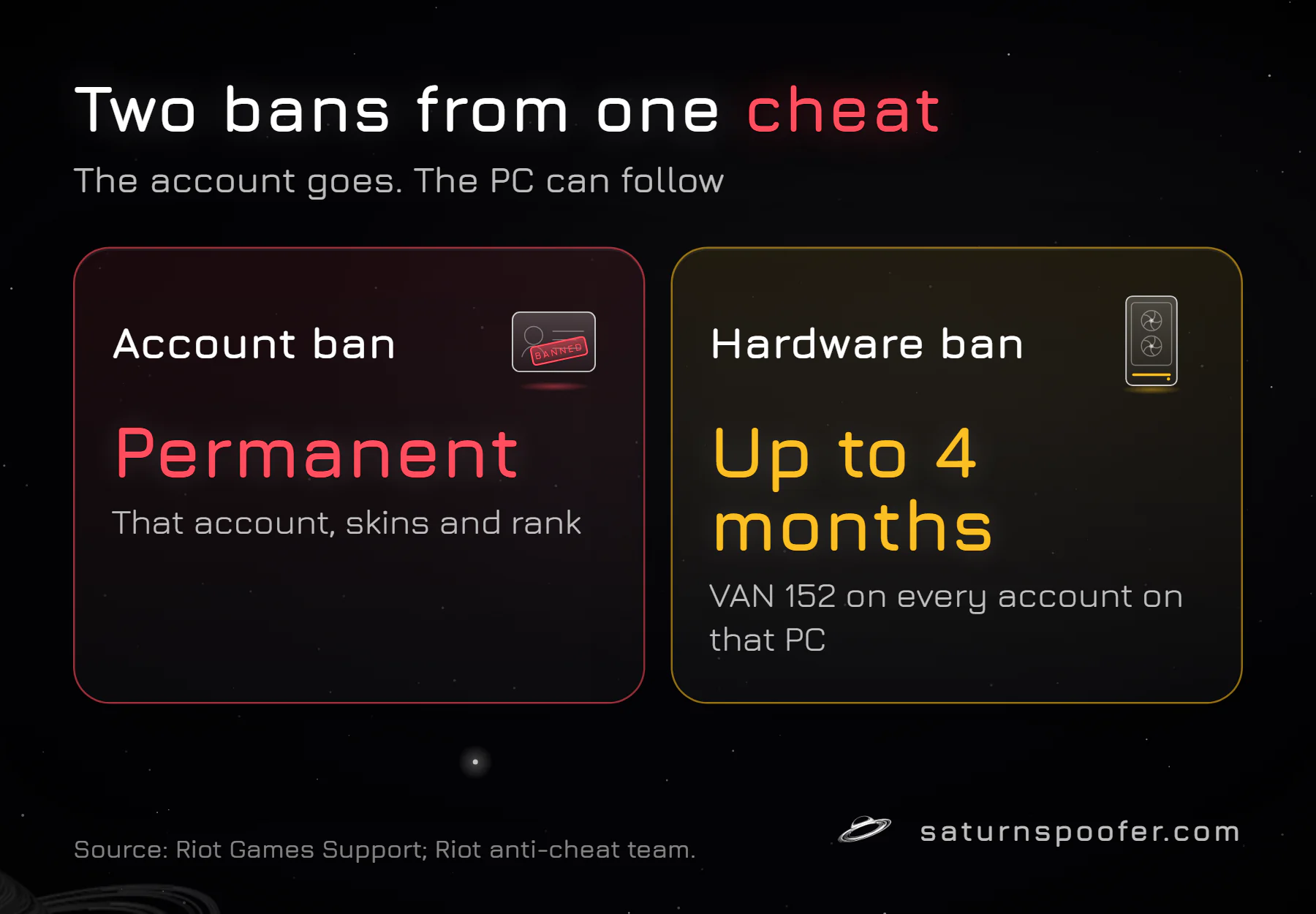
A Valorant cheat ban comes in two parts: a permanent ban on the account, and often a hardware ban on the PC. The hardware ban is the one that decides whether anyone can play Valorant on that machine again.
The Account Ban
Riot's support page says cheating with aimbots, auto-clickers or other unauthorized hardware or software gets the account permanently banned, and players who queue with cheaters get 180 days. Skins and rank go with the account.
The Hardware Ban
A hardware ban flags the physical components of the PC instead of the login. Riot's HWID ban article says every login attempt then fails with error VAN 152, any new account the banned player creates is banned on sight, and a friend's or family member's account that signs in on that PC is restricted there and banned for a set period. Reinstalling the game or deleting the account doesn't remove it. Riot's Valorant error list describes error VAN 152 as a hardware ban that typically lasts four months, the standard length of a Valorant HWID ban.
Who Gets Hardware Banned
Hardware bans fall hardest on players who come back. Riot's Winter 2023 update says repeat offenders using multiple accounts to cheat on the same machine were the majority of Valorant bans, and its September 2024 update describes hardware bans as a delayed suspension for accounts identified as re-offenders.
How Long It Lasts and Which Games It Covers
Riot anti-cheat head Phillip Koskinas said on October 2, 2026 that Riot's hardware bans last four months at most and apply only to the game the cheats were detected in. Riot's HWID ban article describes a wider HWID ban, aimed at the player on any Riot game, for repeat abuse, threats and third-party tools. For a Valorant cheat ban, the newest statement from Riot's anti-cheat team points to Valorant on that PC for up to four months.
| Account ban | Hardware ban | |
|---|---|---|
| What it targets | The Riot account | The PC's hardware components |
| Length for cheating | Permanent | Up to four months (Riot, October 2, 2026) |
| What you see | A ban notice on that account | VAN 152 on every account on that PC |
| New account on the same PC | Not blocked by the account ban alone | Banned on sight |
| What Saturn changes | Nothing; banned accounts stay banned | The hardware IDs the PC reports |
The Account Is Gone. The PC Does Not Have to Be.
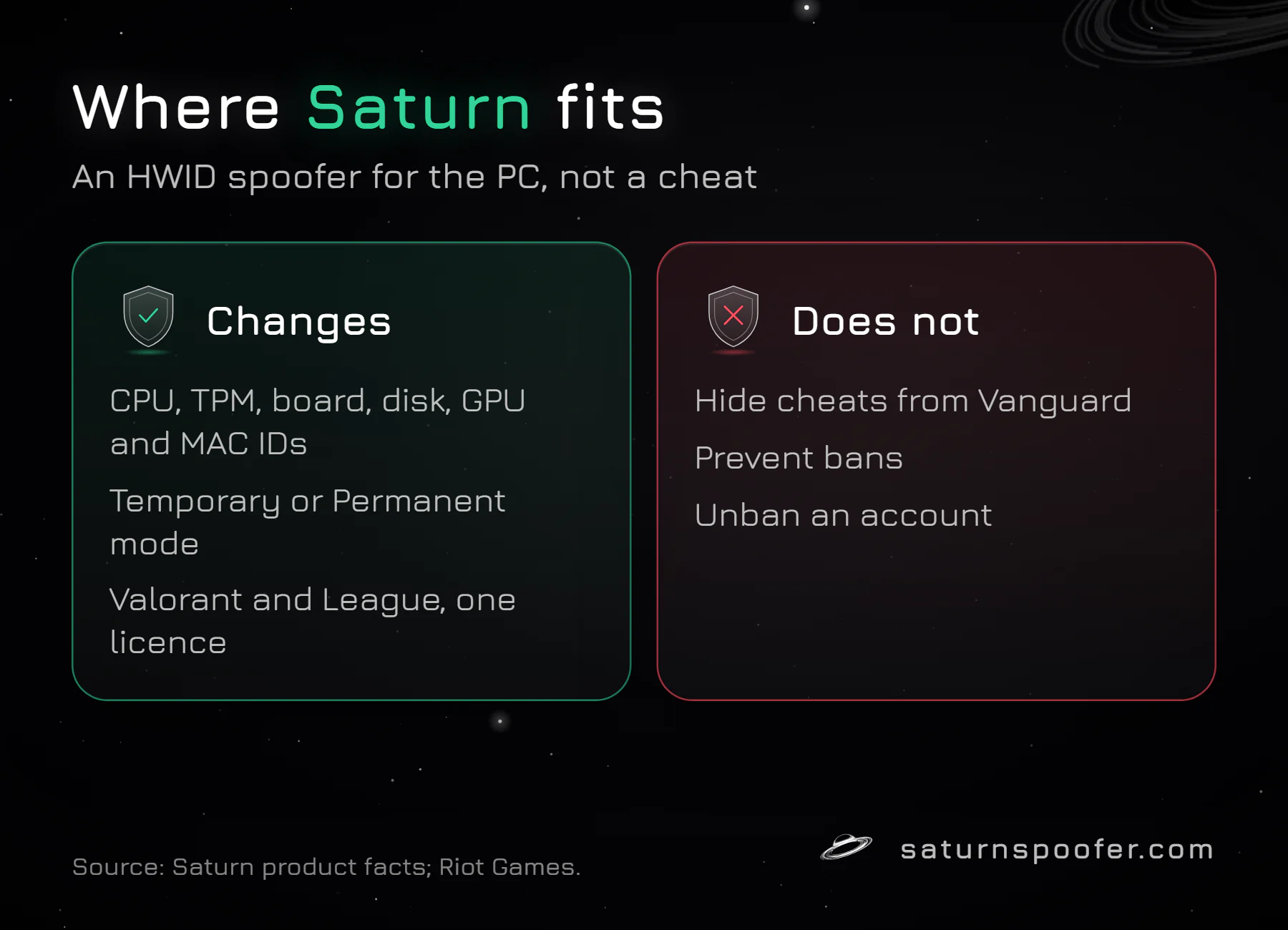
Riot bans the account for good and can flag the hardware on top. Saturn clears and changes the hardware IDs the PC reports: CPU, TPM, motherboard, disks, GPU, monitor, MAC and dozens more. Banned accounts stay banned, and spoofing a hardware ban breaks Riot's Terms of Service.
- Built for Riot Vanguard, covering Valorant and League of Legends
- Switch profiles in Temporary mode, or set one for good in Permanent mode
- Try it free for 24 hours before you pay
Why Saturn Belongs in Every Valorant Cheat Setup
Saturn belongs in every Valorant cheat setup because the hardware ban outlives the account. You can replace an account. You can't replace the PC, unless the identifiers Riot Vanguard reads from it change. Riot said in its Winter 2023 anti-cheat update that repeat offenders cheating on the same machine were the majority of Valorant bans, and that is the gap Saturn covers.
What Saturn Changes
Saturn is an HWID spoofer for Windows, not a cheat. It clears and changes the hardware identifiers a PC reports: CPU, TPM, motherboard and SMBIOS, RAM, disks, GPU, monitor EDID, MAC address, USB devices, UEFI variables and dozens more. The Valorant HWID Spoofer runs under Saturn's Vanguard licence, which covers Valorant and the League of Legends HWID Spoofer from one loader. That list is how HWID spoofers work: the PC reports different values, and Riot's ban record stays where it was.
Temporary and Permanent Mode
- Temporary mode: the PC reports spoofed IDs while Saturn runs, with unlimited profiles; close Saturn and the original IDs come back.
- Permanent mode: the IDs are changed for good on one HWID profile; if that profile gets banned, you buy a new one.
Which one fits comes down to how often a profile gets flagged, the core of the perm vs temp spoofer choice. With Saturn running, the hardware details Vanguard reads are the spoofed ones, so a new hardware flag is designed to attach to that profile instead of to the real parts. Riot doesn't publish how it matches hardware, so read that as how spoofing works, not a promise.
What Saturn Does Not Do
- Saturn does not hide a cheat from Vanguard and does not prevent bans. Every setting above still shows up in the layers Riot runs.
- Saturn does not unban an account. Banned accounts stay banned.
- Saturn does not make spoofing allowed. Riot's June 24, 2026 update counts cheaters trying to bypass their hardware suspensions as tampering, and Riot's Terms of Service bar circumventing the measures that protect access to its games.
Free Valorant Cheats Are a Malware Route
Free Valorant cheats are one of the most common ways malware reaches gamers' PCs. Flare's November 25, 2025 research on 53,896 infostealer-infected devices found 41% of infections started with a gaming-related file, that cheats, mod menus, aimbots and skin changers made up over half of those, and that Valorant was among the top five games whose mods and cheats led to infection. Malwarebytes reported in March 2022 that "Valorant cheat" videos on YouTube were pushing information-stealing malware.
Riot has warned about the same pattern from the other side: cheat ads on social media mostly reuse recorded footage of cheats that are already detected, and the buyers get banned soon after.
Other Valorant Ban Questions
- Riot reverses some cheating bans it gets wrong: Valorant false ban.
- Riot reviews bans through Player Support tickets: Valorant ban appeal.
- Waiting a ban out or asking Riot for a review: get unbanned from Valorant.
- Rigged-feeling matchmaking after reports is not a Riot penalty: Valorant shadow ban.
- A VPN changes the IP address, not the hardware Vanguard reads: Valorant IP ban.
- Skin changers sit next to hacks in Riot's Terms: Valorant skin changer.
- The same settings exist in other games under other anti-cheats: Tarkov cheats on BattlEye, FiveM cheats on Cfx.re's own checks.
Valorant Cheats FAQ
Add Saturn to Your Valorant Setup
Every setting on this page is visible to Riot Vanguard in some way. The hardware ID your PC reports does not have to be the one Riot banned. No card needed for the trial. Saturn does not prevent bans.