Tarkov cheats are third-party programs or hardware devices that read or change Escape from Tarkov's game data to give one player an edge the game does not allow, such as seeing enemies through walls, aiming automatically or spotting valuable loot from across the map. Battlestate Games bans players for them every day. Its Developer's Diary on anti-cheat, published April 6, 2026, counts more than 25,000 players banned between January and March 2026, and 54% of those bans were for cheating.
Escape from Tarkov, often shortened to EFT, runs BattlEye, a kernel-level anti-cheat, on top of Battlestate's own game-side checks and an in-game report system. A ban is the cost everyone knows about. Battlestate's own diary ties bans to stolen accounts, malware and shared logins as well. And whether a ban sits on the account or on the hardware decides if an HWID spoofer like Saturn can help at all.
What Tarkov Cheats Are
Tarkov cheats fall into a handful of families, and most products sold as Tarkov hacks or Escape from Tarkov cheats bundle several of them into one menu. Battlestate's license agreement bans every family: clause 4.3.4 prohibits methods that give "advantages over other players," automated bots, hacking the game client, and outside software that captures or "retrieves" information from the game.
ESP and Wallhacks
ESP, short for extrasensory perception, draws information on the screen that the player should not have: outlines of other players through walls, their distance, health and gear, and sometimes the direction they are facing. A wallhack is the same idea, named after its most obvious effect. Tarkov ESP is hard to prove from the receiving end, because a player using it can look like one who made a good guess or heard a footstep.
Aimbots and No-Recoil Scripts
An aimbot moves the crosshair onto a target for the player, often limited to a field of view and a chosen body part so the motion looks less robotic. No-recoil and anti-sway features remove the kick and drift that Escape from Tarkov gives its weapons. Some menus add a triggerbot that fires the moment a target crosses the crosshair.
Loot ESP and Radar
Loot ESP labels items, containers and bodies through walls, usually filtered by value or by the quest items a player is hunting. A radar draws a map of the raid with players, AI Scavs, bosses and extracts marked on it. Battlestate's patch 0.15.0.0 notes of August 20, 2024 list protection against exploits "related to monitoring loot on players/location using forbidden software," which is this family.
Movement and Vacuum Cheats
The most blatant Tarkov cheats break movement: speed hacks, flying across the map, and the so-called vacuum cheats seen in raid clips shared online. The same 0.15.0.0 patch lists protection against exploits tied to "network synchronization and unfair movement using forbidden software." Cheats like these are hard to mistake for skill, which makes them easy to report.
DMA Hardware Cheats
A DMA cheat uses a plug-in card with direct memory access to read Escape from Tarkov's memory from separate hardware, usually showing ESP or a radar on a second PC instead of on the gaming PC. Battlestate's April 2026 diary names "an active rise of DMA-software and tools" and says it is researching the Windows security features VBS and HVCI, along with IOMMU memory protection, as a response.
PvE Zone Cheats
Tarkov PvE cheats target the co-op PvE Zone, where the threats are AI Scavs and bosses rather than other players, so those menus lean on loot ESP, quest item markers and radar. Players switch between PvE and PvP from the same main menu (patch 0.16.0.0 added a confirmation pop-up for that switch), and the license agreement's ban on cheat software makes no exception for PvE.
How Battlestate and BattlEye Catch Cheaters
Escape from Tarkov catches cheaters with BattlEye first and Battlestate's own systems second. The game's Steam store page lists BattlEye as a kernel-level anti-cheat, which means part of it runs inside the Windows kernel, the core of the operating system. Battlestate's support article on the anti-cheat says BattlEye starts before the game does. It can stop Tarkov from launching if it finds changed game or system files or a virtual machine, and it keeps watching for third-party programs that interfere with the game during a raid.
BattlEye describes its method in broad strokes only. Its About page lists proactive protection that blocks most hacking before it starts, plus scanning in user and kernel mode with "specific and heuristic/generic detection" routines. Its homepage adds that the scanning is controlled from BattlEye's servers, so hackers cannot build permanent bypasses. Battlestate's own side of the work shows up in three places:
- Game-side protections shipped in patches, such as the loot and movement fixes in patch 0.15.0.0 and a "comprehensive update to the anti-cheat components" in patch 0.16.1.0 on February 7, 2025.
- The in-game report system, which the diary calls the best thing a player can do about a cheater. Patch 0.13.0.4 in April 2023 added in-game mail notifications about players banned after a report.
- Money compensation for gear lost to a cheater, which Battlestate plans to raise steadily while guarding against report abuse.
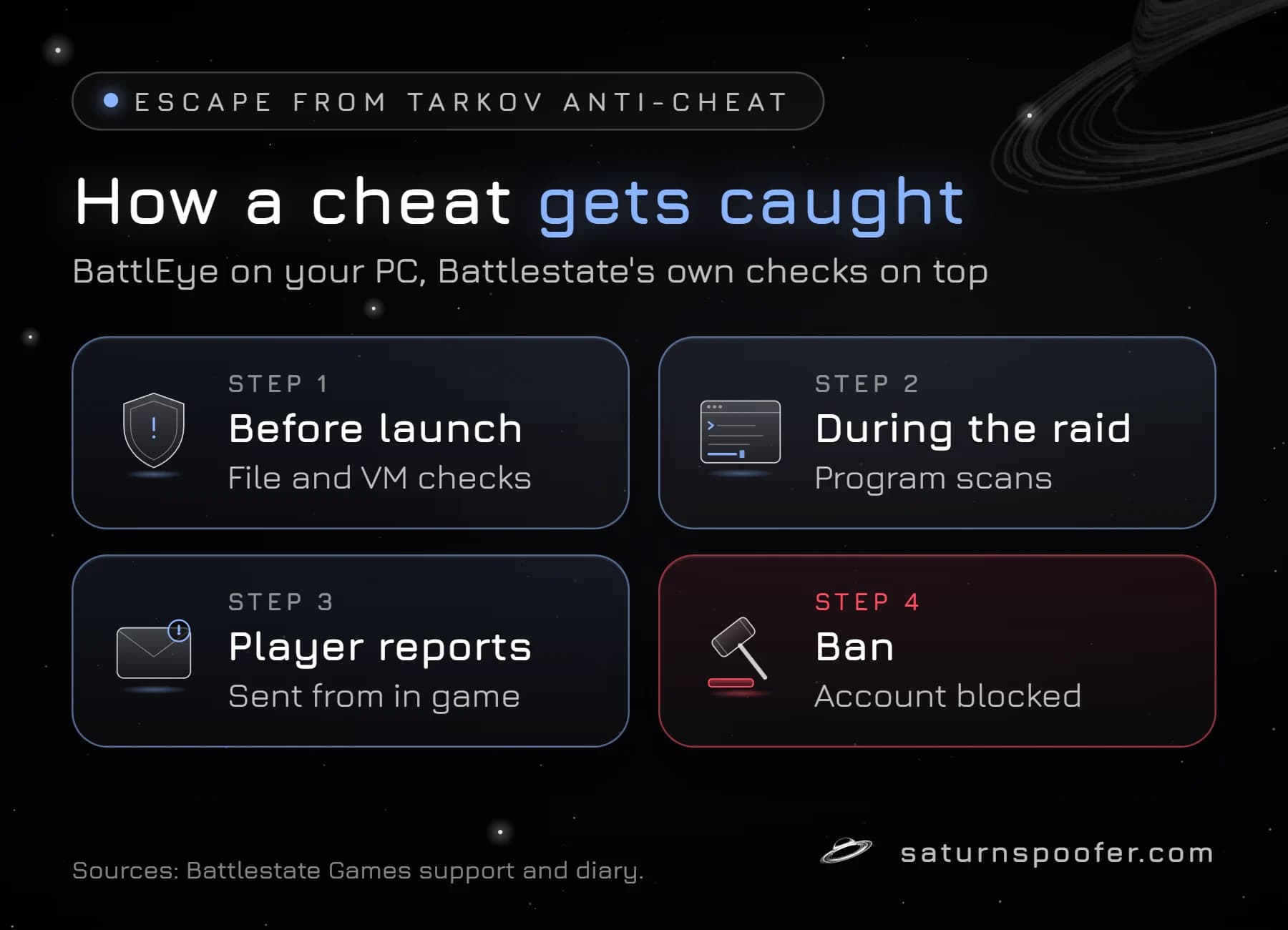
The diary also sets out what comes next for Tarkov anti-cheat. TPM 2.0 and Secure Boot sit at the top of the list, as a way to force some cheat software into rewrites and lost features, followed by new detection systems and a goal of "reducing the amount of raids cheaters can play before getting banned."
How Many Cheaters Tarkov Bans
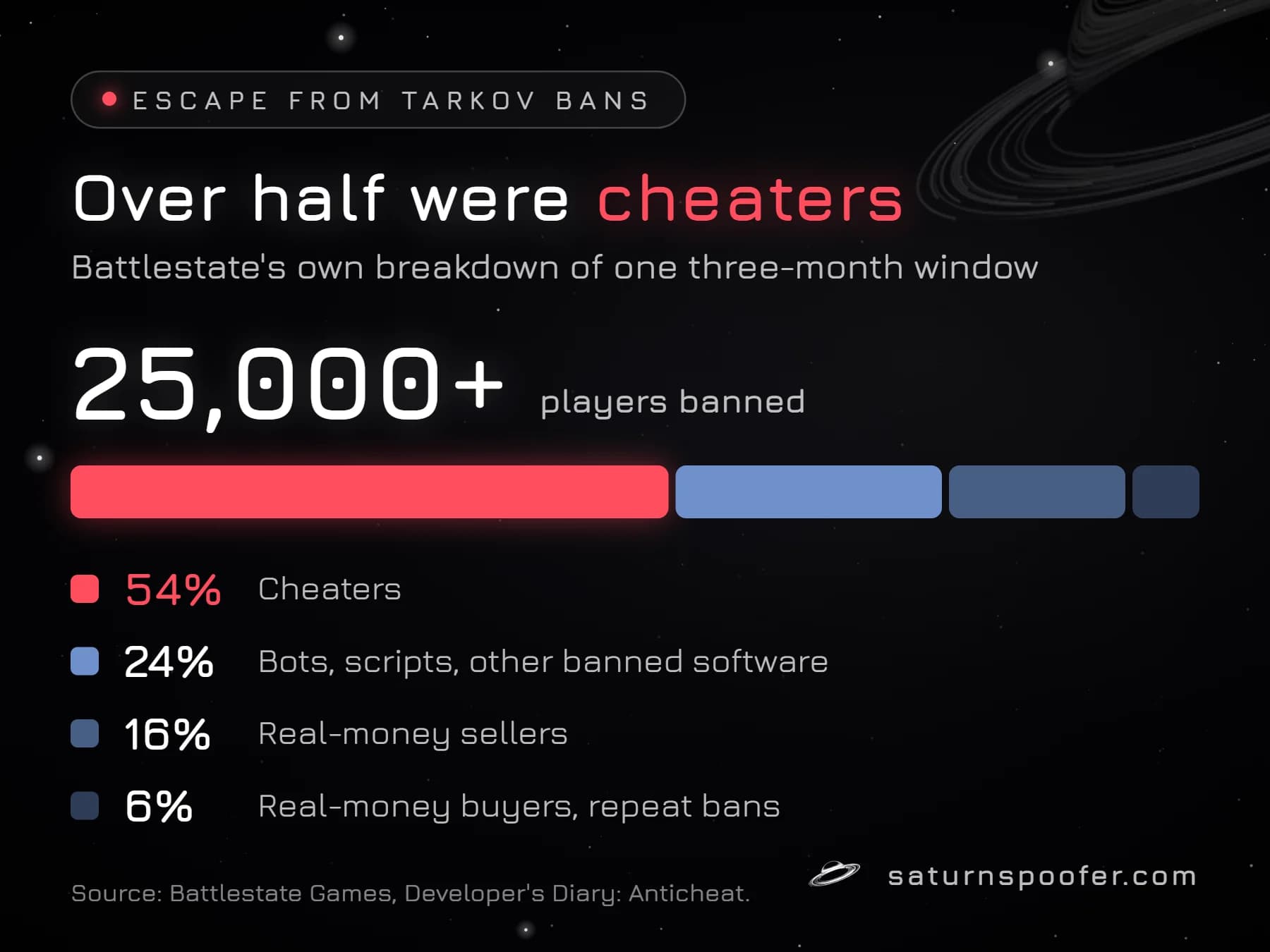
Battlestate Games published its most detailed ban figures in the April 6, 2026 diary: more than 25,000 Escape from Tarkov players banned from January through March 2026. Cheating made up 54%, which is more than 13,500 cheating bans in three months. Real-money traders, bots and scripts make up the rest.
| Ban category | Share | What it covers |
|---|---|---|
| Cheaters | 54% | Cheat software |
| Other | 24% | Leveling bots, KD-lowering scripts, other banned software |
| RMT sellers | 16% | Selling items, currency or accounts for real money |
| RMT buyers | 6% | Buyers, in cases of repeat bans |
The same diary retired Battlestate's habit of posting lists of banned player names in favor of statistics like these. It also calls the belief that bans only land right before a list goes up a myth: bans happen "on a daily basis," whether or not a wave gets announced.
Those figures count bans. They say nothing about how many cheaters a given raid holds, and none of Battlestate's published numbers give the share of raids that contain one. So "Tarkov is full of cheaters" is a feeling built on player experience, and that experience varies a lot from one player to the next. Anyone quoting a precise percentage is guessing.
What a Tarkov Ban Costs You
A cheating ban in Escape from Tarkov can end the account for good. Battlestate's license agreement lets it end a cheater's access to the game, the official forum and its social network groups "for an unlimited time, without prior notification," and Battlestate does not have to show the player the evidence behind the decision.
- A blocked account loses all its virtual currency and other game items "without any compensation being payable."
- A breach, even a one-time one, cancels the license agreement, and the player cannot claim back what was paid for the game.
- Under the Rules of the Game, closing an account also lets Battlestate bar that player from the game in the future.
- The same rules allow short or longer suspensions for smaller breaches and keep closure for serious or repeated ones.
BattlEye, Battlestate's anti-cheat partner, sets the same tone. BattlEye's support page says a cheater has to live with the consequences, that its global bans stay permanent with no exceptions, that it never reveals the evidence behind a ban, and that it cannot lift a ban caused by someone else using a stolen account or key.
Risks Beyond the Ban
Cheat sellers talk about ban risk. Battlestate's anti-cheat diary points to other risks, and some of them land on players who never meant to cheat:
- Stolen accounts. Battlestate says most of the long-lived, high-hour accounts it bans for blatant cheating turn out to be compromised, and that account theft rose after the full release in November 2025. It asks players to turn on two-factor authentication and to redeem promo codes only on the official website or in the launcher.
- Malware. The diary lists installed malware "which emulates cheating behavior" among the causes behind bans that players call false. Cheat downloads from unknown sellers are an easy way to pick it up.
- Shared accounts. Sharing an account with someone who cheats breaks the terms on its own, and the account takes the ban either way.
- Cheats for other games. Battlestate names cheating software used for a different game as another route to a Tarkov ban.
- Spoofers. The same list includes banned accounts that had used a spoofer, so a spoofer is no cover for an account that cheats.
Battlestate also says it is working to take down cheat ads and videos across platforms, because a lawsuit against a cheat developer can take more time than the result is worth. Discord servers and websites selling cheats for Tarkov exist in the open; none of them is named or linked here.
Hardware Bans and Where Saturn Fits
Escape from Tarkov's published rules describe account bans, not hardware bans. Battlestate's license agreement and Rules of the Game cover suspending, closing and barring accounts without a word about hardware IDs. The anti-cheat diary gives no hardware ban policy either, and BattlEye's own description of its global bans mentions Steam IDs and accounts, not hardware. Players do report bans that follow a PC onto new accounts, but Battlestate has not confirmed how it treats hardware.
A hardware ban targets your PC's hardware ID, the set of serial numbers and identifiers an anti-cheat can read from parts like the CPU, disks, motherboard and network card, so every account played on that machine is blocked. Some publishers use them and some do not, and how hardware bans work across games depends on the anti-cheat and on each publisher's rules.
Saturn's Tarkov spoofer is built for the hardware side of that problem. Saturn is a Windows HWID spoofer, not a cheat: you run one loader, and the BattlEye license is what covers Escape from Tarkov. A spoofer lifts the hardware flag from your own PC by swapping out the identifiers the ban matches, and what a spoofer changes on a Tarkov PC goes well past one serial number.
On that PC, Saturn replaces the values read from the processor, the TPM chip, the motherboard and its SMBIOS tables, and the RAM sticks. It also covers every NVMe, SSD or HDD drive through their disk serial numbers, plus the graphics card, the display's EDID data, the network adapter's MAC address, connected USB devices and the UEFI firmware variables, along with dozens more unique values. It runs in two modes, and choosing between temporary vs permanent spoofers decides what happens when you close it. Temporary mode clears the hardware ban while Saturn runs and brings the original, banned IDs back when it closes, with unlimited profiles. Permanent mode changes the hardware IDs for good on one HWID profile, so the PC stays cleared.
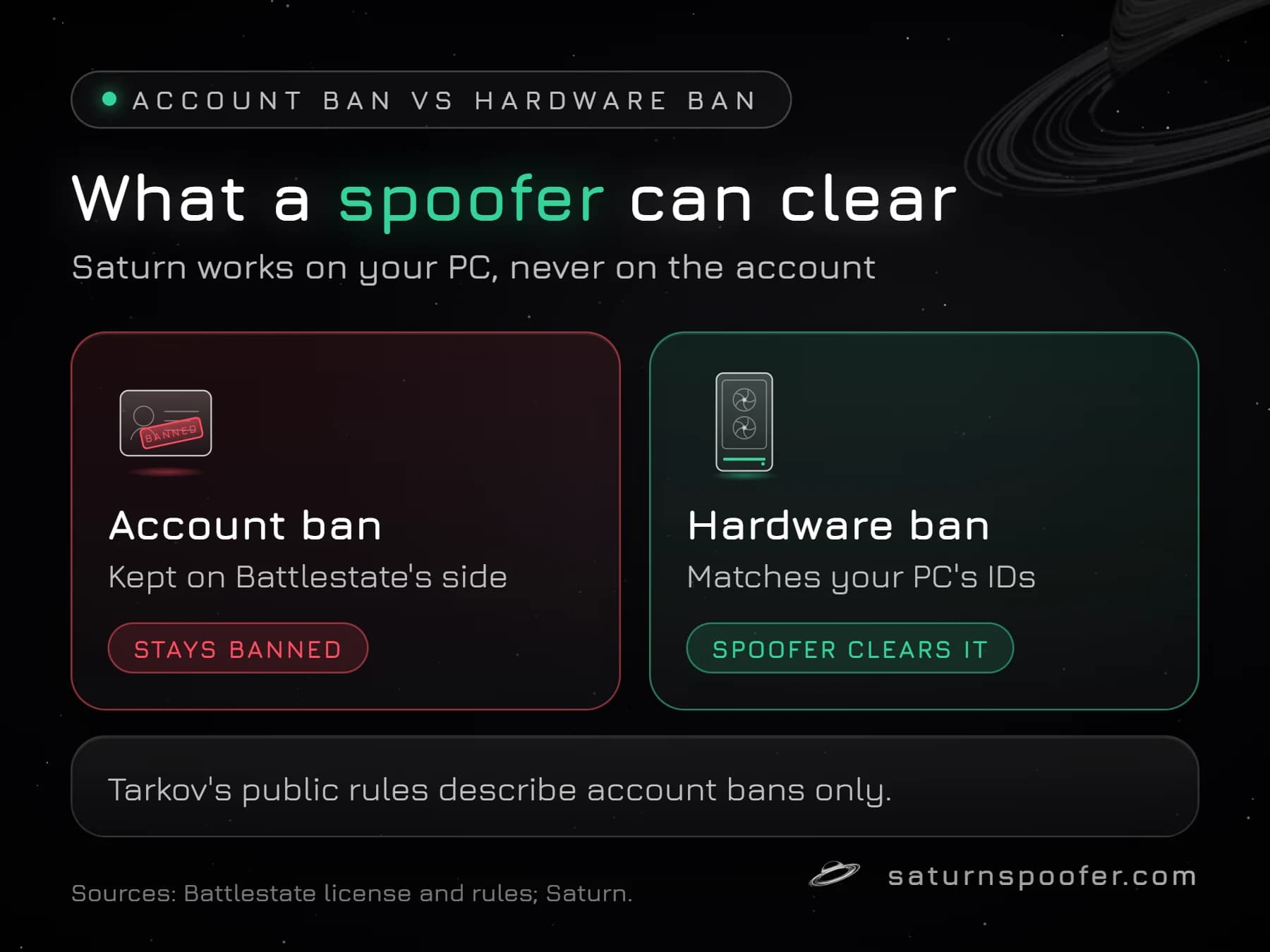
Saturn's reach stops at the PC. Changing hardware IDs leaves a banned Battlestate account banned, because the account ban lives on Battlestate's servers. Saturn does not hide cheats from BattlEye and does not prevent bans, and the spoofer use Battlestate lists among banned accounts shows it is no shield for an account that cheats. A 24-hour Saturn trial costs nothing and needs an email sign-up, no card.
Tarkov Cheats FAQ
Does Tarkov ban cheaters?
Yes. Escape from Tarkov bans cheaters every day, and Battlestate Games counted more than 25,000 bans from January to March 2026, with 54% of them for cheating. A cheating ban can close the account for good, and its items and currency go with it.
What anti-cheat does Escape from Tarkov use?
Escape from Tarkov uses BattlEye, a kernel-level anti-cheat that starts before the game launches and keeps scanning for third-party programs during play. Battlestate adds its own game-side checks, player reports and patch-level protections on top of it.
Is Tarkov still full of cheaters?
Public data cannot answer that. Battlestate publishes ban counts, not the share of raids with a cheater in them, and its anti-cheat diary admits some cheaters are good at avoiding detection. It says it is working to cut the number of raids a cheater can play before a ban.
Can you cheat in Tarkov PvE?
Cheating in Tarkov PvE breaks the same rules as cheating in PvP. The PvE Zone is reached from the same main menu and account, and the license agreement's ban on cheat software and bots makes no exception for PvE, so a ban for PvE cheating lands on that account.
Does Tarkov hardware ban?
Battlestate has not said so. Its license agreement, Rules of the Game and April 2026 anti-cheat diary describe account bans and never mention hardware bans, and BattlEye ties its global bans to Steam IDs and accounts. Players report bans that carry over to new accounts on the same PC; where a ban does sit on the hardware, an HWID spoofer clears it on that machine, while a banned account stays banned.