A Valorant false ban is a Riot penalty that lands on a player who didn't break the rule it names: an account ban for cheating, a boosting suspension, a rank reversal or a hardware (HWID) ban. The cheating and boosting bans come from two automated systems, Riot Vanguard's anti-cheat and the newer Vanguard Anti-Boost detection, and by September 17, 2026, Riot says it had actioned 296,416 VALORANT and League of Legends accounts for rank manipulation.
Plenty of bans that feel false aren't, by Riot's rules. A higher-ranked friend on your account counts as boosting, and a tool you never thought of as a cheat can still break Riot's terms. Work out which ban you have first, because that decides whether an appeal stands a chance.
Why Did I Get Banned in Valorant If I Didn't Cheat?
A Valorant ban that seems to come from nowhere can trace back to any of five things Riot acts on without you ever cheating: someone else playing your account, queuing with a smurf or boosted account, a PC that already carries a hardware ban, third-party software that interacts with the game, or a stolen account used to cheat. Riot's systems judge the account and the machine, not the person who happened to be at the keyboard.
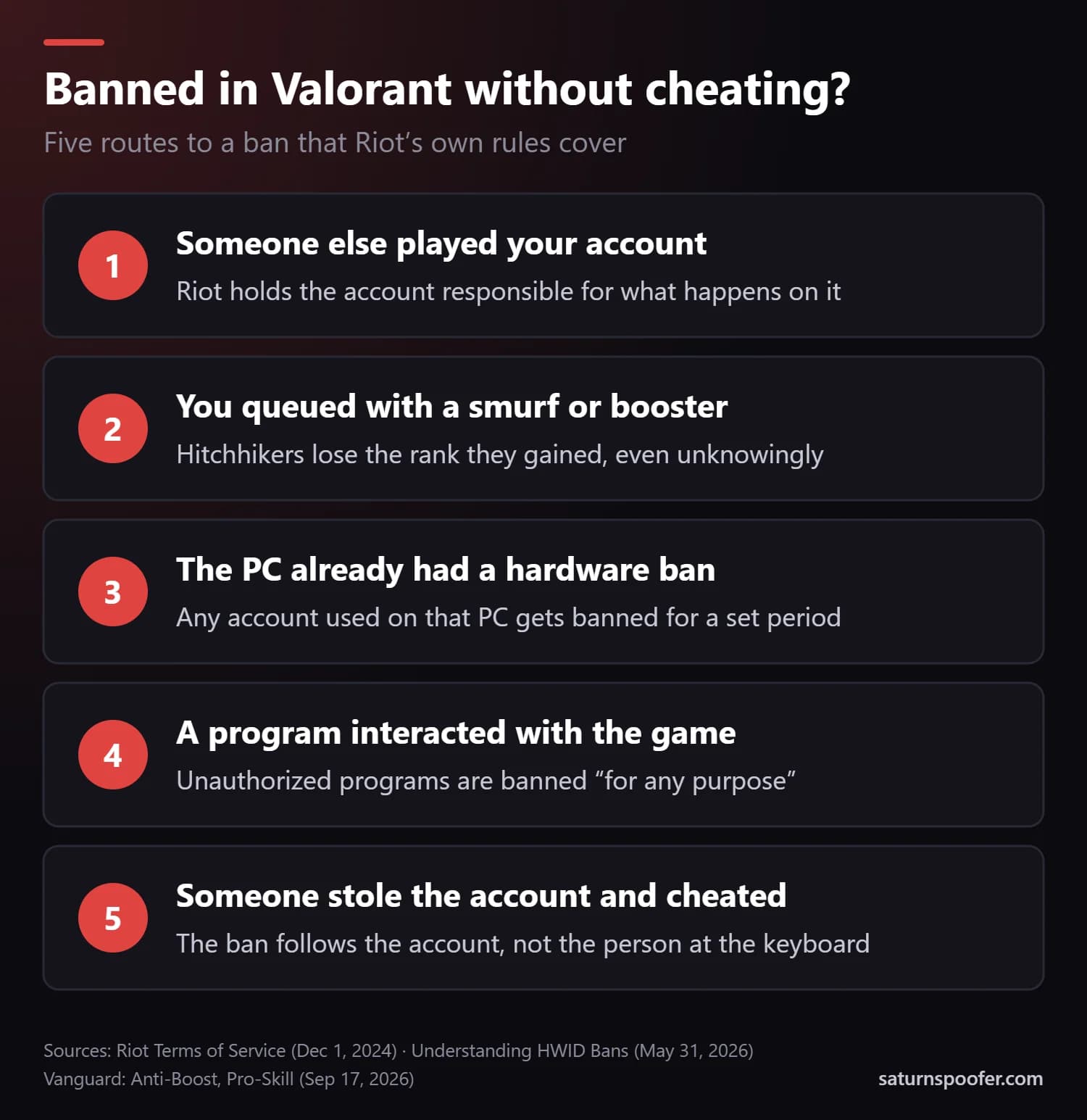
Riot's Terms of Service say it enforces its rules with "both human moderators and technological means, such as automated systems and machine learning tools." Automated systems misfire, and the same section tells players who think Riot made an error to contact Player Support. It has happened in Valorant before. In October 2021, Sportskeeda reported that players whose accounts Vanguard had banned by mistake got them back once Riot Support confirmed the error.
Which Valorant Ban Do You Have?
Your Valorant ban type shows in two places: what happens when you log in, and what you lost. Find your row before you write to Riot.
| What you see | What it is | Worth appealing? |
|---|---|---|
| Error VAN 152 on every account you try on this PC | Hardware (HWID) ban on the PC, across every Riot game | Yes, as a re-evaluation request |
| A timed suspension, with the rank you gained taken away | Anti-Boost suspension, with the boosted rank removed | Only if nobody else ever played the account |
| Rank Rating and MMR rolled back, but no ban | Hitchhiker rank reversion | Hard to argue, since Riot removes it even if you didn't know |
| A permanent ban on an account you bought | Smurf account ban | No. Buying accounts is against Riot's rules |
| A ban on your main for cheating or third-party software | Vanguard cheat ban on the account, sometimes the PC too | Yes, if you can name the program or show someone else had access |
| A game ban with a return date after leaving matches or going AFK | Behavior Game Ban, 7 days up to permanent | Yes, when a Riot server problem caused the disconnects |
Riot's Penalties and Bans FAQ for VALORANT, dated June 2, 2026, keeps game bans for "repeat offenders who have ignored prior warnings and penalties," so a game ban on a clean record deserves a mention in your ticket.
Falsely Banned for Boosting: What Riot's Anti-Boost Flags
Riot's Vanguard Anti-Boost system flags a Valorant account when a big share of its ranked points is earned by a higher-rated player logging into it, and it also goes after the players who queue alongside that account. Riot first ran it privately on League of Legends in September 2025, announced it for VALORANT with Patch 13.01 on July 14, 2026, under the "Play Fair" line of its Community Pact, and laid out the penalties on September 17.
You can test a boosting ban against Riot's own definitions. The Penalties and Bans FAQ says boosting "is when a higher-ranking player logs into another player's account" to raise its rank, and Section 7.1 of the Terms of Service lists "playing on another person's account" under cheating and anticompetitive behavior. The September post adds that Riot has "to hold accounts responsible for the actions taken on them." A higher-ranked friend playing ranked on your account is boosting in Riot's eyes, however good the intentions, and sharing a login breaks the rules whatever the ranks. A suspension for that isn't a false ban.
Riot's detection pattern is worth knowing for your ticket. Riot describes it as an account that "vanishes from one location, appears in another location," then starts beating opponents far above its usual level, often with lower-rated players in its party. If your rank jumped while you were traveling or playing through a VPN, explain that location change in your ticket.
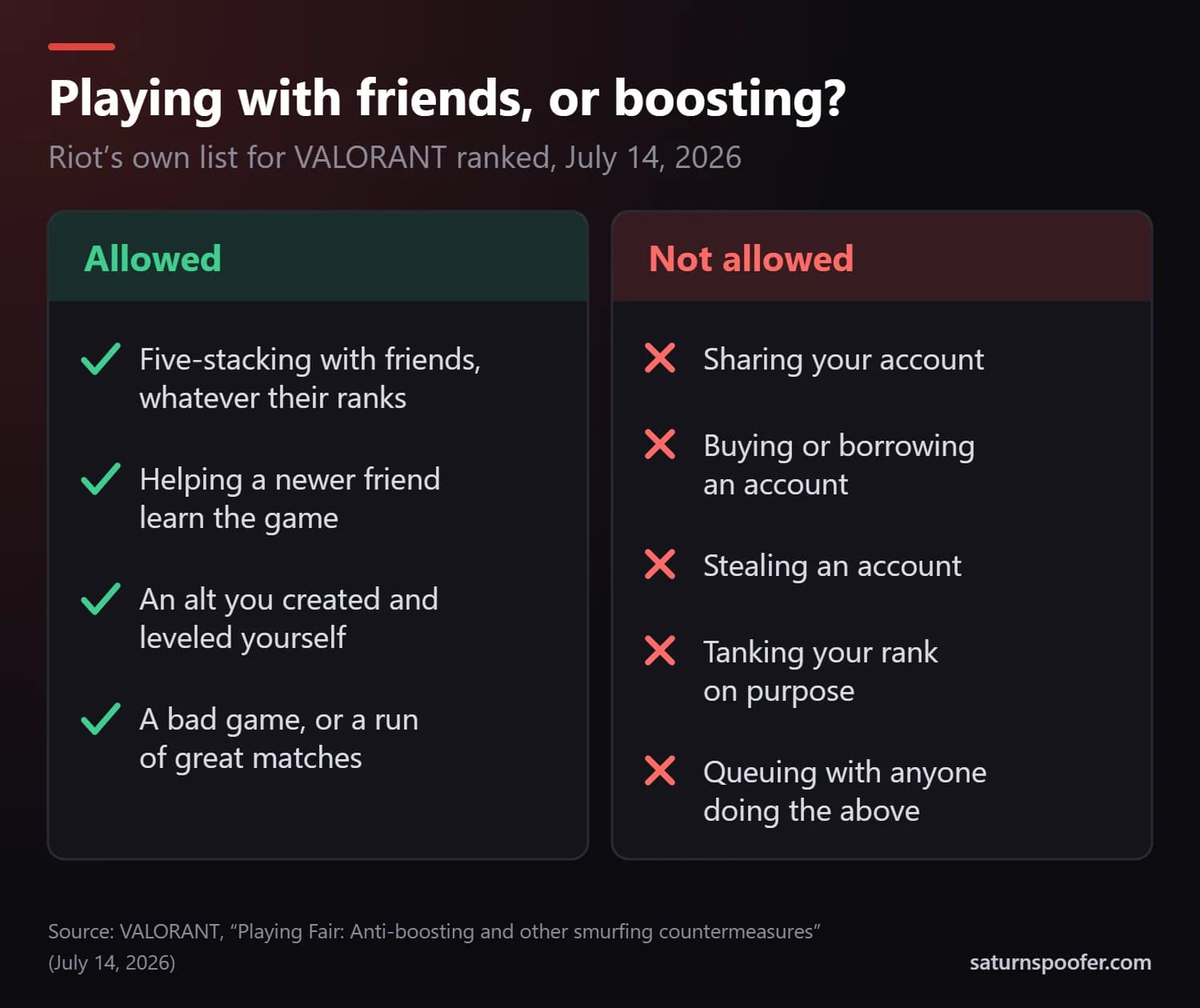
Riot drew the line itself in the July announcement. Five-stacking with friends "even if you are all different ranks" is allowed, and if you're playing normally, "queueing with friends remains completely fine." Riot also says it looks "for repeated patterns and strong evidence before taking action." It won't accept sharing, buying, borrowing or stealing an account, deliberately tanking a rank, or queuing with anyone who does. The September post sets out who pays for what:
| Who | What Riot does |
|---|---|
| The boosted account | Revokes the ranked points and rewards from the boost, then suspends the account for longer with each offense, "from three days, all the way up to three centuries" |
| A purchased or ownerless smurf account | Bans it "for one eternity," which is Riot's way of saying permanently |
| The booster's main account | "Escalating suspensions" once boosting becomes a habit |
| Hitchhikers who repeatedly partied with boosters or smurfs | Removes the rank they gained, "even if obtained unknowingly" |
The hitchhiker rule catches the most innocent-feeling cases, and it stings. Queue night after night with a friend on a bought low-rank account, and the rank you climbed together can be stripped from you, even though you never touched their account. Riot's view is that rank earned alongside a booster was never yours to keep. Alt accounts carry the same risk. Riot doesn't target alts you created and leveled yourself, but warns that playing a low-ranked alt with friends before ranking it up can get their rank removed.
A boosting ban is worth fighting when only you have ever played the account and nobody in your regular party was on a bought, borrowed or shared one. Then Riot's own "strong evidence" standard is on your side, and your ticket should say so.
Falsely Banned for Cheating: How Vanguard Bans Happen
A Valorant cheating ban comes from Riot Vanguard, which Riot's support page on Vanguard calls "custom game security software": a client that runs while Riot's games are active, along with a kernel mode driver. Vanguard doesn't need to catch an aimbot to ban you, because Riot's rules reach well beyond cheats.
Section 7.1 of the Terms of Service bans "unauthorized third party programs, including mods, hacks, cheats, scripts, bots, trainers and automation programs" that interact with Riot's games "in any way, for any purpose," along with programs that read the game's memory. That can take in things players don't think of as cheating: macro software that automates inputs, unauthorized overlays that inject into the game client, and tools that pull data out of the game. The rule makes no exception for good intentions.
A genuine false positive looks different: a ban on an account that ran nothing touching the game, or only mainstream software. Your appeal then rests on the details you give Riot, starting with the program's exact name and version, what it does, and when you installed it.
Two other routes catch players who never cheated. If someone got into your account and cheated on it, the ban follows the account, which is why multi-factor authentication matters. And Riot's HWID ban article names getting "flagged for using third-party tools (scripting or cheating)" as one route to a hardware ban, so a cheating flag can put error VAN 152 on the PC as well.
Was It a Mistake or a Rule? A Four-Question Check
A Valorant false ban is only false if none of Riot's rules fit what happened, and four questions will tell you where you stand. Be straight with yourself before you file anything, because the reviewer can see the records you're guessing about.
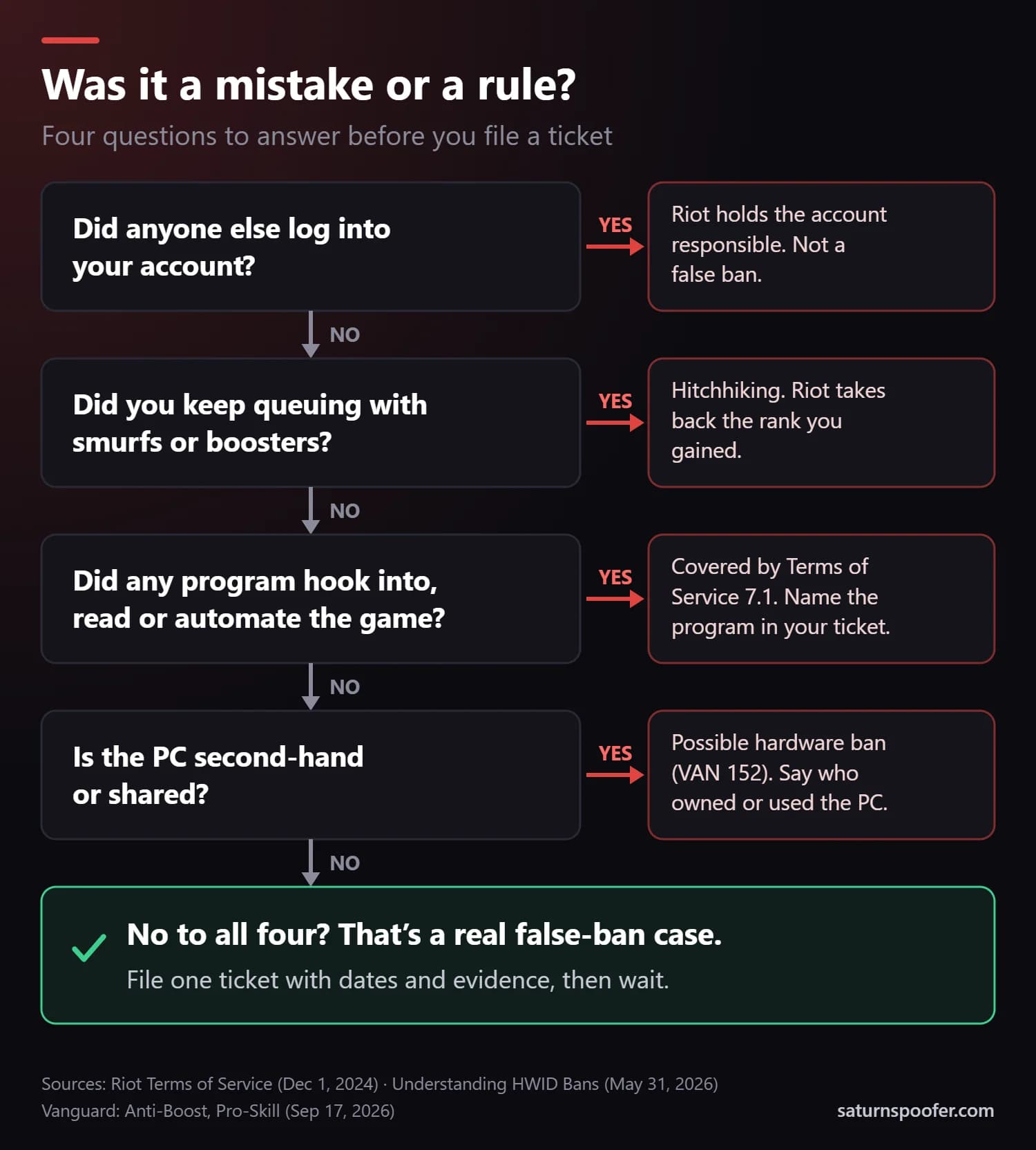
- Did anyone else log into your account? A partner, a sibling or a friend who played "just a few games" all count, since Riot treats the account as responsible for whatever happens on it.
- Did you keep queuing with someone on an account they don't own? Repeated parties with boosters or smurfs make you a hitchhiker, and Riot takes back whatever rank came with them.
- Did anything on your PC hook into, read or automate the game? Unauthorized macros, injectors, trainers and memory readers all fall under Section 7.1. If you ran one, name it in the ticket instead of claiming you ran nothing.
- Is the PC second-hand or shared? A PC with a hardware ban on it gets every account used there banned for a set period, and that includes yours.
Four answers of no make a real false-ban case. That's when an appeal is worth filing.
What to Do After a Valorant False Ban
The first move after a Valorant false ban is to stop making it worse: keep other accounts off that PC and don't fire off several tickets. Then build one clear appeal.
- Stay off other accounts on the same machine. Riot's HWID ban article says a second account used on a hardware-banned PC picks up its own ban for a set period, since Riot's system assumes it's there to dodge the first one.
- Write down the facts while they're fresh: when the ban hit, the exact message or error code, who could access the account and the PC, what was running, and where you played from.
- Secure the account. Change the password and turn on multi-factor authentication, especially if anything suggests someone else logged in.
- File one ticket through Riot Support from the banned account. Our step-by-step Valorant appeal guide covers the ticket fields and includes a template.
- Attach the evidence that fits your case, then wait instead of opening duplicates.
| Your case | What to include |
|---|---|
| Someone stole your account | Riot security emails, the date you noticed, logins you don't recognize, and when you changed the password |
| Boosting flag, but only you played | Your usual rank history, who you queued with, and any travel or VPN use around the time of the jump |
| Cheating flag with no cheats | The name and version of every tool that was running, what each one does, and when you installed it |
| Someone else used your PC | Who used it, when, and on which Riot account |
| Second-hand PC or parts | The receipt, the seller, the purchase date, and when VAN 152 first appeared |
A review ends with the ban lifted or kept, and a hardware ban can even be extended. If Riot keeps it, reply on the same ticket only when you have something new, like a receipt or a date you couldn't find before.
If the False Ban Also Hit Your PC
A Valorant false ban that shows error VAN 152 is a hardware ban as well, and it sits on the PC rather than the account. The standard term is four months, and Riot can extend it for repeat offenses. Our breakdown of what VAN 152 means and the full Valorant HWID ban guide cover the length and the re-evaluation in detail.
Riot calls lifting a hardware ban "possible (but never guaranteed)," so some players whose review stalls look at the other route: changing what the PC reports. That's the job of an HWID spoofer. It changes the hardware identifiers Riot Vanguard collects, and the PC no longer looks like the restricted one. The HWID spoofer explainer covers the mechanics.
Saturn works on exactly those identifiers. The Windows spoofer covers the CPU, TPM, motherboard, RAM, NVMe, SSD and HDD drives, MAC address, GPU, USB devices and monitor EDID. You run one loader, and your license decides which anti-cheats it covers, so a Vanguard license handles Valorant along with League of Legends and Teamfight Tactics. The Saturn Valorant spoofer page shows live Valorant status and the plans, and the free 24-hour trial asks for an email, never a card.
Know what that route can't do. A spoofer doesn't reverse any ban, doesn't return rank that Anti-Boost removed, and does nothing for a ban that sits on the account alone. Section 7.1 of Riot's terms also forbids circumventing "any technological measure implemented by Riot," so playing through a hardware ban this way breaks those terms, and Riot says it bans any account it finds a hardware-banned player using.
How to Avoid Another Valorant False Ban
Avoiding another Valorant false ban mostly means keeping three things clearly yours: the account, the party and the PC.
- Keep your login to yourself. Riot's rules don't care that a friend only played a few games or that nobody paid for it.
- Turn on multi-factor authentication for your Riot account, so a leaked password alone isn't enough for someone to log in and get you banned.
- Queue with friends of any rank, but steer clear of anyone playing on a bought or borrowed account.
- Rank up an alt yourself before you bring it into your friends' games.
- Close macro tools and anything that hooks into games before launching Valorant.
- Buy used PCs and motherboards only where you can return them, and launch a Riot game inside the return window.
Spot a booster in your match? Riot says reports through the Rank Manipulation category in game give it "more data to work with."
Valorant False Ban FAQ
Why did I randomly get banned on Valorant?
A Valorant ban that looks random can still have a cause Riot's rules cover: another person on your account, repeated games alongside boosters or smurfs, a PC with an existing hardware ban, software that touched the game, or a hijacked account. Riot's automated systems can also get it wrong, and Riot points players who suspect a mistake to Player Support.
Can you get banned for playing with a smurf in Valorant?
Queuing with friends of any rank is allowed in Valorant, and Riot lists five-stacking across different ranks as normal play. Partying repeatedly with a booster, or with someone on an account they don't own, makes you a hitchhiker, and Riot takes back the rank you gained even if you didn't know.
Does Riot reverse false bans?
Riot can reverse a Valorant ban after a review finds it was issued in error, and Sportskeeda reported players getting mistaken Vanguard bans lifted in 2021 once Riot Support confirmed the error. When the account was in fact shared, or a cheat did run, no amount of careful wording changes the record.
What is rule 7 in Valorant?
In a Valorant ban, "rule 7" means Section 7 of Riot Games' Terms of Service, the User Rules. Section 7 lists what Riot can ban for, including unauthorized third-party programs and "playing on another person's account" to boost its rank. It also asks players who think Riot made an error to contact Player Support. Riot last modified the terms on December 1, 2024.
How long does a VAN 152 ban last?
Standard VAN 152 bans last four months. Riot can stretch that for repeat offenses or serious violations, and because the restriction is tied to the PC, switching accounts on that computer changes nothing while it runs.
Can I make a new Valorant account after a false ban?
A new Valorant account only helps when the ban sits on the account alone. If the PC carries a hardware ban, Riot restricts any new account that signs in there, hands it a ban for a set period, and counts it as an attempt to evade the first ban.
How long does a Valorant boosting ban last?
Riot's Anti-Boost suspensions grow with each offense, running "from three days, all the way up to three centuries," and the rank gained through boosting is removed. Bought or ownerless accounts are banned permanently, and repeated, severe abuse can end in a permanent ban as well.