 Gabri
Gabri
An aimbot is cheat software that aims for you: it finds where enemies are, from the game's memory or from the picture on your screen, and moves your crosshair onto them faster than a human hand can.
In June 2026, Riot said cheaters show up in about 0.7% of all PC ranked matches across League of Legends and Valorant. It named computer vision cheats, which it calls pixelbots, as one of cheaters' three favorite methods of the past five years.
There are six common types of aimbot, and every one of them leaves a trail an anti-cheat can follow. On October 12, 2026, I read what Riot, BattlEye, EA and Anti-Cheat Expert say about catching them, and what they do to the players they catch.
If a game has already banned your PC, not only your account, skip to the HWID spoofer section. If you're here to understand aimbots or spot one in your lobby, Saturn isn't your answer, so read straight through.
How Does an Aimbot Work?
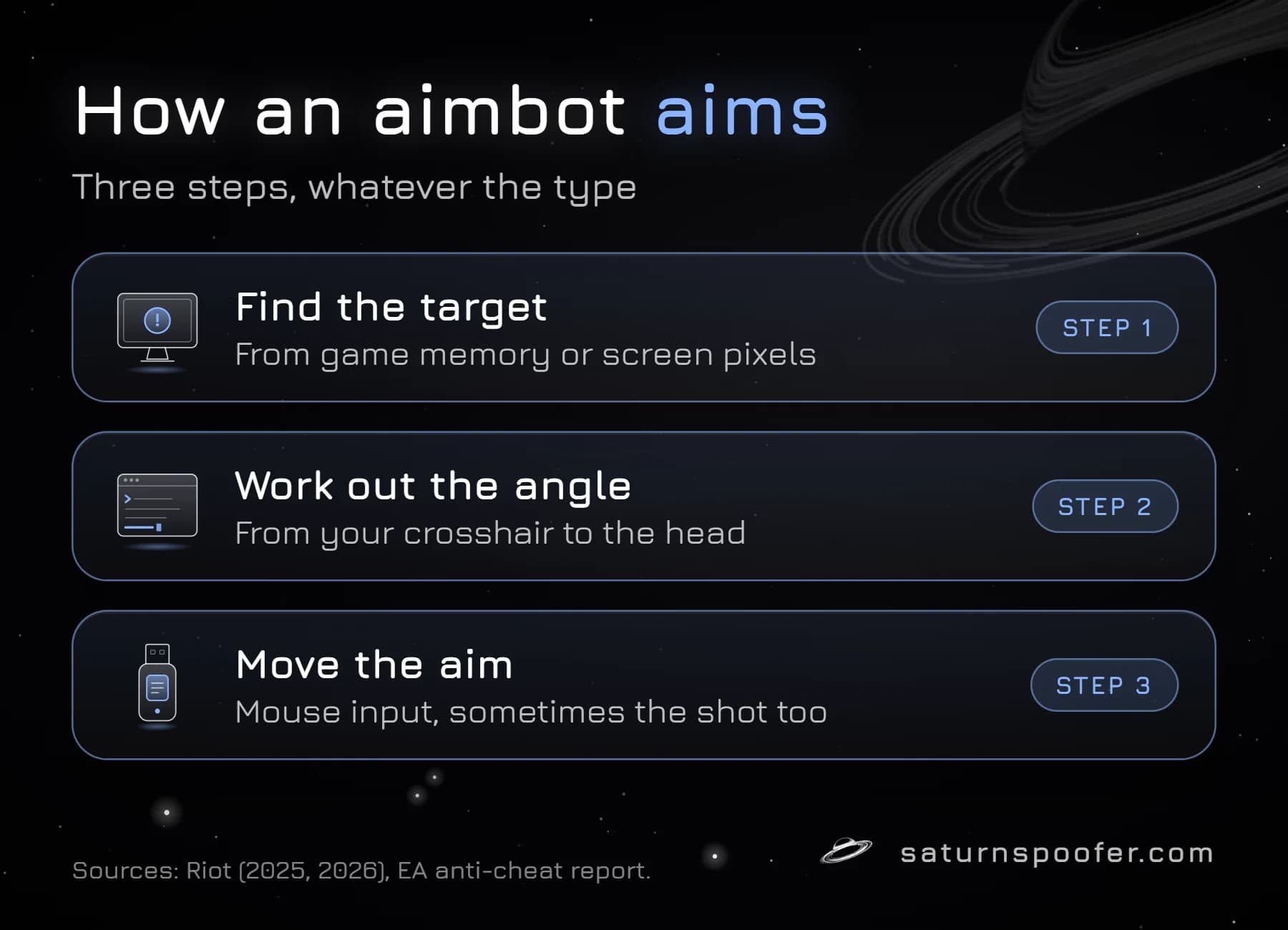
An aimbot works in three steps: it finds the target, works out the angle from your crosshair to it, and moves your aim there, sometimes firing for you too.
Every type of aimbot is a different answer to the first step.
Some read the game's memory, where every player's position is kept. Others read the picture on your screen, the same pixels you see.
I read EA's anti-cheat report next to Riot's posts, and both split cheats the same way. Internal cheats inject code into the game process, external ones work from outside it, and EA names pixel-bots as an external cheat that works as an aimbot "by just reading the screen."
The last step is the one anti-cheats watch hardest.
Riot says Vanguard already rejects input from any device that isn't your primary peripheral, so a screen-reading cheat needs a workaround to move your aim at all.
Aimbots are often sold in one menu next to ESP cheats, the overlays that draw enemies through walls, and EA names both as the cheats shooters are known for.
Find, aim, move. Every aimbot is a version of those three steps.
Types of Aimbots
Aimbots come in six common types, and the split I'd look at first is where each one gets its target: the game's memory, your screen, or separate hardware.
| Type | Where it finds you | What it does |
|---|---|---|
| Memory-reading aimbot | Game memory | Turns your view onto the target |
| Silent aim | Game memory | Sends the shot, crosshair barely moves |
| Colorbot (pixel bot) | Screen colors | Pulls the mouse toward an outline |
| AI aimbot | Screen, via a trained model | Pulls the mouse toward detected heads |
| Rage aimbot and spinbot | Game memory | Locks instantly, no attempt to look human |
| DMA aimbot | Memory, read by outside hardware | Aims with the cheat running off the gaming PC |
Memory-Reading Aimbots
A memory-reading aimbot pulls enemy positions straight out of the game's memory, then turns your view toward them.
It's the classic design, and kernel anti-cheats were built to stop it.
Riot says cheats that load a library into the game client are either prevented under Vanguard or caught quickly, and in its June 2026 data they made up less than about 10% of the cheater-infected matches on Riot's PC games.
Cheat makers answer with smoothing and field-of-view limits that slow the aim so it looks human. The settings sold with a Valorant aimbot exist for exactly that reason.
Silent Aim
Silent aim is an aimbot mode that sends your shots to the target without visibly dragging your crosshair onto it.
In a replay, it looks like a run of hits from a crosshair that was never on the target. Because it changes where the game sends the shot, silent aim works inside the game, in the memory-reading family a kernel anti-cheat watches.
Colorbots and Pixel Bots
A colorbot, also called a pixel bot, is an aimbot that scans each frame for the color of enemy outlines and pulls the mouse toward the match.
Riot calls the pixelbot "baby's first cheat." In February 2025 it wrote that they spread fast in Brazil once Vanguard made memory cheats less viable, and Brazil briefly hit 10% of ranked games with a cheater during Riot's holiday code freeze. The same post says they're as easy to detect as they are to install.
Rage Aimbots and Spinbots
A rage aimbot is an aimbot set to win fast with no attempt to look human: instant locks, headshots on contact, fire the moment a target appears.
A spinbot is the loudest version.
The character spins nonstop while the cheat fires at whatever it locks onto, and Riot says its server-side behavioral detection "mostly just instantaneously deletes the accounts of ragehackers."
The opposite setting gets sold as "legit," with added jitter and deliberate misses.
I think it's the most misleading label in the category. Riot wrote in April 2024 that these humanization features were mostly "goofy pseudo-random noise generators."
DMA Aimbots
A DMA aimbot reads the game through a separate card that uses direct memory access, so the cheat itself runs off the gaming PC, usually on a second computer.
Riot says DMA cheats are usually used for wallhacking, while Delta Force's own security brief says a DMA card can read enemy locations or adjust your aim.
Riot's counter is the IOMMU, a hardware firewall between PCIe devices and system memory.
In June 2026 it said it had spent the past year placing full IOMMU restrictions on high-ranked Valorant cheaters abusing DMA.
One cousin doesn't aim at all.
A triggerbot fires the moment an enemy crosses your crosshair, and Riot says even something that simple "can still be a massive advantage" in a tactical shooter.
What Is an AI Aimbot?
An AI aimbot is a screen-reading aimbot that uses a trained object detection model, instead of a simple color filter, to find enemy bodies and heads in each frame in real time.
The pitch is that computer vision never touches the game's memory. The authors of a June 2026 research paper go further, calling visual aimbots invisible to commercial kernel-level anti-cheats.
Riot's numbers tell the other half. June 2026 anti-cheat update calls local Python colorbots "AI's favorite thing to make for VALORANT," and left their bans off its chart because there were too many to be worth counting.
Publishers name them too: Arena Breakout: Infinite's Season 5 security report lists the "AI-powered aimbots" players were talking about among the Arena Breakout cheats its team disabled.
The weak point is the mouse.
The cheat still has to move it, and that movement lands in match data the server keeps.
Researchers are going after AI aimbots from another angle. That June 2026 paper places adversarial patches in a game as honeytokens: images built to set off a cheat's object detection model, flagging the cheater or flooding their view. On a custom Unreal Engine game the patches caught over 90% of visual aimbots when the researchers knew the cheat's model, and the authors also validated the idea on Fortnite.
Reading the screen hides the cheat from the game. It doesn't hide the aim from the server.
Can Anti-Cheats Detect an Aimbot?
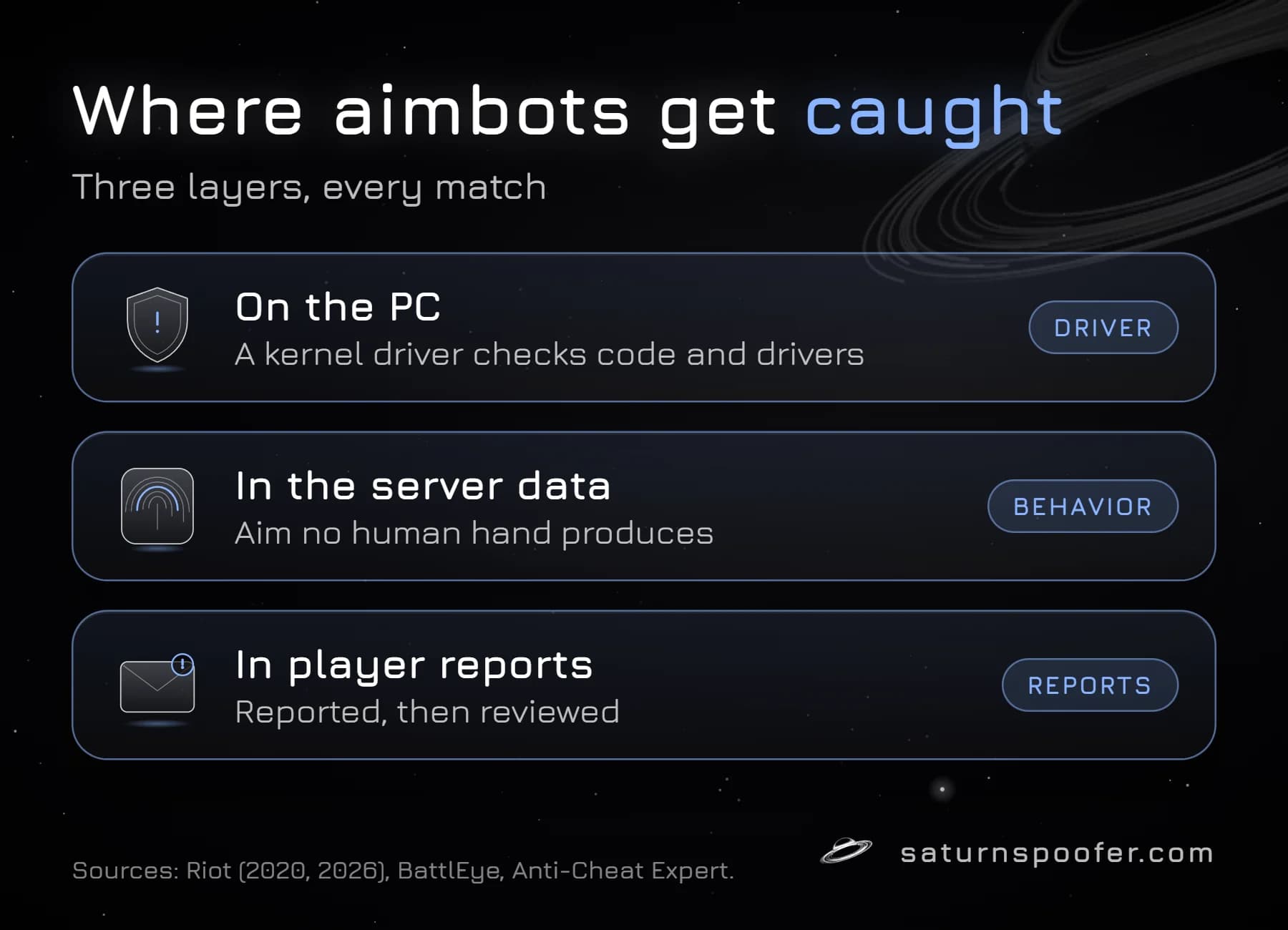
Yes. Anti-cheats detect aimbots in three places: on your PC, in the match data the server already has, and through player reports.
Riot's Valorant anti-cheat lead called this "defense in depth" in May 2020, with detection through Vanguard, hardware bans, player reports, data analysis and machine learning research.
On the PC
On the PC, an anti-cheat looks for the aimbot itself: injected code, vulnerable drivers and tools touching the game process.
BattlEye describes scanning in "user- and kernel-mode" with specific and heuristic detection. EA says EA Javelin Anticheat runs in the kernel because cheats working from there could otherwise hide everything they do.
Riot's Vanguard driver starts with Windows by default and keeps a local blocklist of the vulnerable drivers cheaters favor. If one loads, Vanguard unloads, which is how kernel-level anti-cheats stop a cheat from slipping in before the game starts.
In the Server Data
In the server data, behavioral detection looks for aim no human produces: snaps with no correction, reaction times nobody hits, accuracy that never dips.
Anti-Cheat Expert, Tencent's anti-cheat, says it analyzes player behavior to catch inhuman reaction times and impossible movements. Riot's behavioral layer for Valorant works only from in-game performance data, so it doesn't care where the aimbot got its target. Of the three layers, it's the one I'd least want to bet against.
Reports and Delayed Bans
Player reports are the third layer. Riot said in 2020 that it tracks cheating reports.
A ban doesn't always land in the same match.
Riot says the best way to keep cheats detected is to slow cheat makers down "by obfuscating and delaying our response," so a cheater can play on for a while before the ban arrives.
An aimbot has to beat all three layers, every match, for as long as the account exists.
What Happens If You Get Caught Using an Aimbot?
If you get caught using an aimbot, you lose the account, and in some games the PC gets banned as well.
Every publisher I read bans accounts for it. Riot's terms of service list "using any unauthorized third party programs, including mods, hacks, cheats, scripts, bots" as a rule break.
The Account Ban
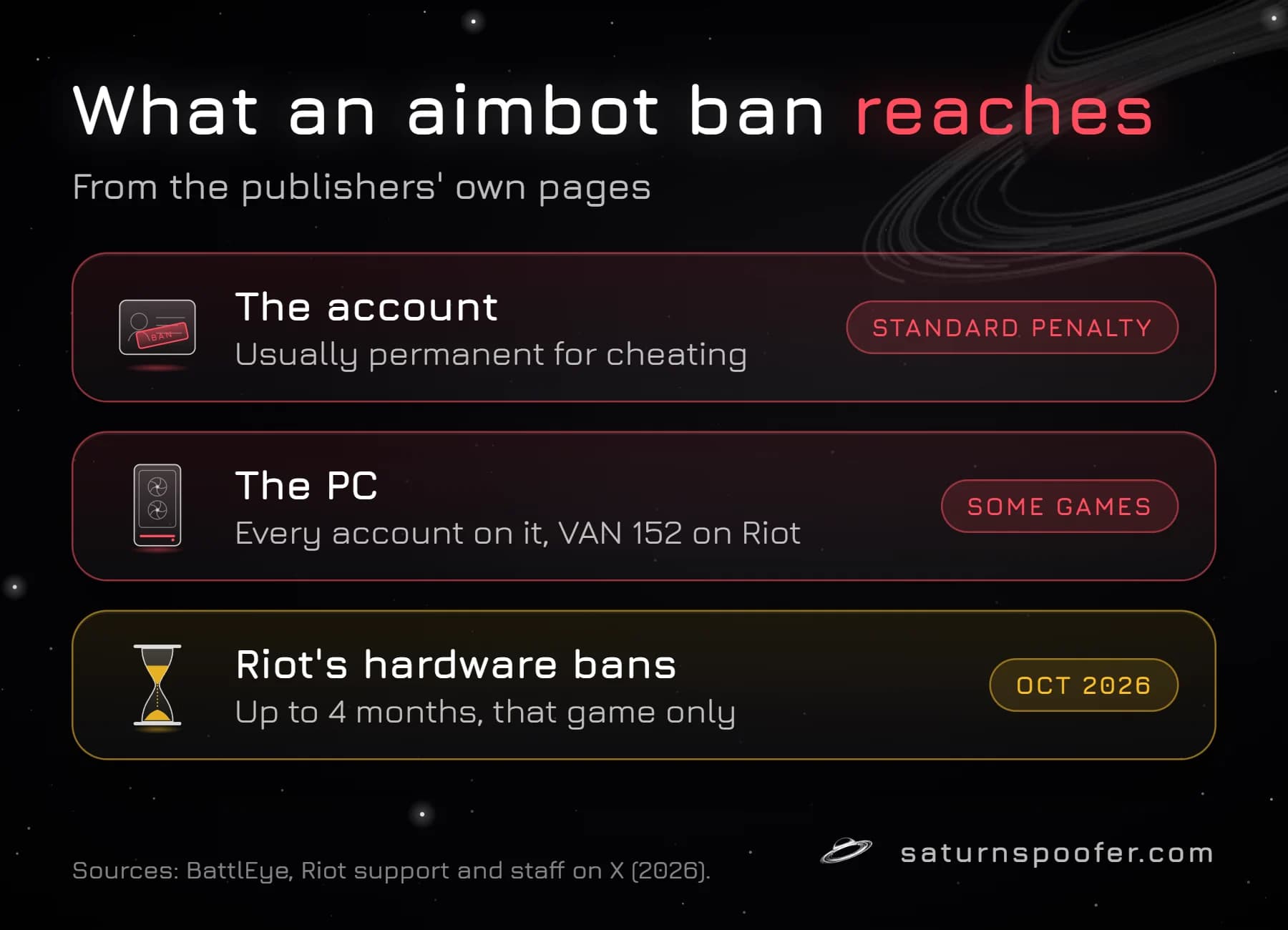
The account ban is the standard penalty for an aimbot, and for cheating it's usually permanent.
BattlEye's support page puts it plainly: "Global bans are permanent and no exceptions will be made." Battlestate's license for Escape from Tarkov lets it end your access "for an unlimited time," and EA says it has permanently banned thousands of cheater accounts across 14 EA games.
The Hardware Ban
A hardware ban blocks the PC itself, so every account that logs in from that machine gets caught, not only the one that cheated.
Riot's support article on HWID bans, updated May 31, 2026, lists being flagged for scripting or cheating as a cause. Login fails with error VAN 152, Riot bans any account the banned player uses on sight, and a friend's account that logs in on that PC gets banned for a set period too.
On October 2, 2026, Phillip Koskinas, who works on anti-cheat at Riot, wrote that Riot's hardware bans last four months at most and apply only to the game the cheat was detected in. That's narrower than the support article's wording. I re-read both on October 12, 2026, and they still don't match, so on a Riot game I'd ask support for the time left.
Riot's December 2023 update shows the scale of the problem: repeat offenders using several accounts to cheat on the same machine were still the majority of bans.
How a hardware ID ban works differs by publisher, and not every publisher documents one. Battlestate's license and rules never mention hardware bans, so whether a ban for Tarkov aimbots reaches the PC is something the studio hasn't confirmed.
The account goes first. In some games, the PC goes with it.
How Can You Tell If Someone Is Using an Aimbot?
You can't prove an aimbot from one clip, but a few patterns show up again and again when you spectate or watch a replay:
- The crosshair snaps onto a head and stops dead, with none of the small corrections a hand makes.
- Reaction times stay identical, fight after fight.
- Tracking stays glued to a target through jumps, strafes and smoke.
- Hits land while the crosshair is visibly off the target, which is the silent-aim tell.
- The aim is already on you before you're visible. That one points to ESP more than an aimbot.
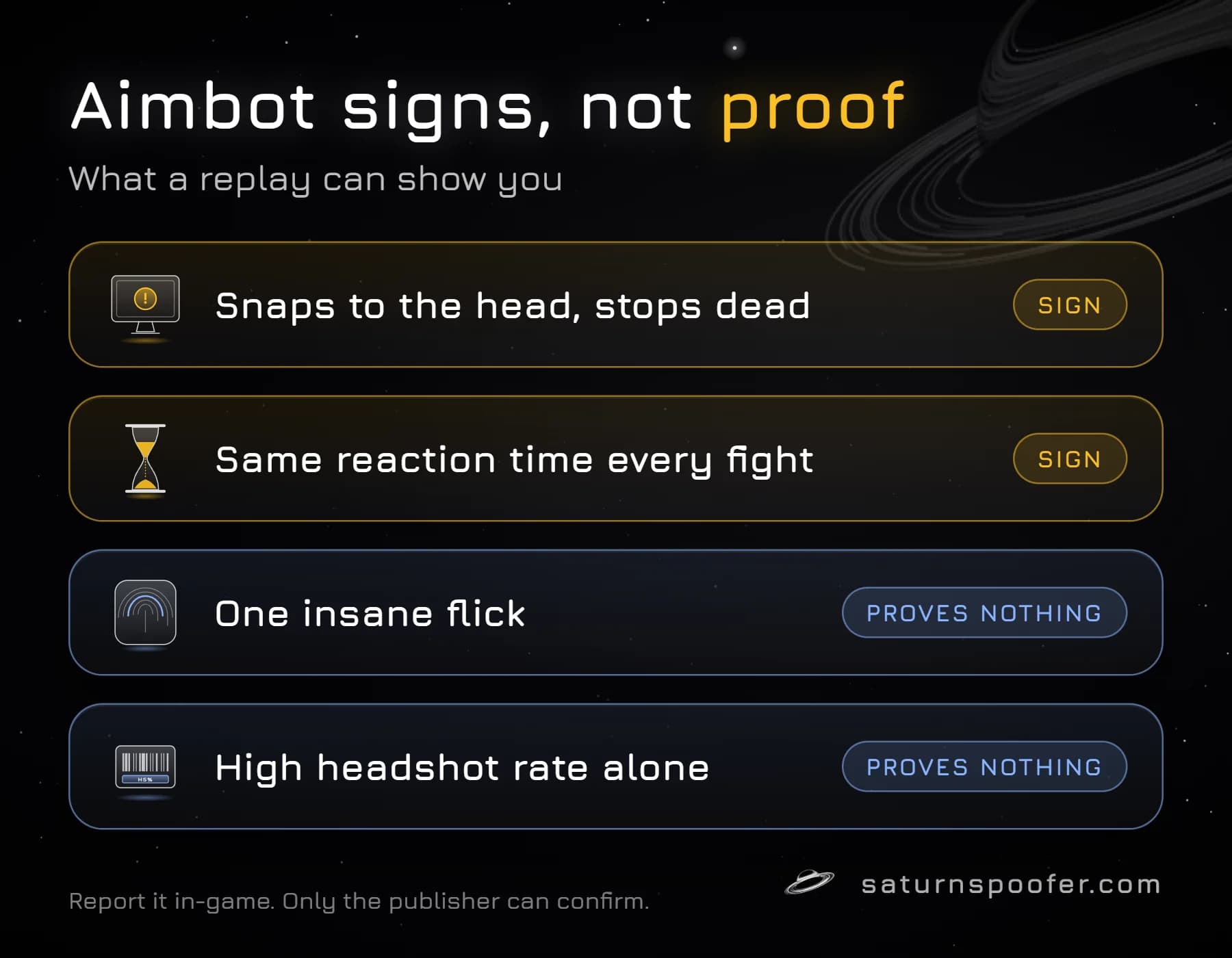
What proves nothing: a high headshot rate on its own, one insane flick, or a player who's better than the rest of your lobby. Smurfs exist, and good players have great nights.
So report it in-game and let the people with the data decide. Battlestate's April 2026 anti-cheat diary says "the best you can do is to report a cheater through the in-game system."
Report it. Don't call it in chat.
The Risks Beyond a Ban
Free cheat downloads, aimbots included, are one of the biggest malware lures aimed at gamers.
Flare, a threat exposure management firm, looked at 53,896 devices infected with infostealer malware between June 7 and August 12, 2025. It found that 41% of the infections came from a gaming-related file, and that cheats, mod menus, aimbots and skin changers made up over half of those.
Riot's League team wrote in April 2024 that most of its legal effort was aimed at ads for "malware masquerading as an aimbot." When the publisher's lawyers spend their time on fake aimbots, I take that as the warning.
The download can cost you more than the ban does.
Where an HWID Spoofer Fits (and Where It Doesn't)
An HWID spoofer fits one situation: a publisher has banned the PC itself, and you want that PC to play again.
That's the one case we build Saturn for. We don't make cheats. We change the hardware IDs your PC reports to an anti-cheat, such as the CPU, TPM, motherboard, disk, GPU, monitor and network adapter values, so a hardware-banned machine shows up as different hardware.
No aimbot cover. No account unban. No protection for an account that keeps cheating, because the aimbot gets caught the same way it did the first time.
Saturn is the wrong answer if:
- Only your account is banned. A spoofer can't touch a record on the publisher's servers.
- You expect it to keep an aimbot account safe. The aimbot gets the new account banned the same way, and Saturn only keeps the PC from being locked out.
- You haven't checked which ban you have, or an appeal is still open.
I'd rather you hear that from me now than find out after paying.
Where it does fit, Saturn is one loader, and your license decides which anti-cheats it covers: Riot Vanguard, Easy Anti-Cheat, BattlEye (with FiveM inside the BattlEye license), EA Javelin and Anti-Cheat Expert, across 61 games. The anti-cheats Saturn supports are listed with the license each one needs.
As of October 12, 2026, Saturn is currently undetected by every anti-cheat it supports, and the live status page is where that's tracked day to day. I'd keep one thing straight, though: that's Saturn's own footprint, not your aimbot's, and an anti-cheat that catches the aimbot still bans the account.
Temporary mode gives you unlimited profiles, and your original IDs come back when you close it. Permanent mode writes one profile for good.
Where it falls short: a spoofer breaks the same kind of rule an aimbot does. Riot's terms list circumventing any technological measure as a rule break, and Epic's Hardware Identifiers Warning, which I read on September 29, 2026, says Fortnite detects tools that hide or change hardware IDs and that accounts may be permanently banned.
Every license comes with a 24-hour free trial, no card needed, only an email address for the key.
Aimbot FAQ
Can you get banned for using an aimbot?
Yes. Every publisher I read for this page bans accounts for aimbots, and for cheating the ban is usually permanent. Some, like Riot, can also ban the PC, which blocks every account that logs in from it.
Is using an aimbot illegal?
Riot's terms and Battlestate's license both treat it as a rule break, and the penalty is a ban. Riot says it sues cheat developers when it needs to. Whether using one breaks the law where you live is a legal question this page can't answer.
What is silent aim?
Silent aim is an aimbot mode that sends your shots to a target without visibly moving your crosshair onto it. It works inside the game, where kernel anti-cheats look.
What is a colorbot?
A colorbot is an aimbot that scans the screen for the color of enemy outlines and drags your aim onto them. Riot also calls it a pixelbot, and says most of them are caught quickly.
Is aim assist the same as an aimbot?
No. Aim assist is built into a game by its developer, mostly to help controller players, and it's allowed. An aimbot is outside software that aims for you, and the publishers covered here ban it.
Does an HWID spoofer hide an aimbot?
No. An HWID spoofer changes the hardware IDs a PC reports and does nothing to hide cheat software. An account running an aimbot gets caught the same way, spoofer or not.
Final Thoughts
An aimbot is software that aims for you, and every version of it, from memory readers to AI models reading the screen, leaves a trail on the PC, in the match data or in someone's report.
My advice is short. If you're thinking about running one, I've read the publishers' own pages, and they say the account goes and sometimes the PC goes too. If you've played against one, report it and move on.
Checked by Gabri on October 12, 2026. Sources: Riot's anti-cheat posts (May 2020, December 2023, April 2024, September 2024, February 2025, June 24, 2026), Riot's HWID ban article (May 31, 2026) and terms of service, Phillip Koskinas on X (October 2, 2026), BattlEye's support and about pages, Battlestate's April 2026 diary and license (read October 6, 2026), EA's anti-cheat progress report, Anti-Cheat Expert, Delta Force's Security Brief Vol. 2, Flare (November 2025), Epic's Hardware Identifiers Warning (read September 29, 2026), and arXiv 2606.07650 (June 2026).