 Gabri
Gabri
ESP in games is a cheat that shows you information the game is hiding, mostly where every enemy is, even behind walls.
The letters stand for extra-sensory perception. The name is the sales pitch: you know things your character couldn't see or hear.
As of October 2026, the clearest numbers I've found on ESP come from PUBG's anti-cheat team. In March 2024 it called ESP one of the most frequently encountered cheating methods, and reported in the same letter that hiding player positions on the server cut cheaters' kills per match by about 20%.
I read Riot's and PUBG's own engineering posts, support pages and ban notices for this guide, and I re-checked each one on October 12, 2026. Nothing here explains how to get, set up or run ESP, and I don't name any cheat seller.
Already dealing with a hardware ban? Jump to the section on where Saturn fits. If you're here to understand the cheat or to spot it in your lobbies, Saturn isn't your answer.
What Does ESP Mean in Games?
ESP means extra-sensory perception, and in games it's the name for any cheat that puts hidden information on your screen.
PUBG's anti-cheat team defines ESP as software that "automatically pinpoints other players' positions in-game". Positions are the core of it, but a full ESP menu also labels names, health, weapons, distance and loot.
Players use the word loosely, and "he's got ESP", "he's walling" and "he's on walls" usually mean the same thing in a lobby: someone knows where you are when they shouldn't.
Riot's third-party rules list "exposing information that's intentionally obfuscated" as an unfair advantage it acts against, and I can't think of a tighter description of ESP.
ESP doesn't aim for you. Moving your crosshair is the job of an aimbot, and the two often come bundled in one menu, but ESP on its own only tells you where to look.
ESP is information. What you do with it is still your aim.
What ESP Shows on Your Screen
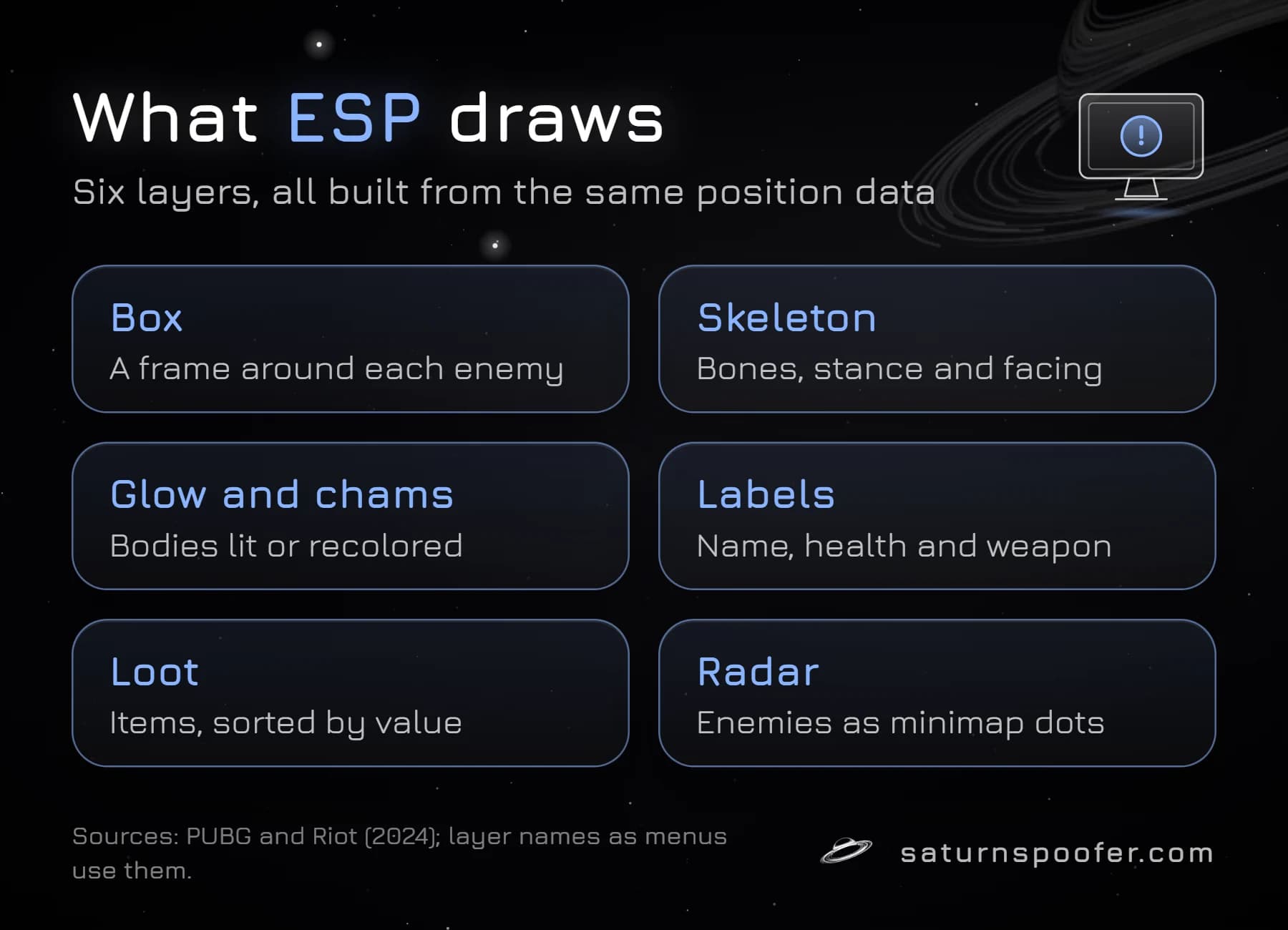
An ESP menu is a stack of layers, each one drawing a single kind of hidden information over the game, and the layers usually toggle one at a time, since all of them at once would be unreadable in a fast fight.
Box ESP
Box ESP draws a 2D or 3D rectangle around every enemy model, so a player behind cover shows up as a floating frame.
Many menus add snaplines, lines drawn from your crosshair or the edge of the screen to each enemy, so an enemy off-screen still gets marked.
Skeleton ESP
Skeleton ESP draws an enemy's bone structure as lines instead of a box. It tells you more than a frame does: whether someone is crouched, which way they're facing and where their head sits behind the wall.
Glow ESP
Glow ESP paints a bright outline around enemy models that shows through walls and smoke, so the body itself lights up instead of sitting inside a frame.
Chams
In games, chams are a cheat that recolors enemy player models in flat, bright colors so they stand out against the map, often one color when the enemy is hidden and another when they're in view.
Cheat menus usually list chams next to ESP rather than inside it, because chams change the model instead of drawing over it. The effect on you is the same: bodies through walls, painted instead of boxed.
Name, Health and Weapon ESP
Text layers label each enemy with a name, a health bar, the weapon in their hands and the distance to them.
Health bars matter more than they sound. You know which fight is already half won before you take it.
Item and Loot ESP
Item ESP labels objects instead of people: weapons, armor, containers, bodies and quest items.
It matters most in extraction shooters, where loot is the point of a raid, and Tarkov loot ESP is the textbook case, with menus that filter loose loot and containers by item value.
Radar Hacks
A radar hack shows every enemy as a dot on a minimap and draws nothing on the player models. Riot's developers group radar hacks with ESP as "informational" cheats, because both run on the same position data.
ESP vs Wallhack vs Chams: What's the Difference?
A wallhack is the part of ESP that shows enemies through walls, so every wallhack is a kind of ESP, but not every ESP layer is a wallhack.
Riot's anti-cheat lead for VALORANT summed up the wallhack in his 2020 write-up as a tool cheaters use to see opponents through walls, while loot labels and health bars are ESP too and have nothing to do with walls.
| Term | What it shows | Where it fits |
|---|---|---|
| ESP | Any hidden info: positions, health, loot | The whole category |
| Wallhack | Enemies through walls | ESP's best-known layer |
| Chams | Recolored enemy models | Next to ESP, same effect |
| Radar hack | Enemies as minimap dots | ESP without on-model drawing |
How Does ESP Work?
ESP works because your game client already knows more than your screen shows.
To draw an enemy the moment they round a corner, and to play their footsteps, the game server sends your PC their position ahead of time, and that position sits in the game's memory whether or not you can see the player.
An ESP cheat reads those positions out of memory and draws them over the game as an overlay. Riot's April 2024 developer post on Vanguard for League of Legends says pulling information straight out of client memory is "exactly what cheats do".
Where the reading happens splits ESP into three builds, and that's as deep as I'll go:
- Internal ESP runs inside the game's own process.
- External ESP is a separate program that reads the game's memory from outside it.
- DMA ESP uses a plug-in card to read memory over the hardware, and like other DMA card cheats it often shows the overlay on a second PC.
Whatever the build, ESP needs the same thing: position data sitting on your PC.
No data in memory, no ESP.
Why Is ESP So Hard to Detect?
ESP is hard to detect because it only reads. It doesn't change the game, so there's nothing modified for an anti-cheat to find.
PUBG's anti-cheat team said it plainly in its March 2024 dev letter: ESP programs don't tinker with game data and "leave no trace on existing files". The same letter says ESP is hard to spot from a third person's view when staff review reports.
Your behavior doesn't give it away easily either. An aimbot changes mouse input, which a server can at least measure, and Riot says its best server-side models still catch only around 30-50% of aimbots that way. ESP changes nothing but your decisions: where you stand, when you peek, which door you check first.
Riot's April 2024 post goes further. With only the data the game server receives, it says, informational cheats like ESP, fog-of-war leaks and radar hacks are "almost totally undetectable", and that's the reason Riot gives for still needing anti-cheat on the PC.
How Do Anti-Cheats Fight ESP?
Anti-cheats fight ESP in three places: on your PC, on the game server and in review after the match. Each one covers a gap the others leave.
Blocking the Memory Read on Your PC
Kernel-level anti-cheats go after the cheat program itself, and Riot describes Vanguard as security software that runs all the time "to block cheat software and detect cheat hardware".
PUBG added kernel driver detection in the second half of 2025 and began banning DMA-based hacks, according to its December 19, 2025 anti-cheat review.
Where it falls short: it hunts the program, not the information. A cheat it doesn't recognize still reads the same positions.
Not Sending the Data at All
Server-side culling goes after ESP itself: the server stops sending a player's position to anyone who can't see them yet. Riot calls its version Fog of War, and PUBG calls its version Anti-ESP.
Riot's VALORANT anti-cheat lead explained the system in an April 14, 2020 Fog of War write-up. The server checks line of sight against a precomputed visibility table, sends an enemy's position a moment before they could come into view, and the whole check takes under 2% of server frame time.
PUBG put Anti-ESP live in September 2023. In its Anti-ESP dev letter, the team reports that cheaters' average damage distance fell about 23% after launch, and their kills per match dropped about 20%.
When the server holds a position back, the cheat has nothing to read. No position. No box. No skeleton.
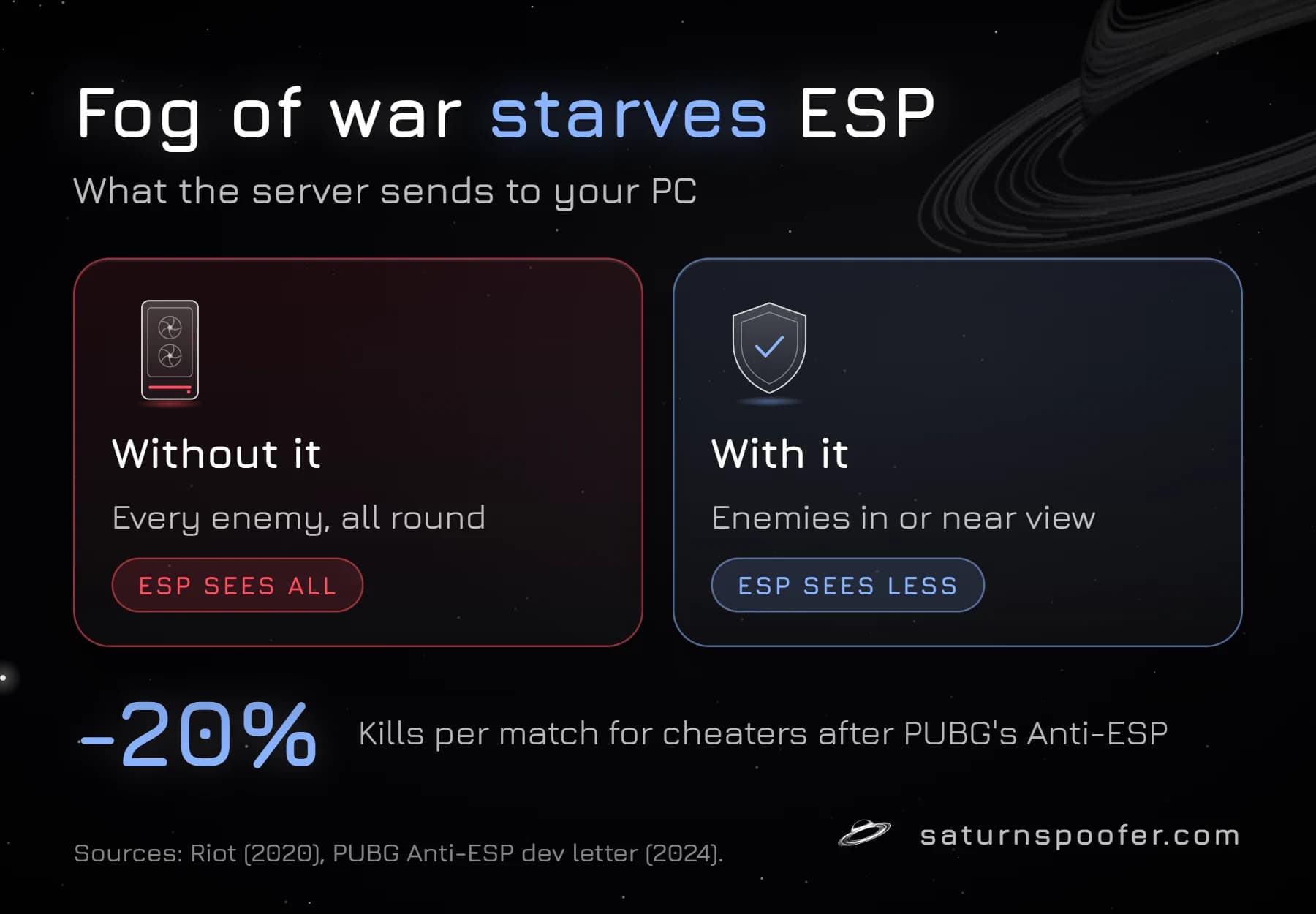
Where it falls short: the look-ahead window. The server has to send an enemy a moment before they're visible, or players would pop in late, so ESP still sees whoever is about to come around the corner. Riot's own word for the result is "drastically" reduced, not gone.
In Valorant, that limit is why Valorant ESP settings for boxes, skeletons and the Spike can only mark what the server has already sent.
Sound is the other gap. A footstep or a gunshot has to play from a position, and Riot's write-up says it had to tie the audio system into Fog of War.
Of the three methods, I think this is the one that matters most for ESP, because it's the only one aimed at the information itself.
Catching the Pattern in Reports and Replays
Reports and video review catch what the first two miss: a player whose decisions only make sense with information they shouldn't have.
PUBG says it rebuilt its process in 2025 so reports could go straight to video review, and about 39,000 of the 7.81 million permanent bans it reported up to November 2025 came from that review.
Where it falls short: it's slow, and it needs a pattern. One suspicious round isn't enough for a reviewer.
Hide the data, block the reader, review the pattern. No single layer does all three.
What Happens When You Get Caught Using ESP?
Getting caught with ESP gets your account banned, and on some publishers' games it can lock the PC as well.
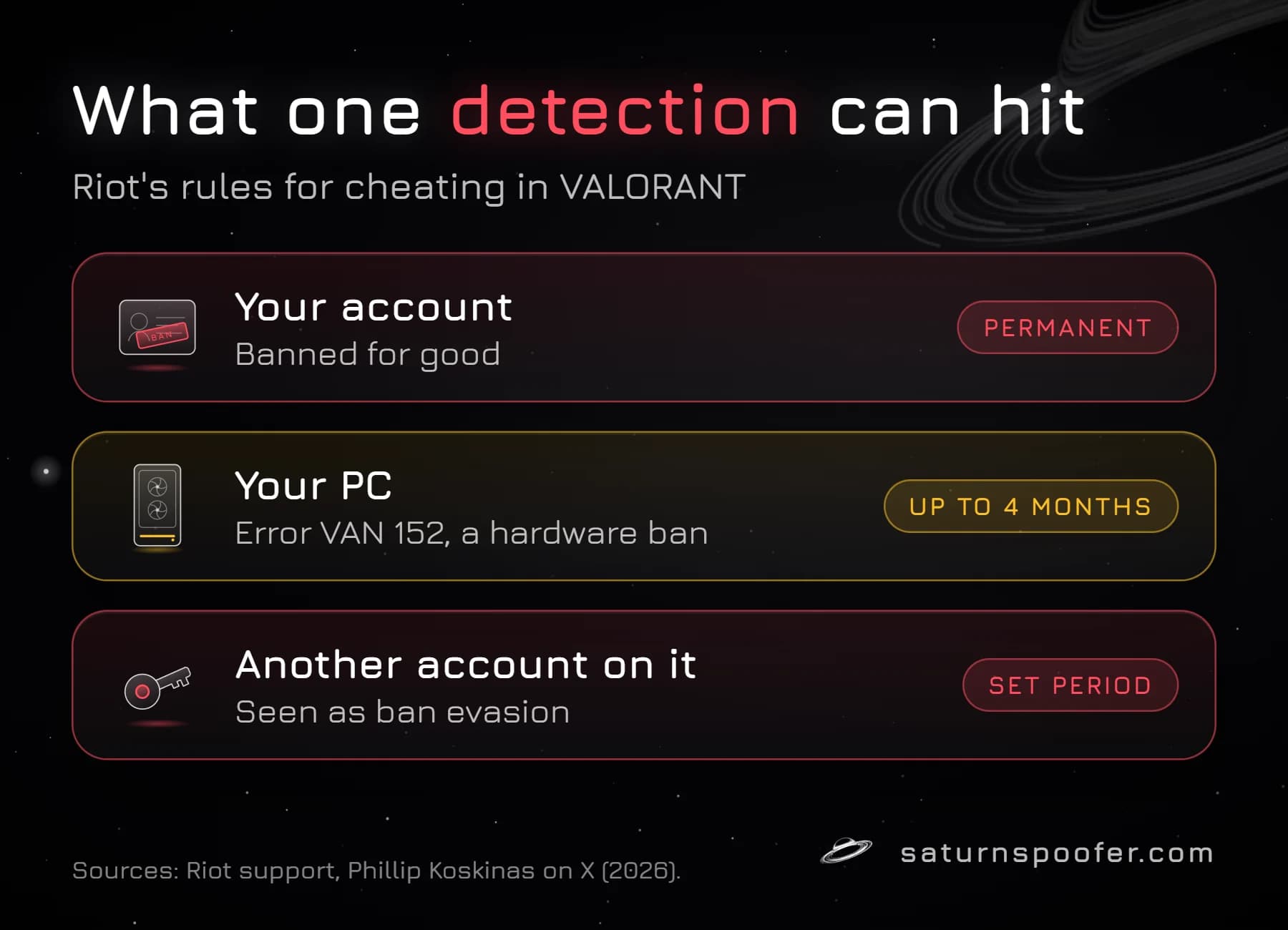
Riot's VALORANT support page on cheating says using aimbots or other unauthorized software for an unfair advantage gets an account permanently banned, and queuing with a cheater gets the other players in that group a 180-day ban.
PUBG reported about 7.81 million accounts permanently banned for using cheat programs as of November 2025.
The second layer is the hardware ban. Riot lists being flagged for third-party tools as one of the reasons for an HWID ban, and a hardware-banned PC shows error VAN 152, which Riot's VALORANT error list describes as a hardware ban that typically lasts four months.
Phillip Koskinas, who works on anti-cheat at Riot, added on X on October 2, 2026 that hardware bans last four months at most and apply only to the game the cheats were detected in.
A second account on that PC won't get around it. Riot says the new account is restricted on the banned device and banned for a set period, because the system reads it as an attempt to circumvent the first ban.
Other publishers handle this their own way, and how an HWID ban works differs by publisher and by game.
The account goes first. The PC can follow.
How to Tell If Someone Is Using ESP
You can't prove ESP from one round, and I wouldn't try. You can spot a pattern across several, and that pattern is what's worth reporting.
These are the signs I'd watch for:
- Their crosshair tracks you through a wall or smoke before you're in view.
- They pre-aim the exact spot you're hiding in, round after round, on angles most players don't check.
- They rotate straight to you with no sound or callout to go on.
- They skip every empty room and clear the one you're in first.
- In a loot game, they walk past everything to one valuable item, again and again.
If your game has a death cam, kill cam or replay, watch where their crosshair was before you came into view. I'd weigh that above everything else on the list, because it shows what they knew rather than how well they aimed.
Then report it in-game. Riot asks for cheating reports during or after the match, and PUBG says player reports feed its video review.
Keep the bar high, though. Good players pre-aim common spots, read sound well and guess right, and Riot's own engineers wrote that this doubt is part of what makes wallhacks so damaging.
Report the pattern, not the play.
Where Saturn Fits (and Where It Doesn't)
Saturn is an HWID spoofer, not a cheat. It changes the hardware IDs your PC reports to an anti-cheat, and it has no part in ESP, aim or anything else that happens inside a match.
It doesn't hide ESP from an anti-cheat or prevent bans, and an account banned for cheating stays banned, whatever runs on the PC afterwards.
If your ban is on the account only, Saturn is the wrong tool. The same goes for a ban you think was a mistake: that's an appeal to the publisher, and I'd start there.
Where Saturn does fit is a hardware ban on the PC, the VAN 152 kind, where every account on that machine is blocked. Saturn changes the hardware IDs the anti-cheat reads from that PC.
We built it as one loader. Your license decides which of the 5 anti-cheats it covers: Riot Vanguard, Easy Anti-Cheat, BattlEye (FiveM sits inside that license), EA Javelin and Anti-Cheat Expert. That's 61 games on Windows, and the anti-cheats Saturn supports each have a page listing theirs.
As of October 12, 2026, Saturn is currently undetected by every anti-cheat it supports, and the live status page is where that's tracked day to day. I'd keep one thing straight, though: that's Saturn's own footprint, not your ESP, and an anti-cheat that catches the cheat still bans the account.
Temporary mode gives you unlimited profiles and puts your original IDs back when you close it, while Permanent mode writes one profile to the PC for good.
Where it falls short: our tool changes hardware IDs and nothing else. It doesn't touch your account record, your IP address or what an anti-cheat sees of a cheat.
Every license comes with a 24-hour free trial that needs no card, only an email address.
ESP FAQ
What does ESP stand for in cheats?
ESP stands for extra-sensory perception. In cheats, it's any tool that shows hidden information on your screen, mostly enemy positions through walls, plus labels for health, weapons, distance and loot.
Are ESP cheats detectable?
Yes, but not easily. ESP only reads game memory, so it changes nothing an anti-cheat can scan for, and Riot calls it almost totally undetectable from server data alone. Publishers rely on kernel anti-cheats, server-side culling and video review of reports.
Is a wallhack the same as ESP?
A wallhack is one kind of ESP: the layer that shows enemies through walls. ESP is the wider category, which also covers health bars, loot labels and radar dots.
What are chams in games?
Chams are a cheat that recolors enemy player models in bright, flat colors so they stand out through walls and against the map. They change the model instead of drawing over it, so menus usually list them next to ESP.
Can you get banned for using ESP?
Yes. Riot permanently bans accounts caught using unauthorized software for an unfair advantage, and PUBG had permanently banned about 7.81 million cheating accounts by November 2025. Riot can also hardware-ban the PC, shown as error VAN 152.
Does fog of war stop ESP completely?
No. Server-side fog of war stops sending the positions of enemies you can't see, but it sends them a moment early to avoid pop-in, so ESP still shows players about to come into view.
Final Thoughts
ESP turns information into an advantage, and it works because your PC holds enemy positions the screen doesn't show. Publishers fight it by blocking the read, withholding the data and reviewing the pattern, and none of the three works alone.
My advice depends on which side of it you're on. If you're facing it, report patterns, not single rounds. If a ban has already reached your PC, find out whether it's on the account or the hardware before you spend anything, because a hardware ban is the only one a spoofer can touch.
Checked by Gabri on October 12, 2026. Sources: Riot's Fog of War write-up (April 14, 2020), Riot's /dev: Vanguard x LoL (April 11, 2024), Riot support pages on third-party apps, cheating in VALORANT, HWID bans and VALORANT error codes, Phillip Koskinas on X (October 2, 2026), PUBG's Anti-ESP dev letter (March 25, 2024) and 2025 anti-cheat review (December 19, 2025), a developer's ESP analysis on GitHub, and Saturn's product facts. Glow ESP: UNVERIFIED against any publisher page; the definition follows common usage.