 Gabri
XIGNCODE3 is a game anti-cheat made by Wellbia, a security company in Seoul, and it ships inside online games on PC, Android and iOS. Wellbia's product page says the PC version protects more than 150 game titles worldwide.
On Steam, Black Desert's store page names XIGNCODE3 outright, and Pearl Abyss moved the game onto it on January 17, 2024.
On November 18, 2026, I read Wellbia's own product, partner and EULA pages, the Steam store entry for Black Desert, notices from Pearl Abyss, gamigo, Move Games and SEGA, and the National Vulnerability Database record for the XIGNCODE3 driver. This page covers what XIGNCODE3 is, which games use it today, what it scans and sends, whether it's safe, how to remove it and who decides a ban.
If Pearl Abyss has restricted your PC in Black Desert, the section on hardware bans further down is the one you want.
If you came to find out what this module does on your computer, read straight through. Saturn isn't your answer to that question.
What Is XIGNCODE3?
XIGNCODE3 is Wellbia's anti-cheat, a module game studios ship inside their own client to spot hacking tools, macros and tampered game files while you play. Wellbia.com Co., Ltd. sells it to publishers, and players never buy or install it on its own.
Wellbia offers XIGNCODE3 in three versions, one per platform:
- PC. The Windows module most players meet, with features such as blocking macro input devices, stopping multiple game clients and protecting resource files from edits.
- Mobile. An Android and iOS SDK that looks for repackaged apps, rooted or jailbroken phones and injected libraries.
- Console. Wellbia lists an Xbox version released in January 2019. Its Switch and PS4 lines still read "expected" for 2020 and 2021, so treat those two as UNVERIFIED.
Wellbia also sells a lighter product called UNCHEATER, which its PC page describes as an independent SDK that loads instantly and runs with minimal administrator privileges.
The company's About page says its software protects more than 100 million users every day. Neither that figure nor the 150 titles carries a date, so I'd read both as Wellbia's own marketing numbers rather than a count anyone has checked.
Which Games Use XIGNCODE3 Today?
XIGNCODE3 runs in Black Desert, Trove and Digimon Masters Online, the three PC games whose publishers I confirmed naming it on November 18, 2026. SEGA uses Wellbia software in the Japanese PC version of PSO2 New Genesis, so it gets a row too:
| Game | Publisher | What the publisher says | Since |
|---|---|---|---|
| Black Desert | Pearl Abyss | Steam lists "XIGNCODE3" as third-party DRM; Pearl Abyss's notice names it | January 17, 2024 |
| Trove (PC, Glyph and Steam) | gamigo | "we launched a new anti-cheat (Xigncode) system" | July 7, 2026 |
| Digimon Masters Online | Move Games | "We are using the security solution (XIGNCODE3)" | Named in a 2026 notice |
| Phantasy Star Online 2 New Genesis (Japanese PC) | SEGA | Wellbia software, which SEGA's Wellbia help page calls UNCHEATER, not XIGNCODE3 | Full switch August 21, 2024 |
Black Desert ran Easy Anti-Cheat, Epic's anti-cheat before the switch. Pearl Abyss's Security Module Change Notice of January 15, 2024 blamed "policy changes of the previous security module provider" for the move.
Trove is the newest arrival, and gamigo said it added Xigncode after item duplication, automation tools, speed manipulation and multi-client play hurt the game's economy.
SEGA's case is the odd one, because its Japanese notices first added Wellbia's program on November 8, 2023, let players switch back to nProtect GameGuard from the launcher, and then removed GameGuard completely with the August 21, 2024 update. SEGA's own Wellbia help page talks about UNCHEATER, Wellbia's lighter product, rather than XIGNCODE3 by name.
That's what I confirmed, not a full count. Wellbia's partner page spans publishers from Korea and Japan to North America, Europe and Southeast Asia, but it lists companies, not games, and trackers and press name more titles. I left out every game whose publisher page I didn't read myself.
How Does XIGNCODE3 Work?
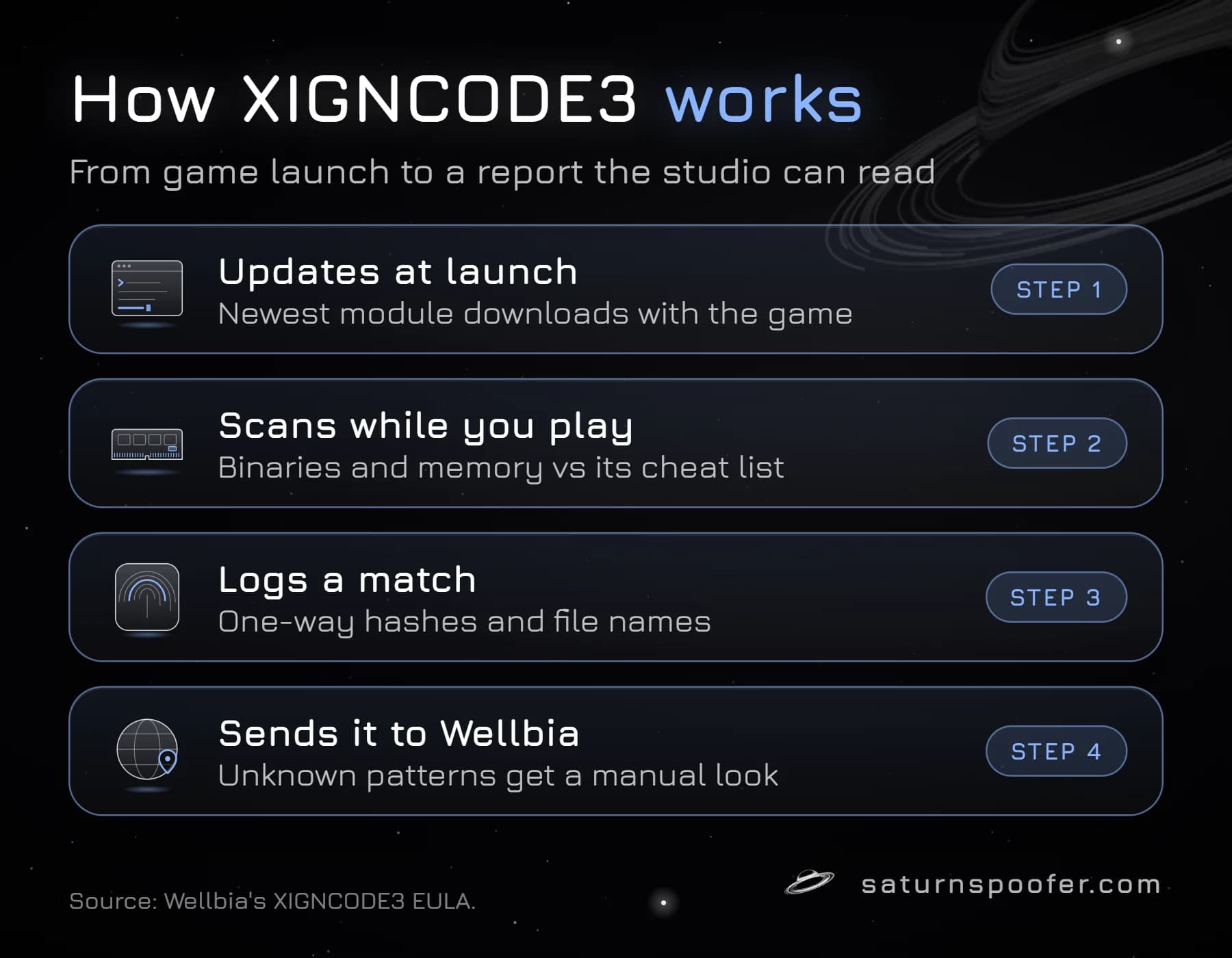
XIGNCODE3 works by loading with the game, checking your PC against Wellbia's list of known hacks, and reporting a match to the studio. Wellbia's EULA lays out the steps in plain language.
- It updates itself. Each time you start a protected game, the game checks for the newest XIGNCODE3 version and downloads it.
- It watches while you play. The module analyzes software binaries and scans system memory for hack or cheat programs that sit in the XIGNCODE3 database.
- It reports matches. When it finds one, it can log limited details, such as one-way hash values and file names, and send them to Wellbia's backend.
- Wellbia sorts the data. An unknown pattern goes to manual analysis. A known cheat pattern can be kept indefinitely as evidence.
The patterns change often, and Wellbia's PC page promises regular pattern updates at least once a month, plus extra blocking patterns whenever they're needed. Move Games described a slower cycle for Digimon Masters in its 2026 notice, where XIGNCODE3 updates every three months, with its own detection rules added in between.
Pearl Abyss described the Black Desert version in its own words in January 2024. It "starts operating from the moment Black Desert is launched", "operates locally and only sends detection data when unauthorized programs are detected", and "shuts down together with Black Desert."
What Does XIGNCODE3 Collect?
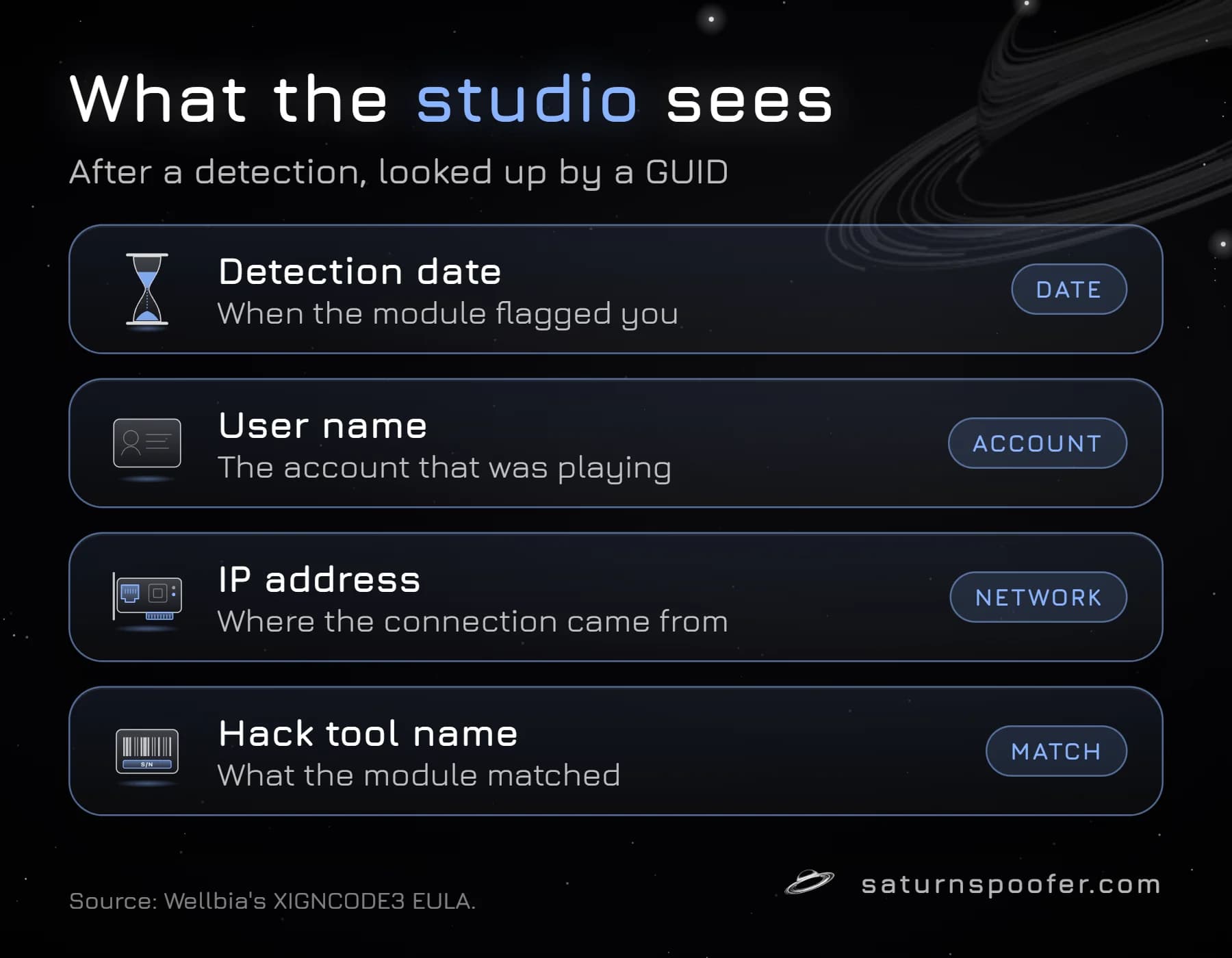
XIGNCODE3 collects details about cheat programs it finds and hands the studio enough to act on them, according to Wellbia's EULA. When a game uses XIGNCODE3, the studio can look a player up by a GUID on Wellbia's web server and see four things: the detection date, the user name, the IP address the player connected from and the name of the hack tool the module matched.
Wellbia puts limits on itself in the same document. The EULA says XIGNCODE3 "never scans files stored on your system or collects personal IDs or passwords", that it never arbitrarily shares, rents or sells personal information, and that data from patterns found to be harmless is generally discarded within six months.
The XIGNCODE3 EULA on Wellbia's site also has a clause most players skip. If you refuse the processing or ask for your data to be deleted, the studio, Wellbia and third parties may block you from the game.
Hardware details show up in one place. Wellbia's FAQ says the xigncode.log file, which you'd only send in when asking for help with an error, holds your username, hardware information, the OS version and the game's file name, launch time and path, and that Wellbia discards it once the error is checked.
That's the deal every XIGNCODE3 game offers you: the scan runs, or the game doesn't.
Is XIGNCODE3 Kernel Level?
Yes. XIGNCODE3 uses a Windows kernel driver, the file xhunter1.sys, which sits at the same level of access as the core of Windows. The National Vulnerability Database's 2026 record calls it "Wellbia's XIGNCODE3 xhunter1.sys kernel driver".
Riot said the same years earlier, in its February 3, 2020 /dev/null post explaining why its own anti-cheat needed a driver, where it named XIGNCODE3 next to EasyAntiCheat and BattlEye as anti-cheats already using a kernel driver, which puts all three on the list of anti-cheats that run inside the Windows kernel.
A kernel driver doesn't have to mean a boot driver, though. Pearl Abyss says Black Desert's XIGNCODE3 starts with the game and closes with it, and its notice states the module "does not correspond to a rootkit".
I found no use of the word "kernel" on any of the nine Wellbia pages I read. The product page talks about "OS-based detection" instead, which is why the NVD record is the clearest source on what the driver is.
Is XIGNCODE3 Safe?
XIGNCODE3 is legitimate software from a real security vendor, not malware, but its kernel driver has a published security flaw. The NVD entry for CVE-2026-3609, published May 11, 2026, describes a privilege escalation bug in xhunter1.sys.
The record sets out four points, in NVD's terms:
- The flaw. The driver's IRP_MJ_WRITE command interface lets any user process request PROCESS_ALL_ACCESS, full control over another process.
- The versions. Driver version 10.0.10011.16384 through 2023.12.7.78.
- The history. Korea's earlier advisory, KVE-2023-5589, covered version 10.0.10011.16384, but the record says the bug "was not fully remediated" and remains in 2023.12.7.78.
- The scores. NVD rates it 7.8, High, and a second assessment in the same record, from CISA, rates it 5.3, Medium.
The record lists no fixed version, and I found no Wellbia notice about it on the day I checked. So I can't tell you which build closes the hole, and the version on your PC depends on the game, since XIGNCODE3 updates itself at launch.
That fits the wider rule for every kernel anti-cheat: code at that level isn't walled off from Windows, so a bug in it is worth more to an attacker than a bug in an ordinary app.
If you play a XIGNCODE3 game, keep the game updated so the module updates with it, and uninstall games you've stopped playing rather than leaving their driver behind.
How Do You Remove XIGNCODE3?
You remove XIGNCODE3 by uninstalling the game that installed it. Wellbia's EULA says XIGNCODE3 modules are "generally removed when the software is uninstalled".
For the cases where that doesn't happen, the company offers a XIGNCODE3 Uninstallation KIT, linked from the same EULA page. I'd use Wellbia's own kit rather than deleting driver files by hand from a forum post.
Removing the module has a cost, because the game will reinstall XIGNCODE3 the next time you launch it, and it won't run without it.
Does XIGNCODE3 Ban Your Hardware?
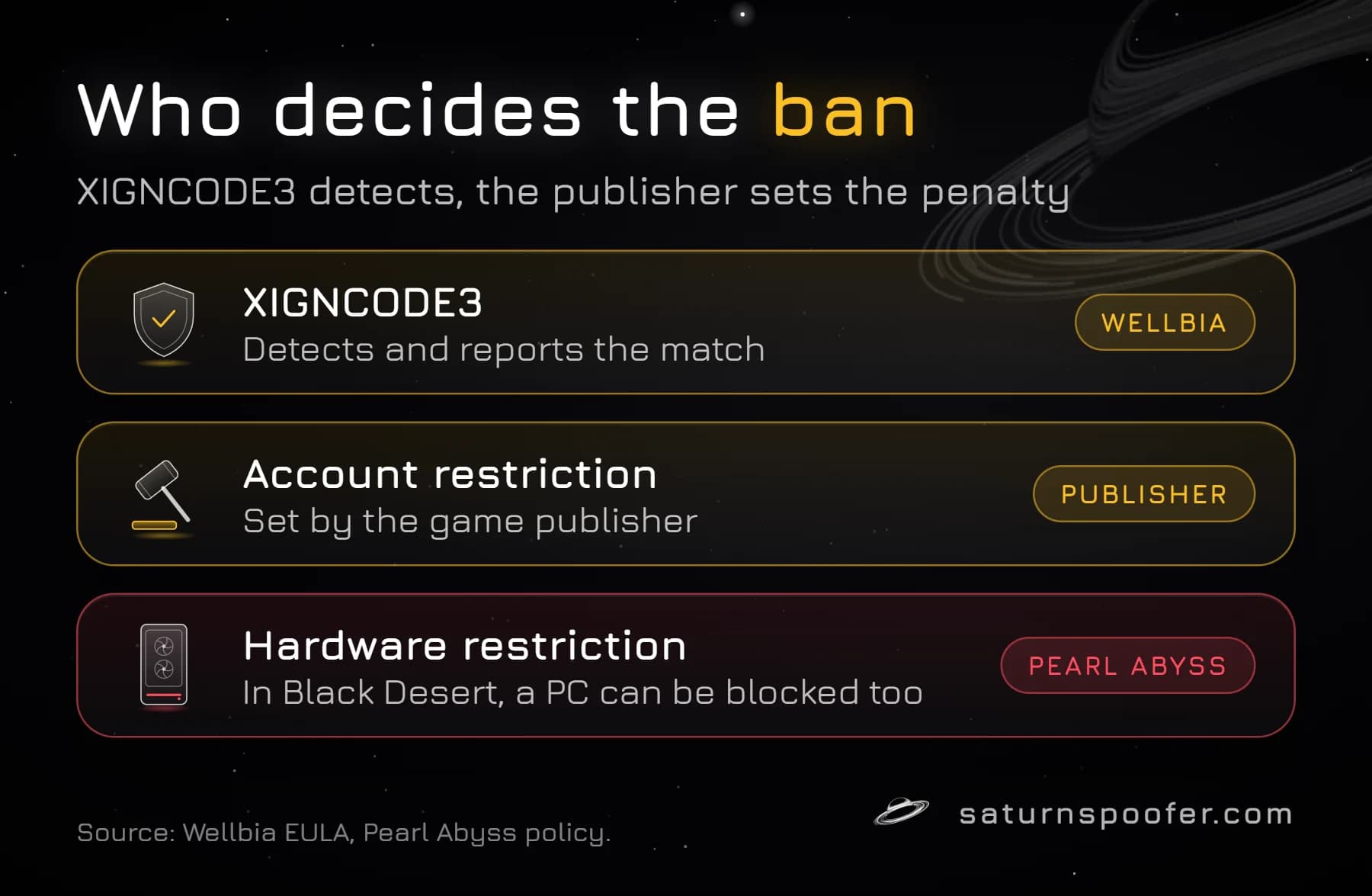
No, XIGNCODE3 doesn't ban anyone by itself; it detects, and the game's publisher decides the penalty. Wellbia's EULA says studios use its data to "impose account restrictions", and its PC page lists ban-list management through what Wellbia calls the XIGNCODE3 Solomon system.
What a ban covers depends on the publisher's own rules. Move Games says accounts its detection flags in Digimon Masters "are reviewed and sanctioned accordingly". Pearl Abyss goes further in the NA/EU Operational Policy it has applied to Black Desert since April 30, 2025, which lists Hardware Restriction among its penalties, and says that when a device keeps using unauthorized programs, "the IP and/or hardware will be restricted."
A Black Desert HWID ban is the case where the PC itself is locked out, not only the Pearl Abyss account.
Saturn is the wrong answer if:
- Only the account is banned. A new set of hardware IDs does nothing for a restricted account.
- The restriction is temporary. Waiting it out costs you nothing.
- The detection looks wrong to you. Black Desert gives you 15 days to appeal through Pearl Abyss Support, and that comes first.
- Your game isn't Black Desert. Saturn doesn't cover Trove, Digimon Masters Online or PSO2 New Genesis.
Saturn fits one case: Pearl Abyss has restricted the hardware of a PC that plays Black Desert.
Saturn has no XIGNCODE3 product, but where it does fit, Saturn covers Black Desert through its BattlEye license, and our Black Desert HWID spoofer runs from the same single loader as every other Saturn license, with your license deciding which games it covers. It changes the IDs a restriction can be tied to, from the CPU, motherboard and TPM to disk serials, the MAC address and the monitor's EDID, which clears that hardware ban from the PC.
Where it falls short: it doesn't touch the account. A restricted Pearl Abyss account stays restricted, so you play on a different one. Saturn is an HWID spoofer, not cheat software, so it hides nothing from XIGNCODE3 either.
Temporary mode gives you unlimited profiles, and your original IDs come back when you close it. Permanent mode writes one profile for good. Saturn runs with Secure Boot, TPM 2.0 and memory integrity switched on.
Every license comes with a 24-hour free trial, no card needed, only an email address for the key.
XIGNCODE3 FAQ
Is XIGNCODE3 a virus?
No. XIGNCODE3 is a commercial anti-cheat from Wellbia that games install on purpose, and it comes with its own EULA. It runs a kernel driver, which is why antivirus tools and players sometimes treat it with suspicion.
Who makes XIGNCODE3?
Wellbia.com Co., Ltd., a game security company based in Seoul, South Korea. Wellbia sells XIGNCODE3 for PC, mobile and console, plus a lighter product called UNCHEATER.
Does XIGNCODE3 run all the time?
Not in Black Desert. Pearl Abyss says the module starts when the game launches and shuts down together with it, and Wellbia describes the monitoring as something that happens while you use the protected software.
Can XIGNCODE3 see my files?
Wellbia says in writing that XIGNCODE3 never scans files stored on your system and never collects personal IDs or passwords. It does scan system memory and check running programs against its cheat database, and nobody outside Wellbia can read its code, so you're taking Wellbia's word for it.
Why does XIGNCODE3 flag programs that aren't cheats?
Its pattern database can match tools that only look like cheats, and Wellbia's update process includes a step for receiving and resolving false positive reports. If your game blocks a program you trust, send the details to the game's support team, since Wellbia takes reports about affected players from the studio through its monitoring system.
Is XIGNCODE3 the same as nProtect GameGuard?
No. nProtect GameGuard is a separate anti-cheat from a different company, not a version of Wellbia's product. SEGA replaced GameGuard with Wellbia's software in the Japanese PC version of PSO2 New Genesis, completing the switch on August 21, 2024.
Final Thoughts
XIGNCODE3 is Wellbia's kernel-level anti-cheat, it protects Black Desert, Trove and Digimon Masters Online on PC today, and the hard facts about it come from three places: Wellbia's EULA, the publishers' notices and a 2026 vulnerability record that still lists no fixed driver version.
My advice: keep XIGNCODE3 only for as long as you play the game that brought it, keep that game updated, and uninstall both when you're done.
Checked by Gabri on November 18, 2026. Sources: Wellbia's PC, mobile, console, About, partner and EULA pages; the Steam store page for Black Desert (app 582660); Pearl Abyss's Security Module Change Notice (January 15, 2024) and Operational Policy for NA/EU (effective April 30, 2025); gamigo's Trove notice (July 7, 2026); Move Games' Digimon Masters notice (2026); SEGA's PSO2 New Genesis notices (October 26, 2023, November 8, 2023, August 7, 2024) and its Wellbia help page; the NVD record for CVE-2026-3609; Riot's /dev/null post on its anti-cheat kernel driver (February 3, 2020, re-read November 18, 2026); Pearl Abyss's EAC-era notices for Black Desert (read October 9, 2026). I didn't install or run any software on a PC for this page. UNVERIFIED: Wellbia's 150-title and 100-million-user figures, its console release dates after 2019, the driver build that fixes CVE-2026-3609.