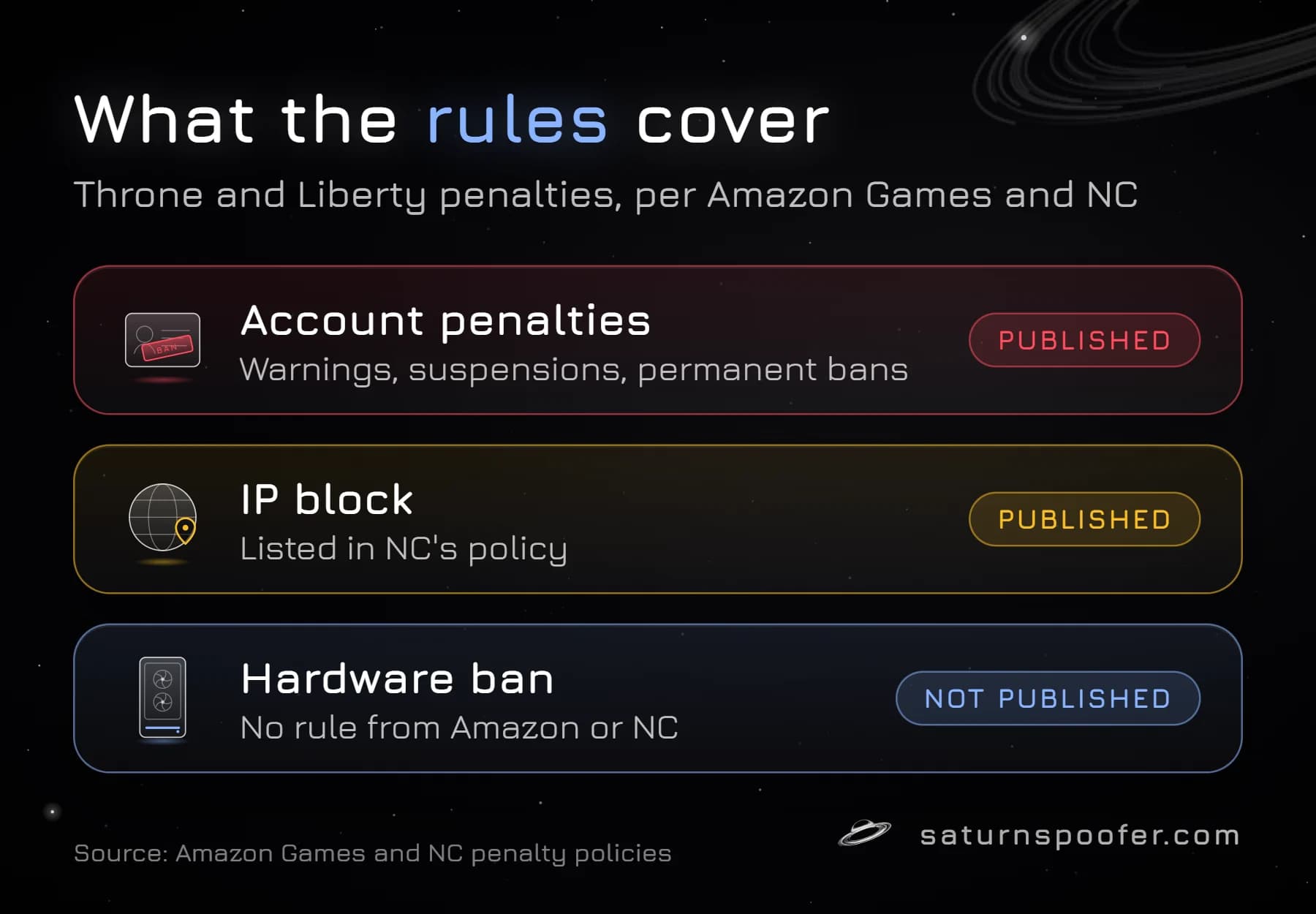
Throne and Liberty's published rules describe account penalties, not hardware bans. Amazon Games, which runs the game in the West until NC takes it over after maintenance that starts on November 10, 2026, lists three kinds of penalty: warnings, temporary suspensions of 24 to 168 hours, and permanent bans. Neither company has published a rule that blocks a PC.
That still leaves a real question for anyone who has been banned. Easy Anti-Cheat, the anti-cheat the game runs on PC, keeps hardware identifiers so that banned players cannot quietly return, and Amazon's Code of Conduct punishes any attempt to get around a penalty.
Does Throne and Liberty HWID Ban Players?
No published Throne and Liberty rule bans hardware. Amazon Games' support site for the game has 47 articles, and the three that cover penalties and appeals talk only about accounts. NC's operation policy for the game, dated July 24, 2024, lists six restriction types, and the only one that reaches past the account is an IP block.
Compare that with games that do publish hardware bans, such as Valorant with its VAN 152 error or Arena Breakout: Infinite with its ten-year device bans. Throne and Liberty has nothing equivalent in writing. Vendor blogs and some AI answers say otherwise, but none of them cites a Throne and Liberty source.
What the game does have is Easy Anti-Cheat, and Easy Anti-Cheat is explicit about one thing: its player FAQ lists hardware identifiers among the data it gathers, with the stated aim "to prevent ban evasion." So a banned player's PC can be recognized when that player comes back, even though no Throne and Liberty rule calls the result a hardware ban.
Which Penalties Does Throne and Liberty Use?
Throne and Liberty uses three penalty types under Amazon Games and six restriction types under NC's policy. Amazon's penalty types article defines them like this:
- A warning shows a notice of the infraction when you sign in, with no suspension.
- A temporary suspension "ranges from 24-168 hours, but can be longer depending on the severity of the infraction and past behavior."
- A permanent ban removes access to the game after severe or repeated violations, and Amazon can issue one without a warning or suspension first.
NC's list is longer, and two entries matter here: a permanent ban on the integrated account, which covers every NC game, and the IP block. Amazon has a cross-title penalty too: its appeal article mentions penalties that stop you playing all Amazon Games titles, and those are appealed through the game where they were issued.
| Penalty | Amazon Games | NC policy |
|---|---|---|
| Warning | Yes | Yes |
| Temporary suspension | 24 to 168 hours | Yes |
| Permanent game ban | Yes | Yes |
| Ban across all titles | Amazon Games titles | NC games |
| Item adjustment | Lucent removal | Yes |
| IP block | No | Yes |
| Hardware ban | No | No |
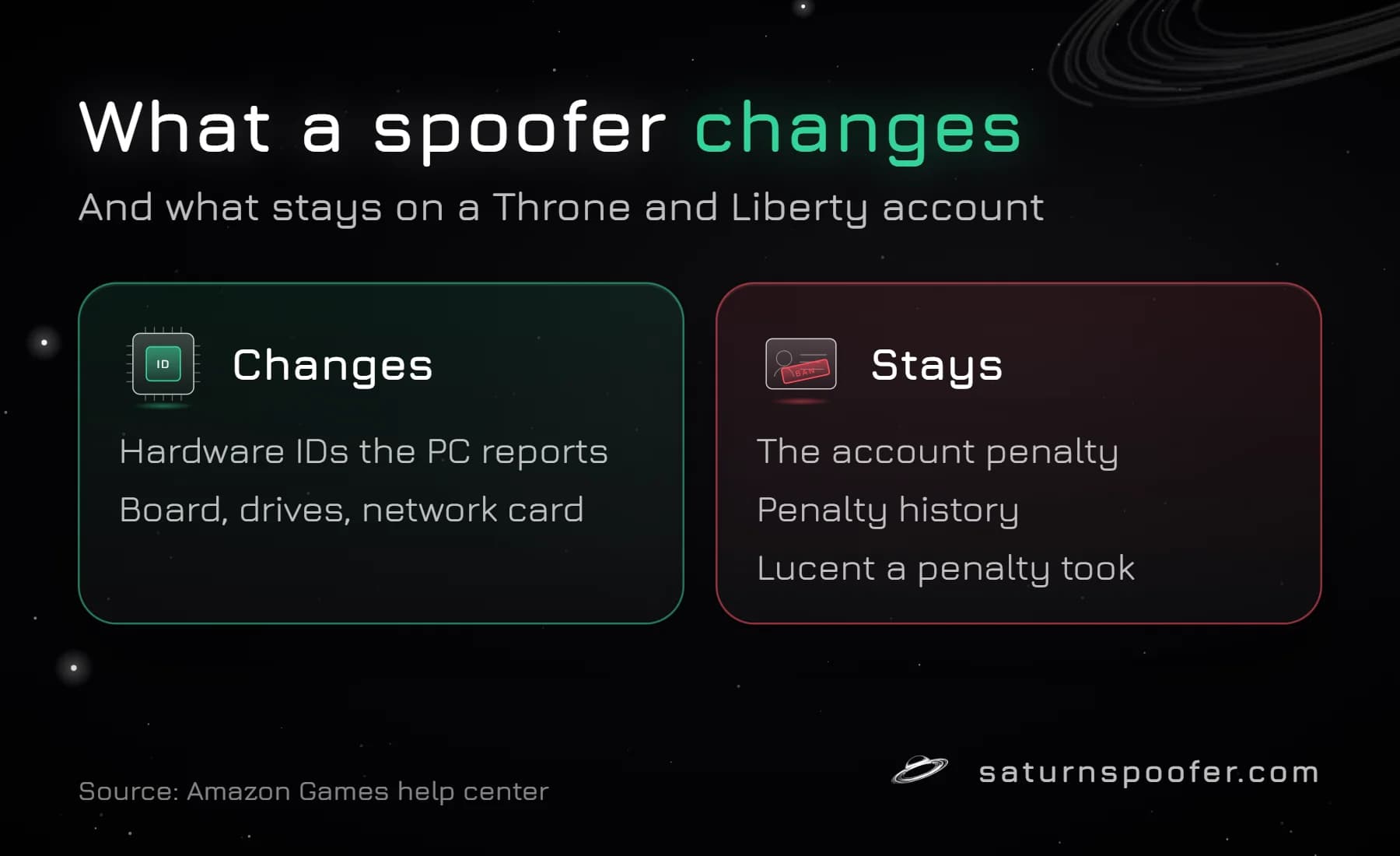
Amazon also notes that some penalties remove Lucent, and that Lucent is not given back when the penalty ends.
What Gets a Throne and Liberty Account Banned?
A Throne and Liberty account gets banned for the behavior in Amazon's Penalty Categories article, and Cheating is the category that covers bots and cheat programs. Section 3 of the Amazon Games Code of Conduct, "play fair," covers these Cheating violations:
- Botting, meaning a program that plays the game on your behalf
- Exploiting a bug, such as duplicating items
- Buying or selling through real-money trade
- Tampering with game files
- Account sharing
- A known cheat program detected
Bots were the first big target. On October 16, 2024, two weeks after the Steam launch, the team behind the game announced it had "enacted a set of bans against accounts suspected of operating bots," as PCGamesN reported at the time. The other categories are Commerce Issues (fraud, chargebacks, a missing game key), Disruptive Behavior, Abusive Language and Naming Policy Violation. Naming Policy Violation is a category of its own, so an offensive player or guild name alone can draw a penalty.
The account holder carries the penalty either way. Amazon's appeal article says penalties apply "no matter who was playing at the time," and NC's policy says a shared or carelessly lost account can be restricted along with the person who misused it.
Where Easy Anti-Cheat Fits in Throne and Liberty
Throne and Liberty's Steam store page names Epic Games' Easy Anti-Cheat service and marks it as running at kernel level. Easy Anti-Cheat detects, and the publisher decides: according to the EAC player FAQ, an account that EAC flags for cheating can then be suspended or banned by the game's publisher.
That split explains most of the confusion in the forums. A "known cheat program detected" penalty is an Amazon decision based on an Easy Anti-Cheat detection, and it lands on the account. Easy Anti-Cheat is one of several anti-cheats that load as kernel drivers, and it reads the PC itself, which is how it gathers the hardware identifiers its FAQ mentions.
Epic does not say which identifiers those are for Throne and Liberty, and each Easy Anti-Cheat game sets its own rules. Fortnite is the example on the other side: there, Epic's own warning about Fortnite hardware bans puts machine-level action in writing, while Throne and Liberty's publishers have not.
How to Appeal a Throne and Liberty Ban
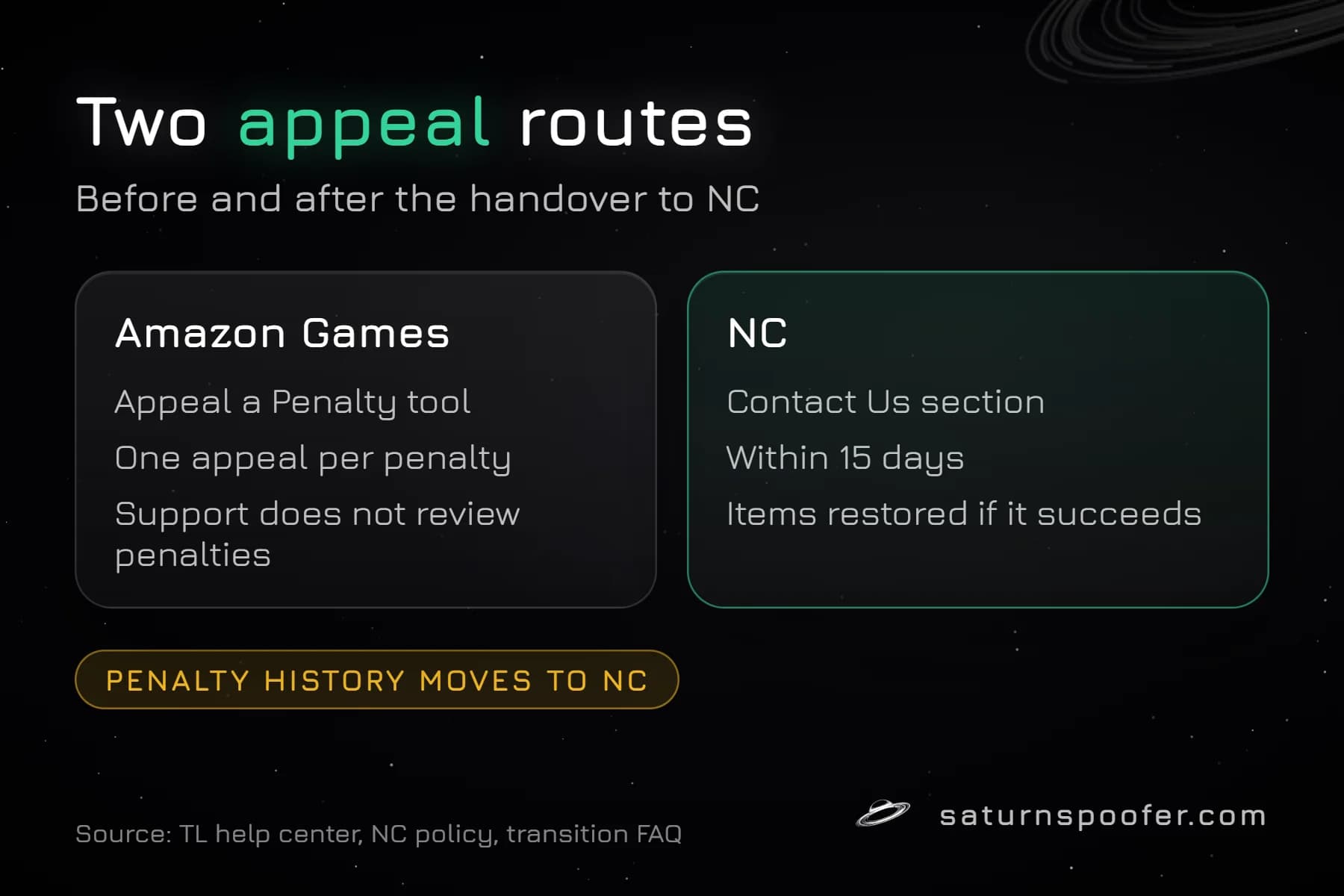
Under Amazon Games, you appeal a Throne and Liberty penalty through the Appeal a Penalty tool, once per penalty. The help center says there are "no other channels for appealing your penalty," and its Contacting Support article adds that Customer Support "does not assist with account penalties."
- Read the Code of Conduct and the Penalty Categories article, so the appeal speaks to the category on your notice.
- Sign in to the Appeal a Penalty tool with your platform account and open the penalty.
- Write one complete appeal, and include links to any video or screenshots you have.
- Watch the status: Pending, In Review, then Approved, Denied, Expired or Closed.
Amazon is blunt about what fails. Excuses such as "My little brother did it" or "I didn't know that was against the rules" are listed as reasons that will not overturn a penalty. A short suspension may also run out before anyone reviews it, and the appeal then shows as Expired.
NC's process will apply once its service is live. NC's operation policy for Throne and Liberty routes appeals through the Contact Us section and says an appeal "must be filed within 15 days from the start of Restriction." If an appeal succeeds, NC removes the restriction and restores adjusted items.
What Changes When NC Takes Over?
When NC takes over Throne and Liberty in the West, your penalties come with you. The official transition FAQ answers the question directly: "Account enforcement history (bans, suspensions, penalties) transfers to NC." The game's publisher, customer support provider, support channels and policies and its Terms all change, and every player accepts NC's Terms and Policies at first login.
Two details matter for anyone with an open case. Support tickets filed with Amazon Games are not transferred to NC's customer center, so an appeal still pending with Amazon at the switch may need to be raised again with NC. And players who opt out of the data transfer, which had to be done before October 30, start fresh under NC with nothing carried over.
Where an HWID Spoofer Fits in Throne and Liberty
An HWID spoofer gives the PC different hardware identifiers to report, and nothing else. It does not remove a Throne and Liberty penalty, because every published penalty sits on the account. A suspended or banned account stays suspended or banned, on Amazon's systems now and on NC's after the transition.
That limits what a spoofer means for this game. Throne and Liberty's publishers list no hardware ban, so there is no published PC block for a spoofer to lift, and how a spoofer swaps the identifiers a PC reports works no differently here than in any other Easy Anti-Cheat game.
Saturn, which spoofs hardware IDs on Windows PCs, sells its EAC HWID spoofer for Throne and Liberty on the same license as the rest of its Easy Anti-Cheat list. It swaps the IDs on the motherboard, the CPU and its TPM, memory, every storage drive, the graphics card, the display, the network card and USB devices, and it comes in the temporary and permanent spoofing modes. Saturn's 24-hour trial on Throne and Liberty starts from an email address; it does not ask for a card.
Know the rule before you use one. Amazon's Code of Conduct says "Do not try to evade any disciplinary action by, for example, creating new accounts," and that "any attempt to circumvent a penalty will also result in additional enforcement against your account, up to a permanent ban." A spoofer is not a cheat, and it does not change that rule.
Throne and Liberty HWID Ban FAQ
Can I make a new account after a Throne and Liberty ban?
Amazon's Code of Conduct names creating new accounts as an example of evading disciplinary action, and says an attempt to circumvent a penalty brings further enforcement, up to a permanent ban.
How long is a Throne and Liberty suspension?
Amazon Games says a temporary suspension usually lasts 24 to 168 hours, and can run longer for severe infractions or a poor history. Permanent bans have no end date.
Is an Easy Anti-Cheat detection a hardware ban?
No. It shows as a Cheating penalty, "known cheat program detected," on the account. Easy Anti-Cheat reports the detection and Amazon Games decides the penalty.
Do I get my Lucent back when a penalty ends?
Not always. Amazon's appeal article says certain penalties remove Lucent, and that it is not granted back when the penalty expires.
Will my ban follow me to NC's service?
Yes. The transition FAQ says bans, suspensions and penalties transfer to NC with the rest of the account data.
Can a spoofer restore my banned Throne and Liberty account?
No. Spoofers work on hardware identifiers, and account records are a separate system, so a banned account stays banned under Amazon Games and NC.