Rainbow Six Siege can ban hardware, not just accounts, but Ubisoft has never said when it does. Siege's developers wrote in an August 4, 2021 AMA that hardware bans are a sanction they use, while Ubisoft's rulebook for Siege, refreshed on July 31, 2026, names four levels of punishment and never mentions a PC ban. Most R6 bans players run into are account sanctions: a temporary ban, a permanent ban, a lock on the Ubisoft account, or a one-year MouseTrap ban on console.
That gap between "Ubisoft uses them" and "Ubisoft explains them" is where most of the R6 hardware ban advice online comes from, and much of it is guesswork. The sections that follow stick to what Ubisoft has put in writing, and say so plainly where it hasn't.
Does Rainbow Six Siege HWID Ban?
Yes, Rainbow Six Siege has hardware bans. Asked in the Y6S2 dev team AMA when the developers would look into hardware-based bans, Ubisoft answered that "hardware bans are indeed a sanction used by us and across the industry," and added that they are "not a silver bullet." A Ubisoft support agent went further in a 2020 thread about DDoS attacks, writing that Ubisoft can ban players' IP addresses and computers as well as their accounts.
What Ubisoft hasn't published matters just as much:
- Which offenses lead Ubisoft to block a PC instead of only the account.
- Which identifiers it records, such as drive serials, motherboard data or network addresses.
- How long a hardware ban runs, and whether it has its own appeal route.
So the honest answer to "does R6 HWID ban" is yes, it can, with no public rulebook for it. The sanctions Ubisoft does document in detail are covered below, and they're the ones nearly every banned player is dealing with. If you want to compare, hardware bans in other online shooters range from openly documented to just as vague.
How Rainbow Six Siege Bans Work
Rainbow Six Siege punishes players in steps that Ubisoft's Core Rules spell out. Depending on how severe, how frequent and how deliberate a violation is, a player can get temporary limits on game features, a short-term ban from online matches, an online ban with no end date, or losing access to Siege for good. Ubisoft says these can stack, and for the worst cases the rules mention a permanent ban on all of a player's accounts.
| Sanction | How long | Where Ubisoft says it |
|---|---|---|
| Feature limits (mute, RFF) | Match or set time | Core Rules, help |
| Temporary ban | Set period | Help center |
| MouseTrap ban | One year | Help center |
| Permanent ban | No end | Core Rules |
| Account lock | Temporary or permanent | Help center |
| Hardware ban | Not published | 2021 AMA |
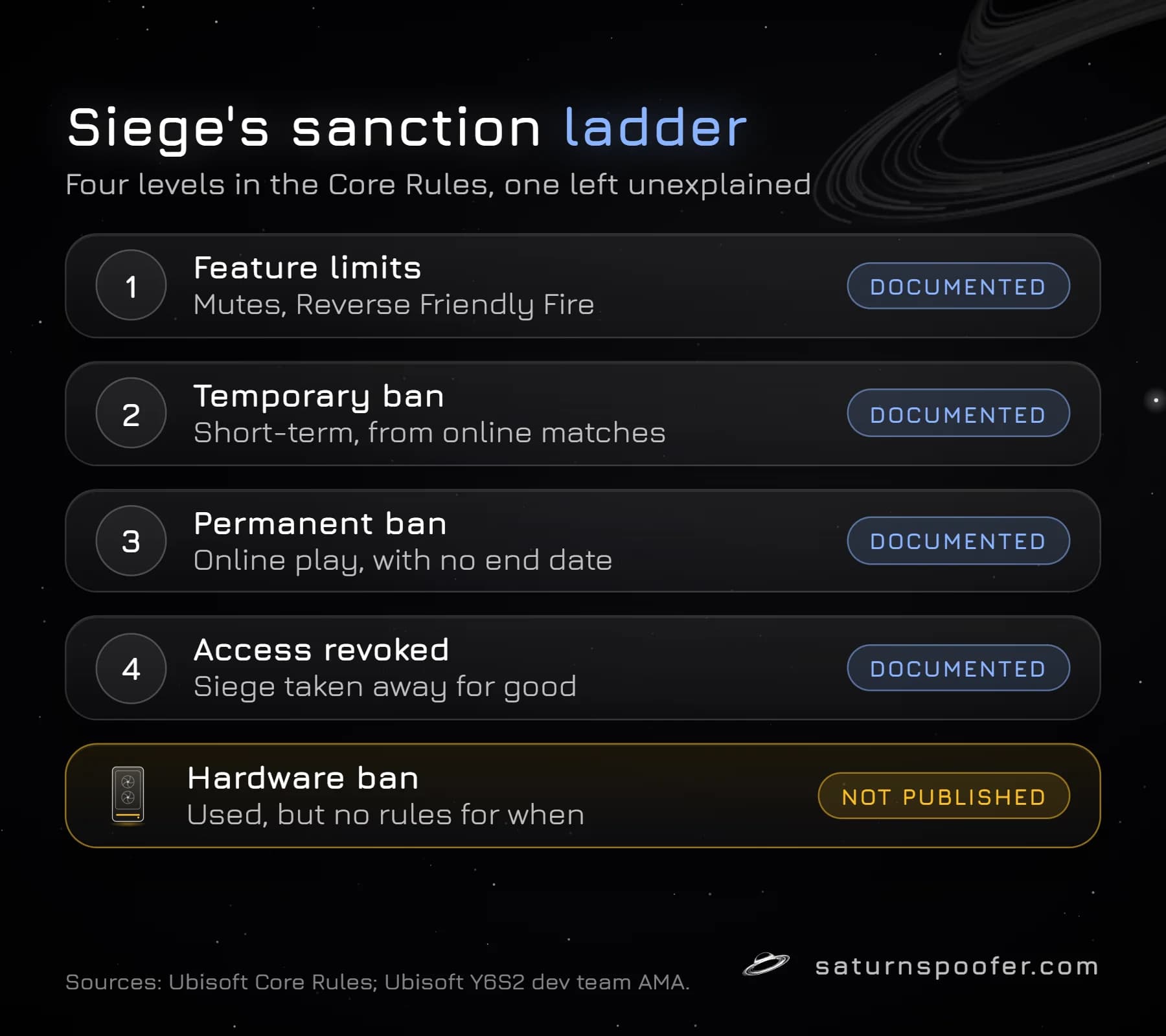
Quitting a Ranked match, for example, costs a timed ban along with Renown or Rank, while deliberately killing teammates turns their damage back on you (Reverse Friendly Fire) until the match ends. A lock is different from a ban: Ubisoft says a temporary ban leaves your other Ubisoft games and websites working, while a lock blocks every online service tied to the account, login pages included.
What Gets You Banned in Siege
Rainbow Six Siege's Core Rules group banned behavior into a handful of categories. The ones most likely to end in a permanent sanction:
- Cheating: any program or device built for an unfair edge, even one that sits unused, plus input adapters, macro devices and in-game exploits.
- Circumvention: attempts to get past or switch off Ubisoft's detection, and playing on a second account while the first is banned.
- Competitive abuse: smurfing, boosting, playing in a squad with cheaters, and Elo trapping, which means queuing against chosen accounts to wreck their rank.
- Account abuse: sharing, selling or buying accounts, and giving false account information.
- Disruption: harassment, hate speech, griefing, throwing matches and bots that farm XP.
Ubisoft also says the list isn't complete. Behavior that breaks the spirit of fair play can draw a sanction even if no rule names it, and actions outside the game that affect matches or enforcement count too.
How a cheating ban gets decided matters if you think yours is wrong. Ubisoft's developers told players on August 7, 2026 that a manual ban follows a staff check of evidence plus server-side data, and that a clip shared online is never enough on its own. Its new recoil-macro detection, rolling out on PC first, is built to ban an account only after several confirmed detections.
How to Tell Which R6 Ban You Have
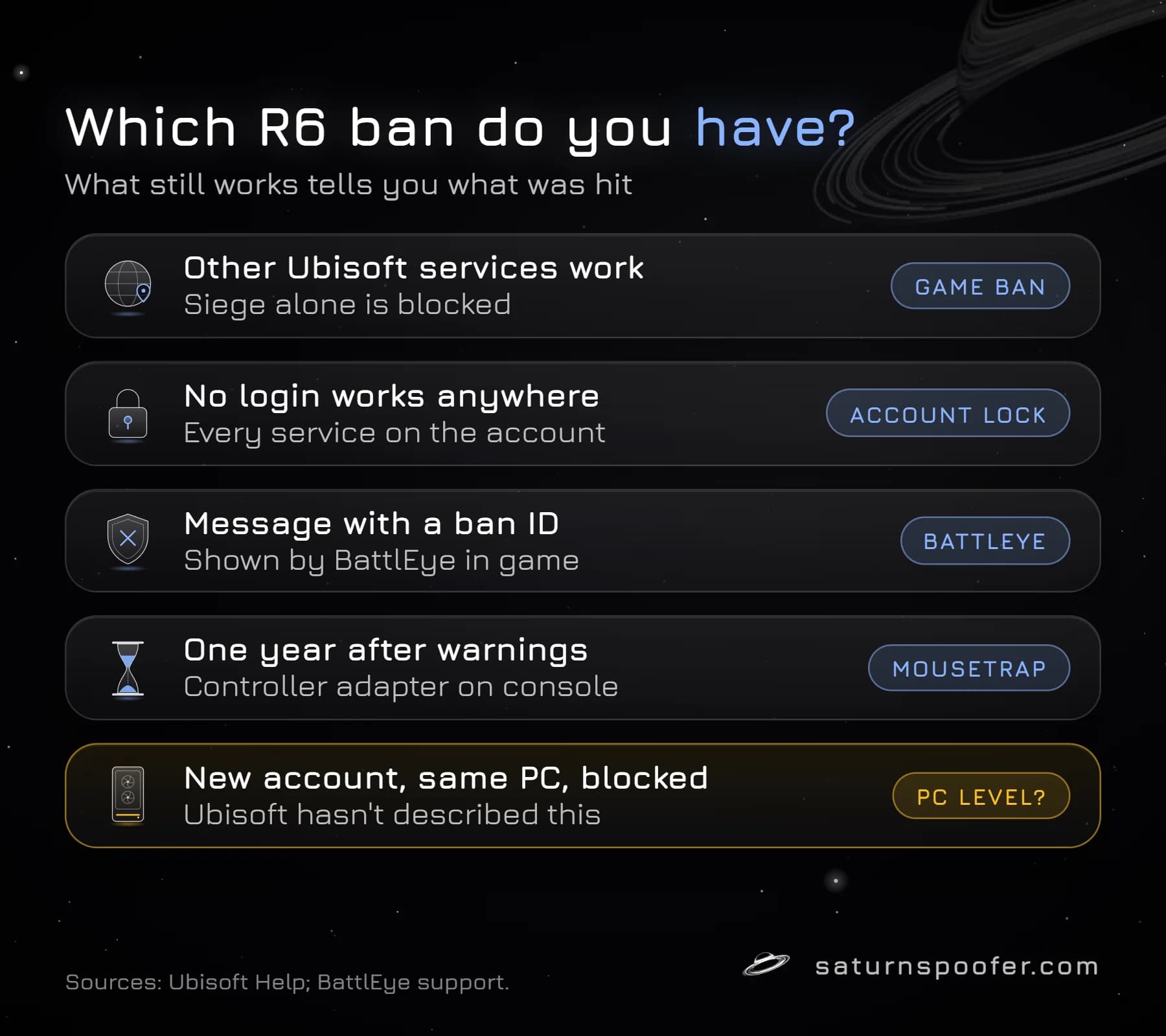
Rainbow Six Siege doesn't put "hardware ban" on any message we could find, so the clues come from what stops working and what Ubisoft sent you. Check these in order:
- Your email and the in-game message. Whatever notice you got names the penalty type.
- Other Ubisoft services. If they still work, it's a game ban; if you can't log in anywhere, it's an account lock.
- The Reputation tile on your profile, where voice chat penalties show up.
- A BattlEye message with a global ban ID, which points to a BattlEye ban rather than one issued by Ubisoft staff.
- The timing. A one-year block after warnings about a controller adapter on console is MouseTrap.
A machine-level block, if you have one, would show as a ban that follows the PC: a clean new account on the same computer is blocked too, while your own account works elsewhere. That's an inference from how hardware bans work, not something Ubisoft describes, and making extra accounts to test it can itself break the ban-evasion rule. If you believe any of these penalties is wrong, you can appeal a Rainbow Six Siege ban with Ubisoft Support instead.
BattlEye, MouseTrap and Siege's Anti-Cheat Now
Rainbow Six Siege used the BattlEye kernel anti-cheat Siege adopted in 2016 for most of its life, and BattlEye keeps its own records of global bans. According to BattlEye, a global ban on a cheater never expires, appeals are taken only through its contact form, each one must quote the ban ID the game displays along with the game title, and the evidence stays private.
The current setup is harder to pin down. On October 9, 2026, Siege's Steam page carried no anti-cheat notice at all. Ubisoft said on August 7, 2026 that its own kernel-level anti-cheat, built by Ubisoft Security and shared across its games, would come to Siege in Season 3, which began on September 1, 2026. No Ubisoft announcement we could find says the new system went live or that BattlEye was retired.
Console enforcement runs separately. MouseTrap detects mouse-and-keyboard adapters that pose as controllers, and from Year 11 players caught with one after in-game warnings get a one-year ban that Ubisoft says it cannot lift. Ubisoft also introduced R6 Shieldguard, a PC check built on Secure Boot, starting in its most competitive playlist.
R6 Hardware Ban Myths
Several claims about Rainbow Six Siege hardware bans circulate without a Ubisoft source behind them:
- "Siege tracks your SMBIOS UUID and BIOS serial." Some 2026 articles say so, but Ubisoft has not named any identifier. Anti-cheats in general can read the SMBIOS system UUID stored in a motherboard's firmware, which is why the claim sounds plausible.
- "It takes 3 to 10 account bans before an HWID ban." This number comes from cheat forums, not Ubisoft.
- "A dishonorable ban is a hardware ban." Dishonorable is the lowest standing in Siege's Reputation System, which Ubisoft describes as showing clear negative behavior trends. It is a standing, not a block on your PC.
- "Siege only bans IPs." Ubisoft's staff have said IP bans are possible, but the documented sanctions are account-based.
Used hardware is the other worry. Reports of secondhand CPUs carrying bans come from other games; we found no Siege case and no Ubisoft statement either way.
HWID Spoofers and Siege's Core Rules
Rainbow Six Siege's rules leave no room for workarounds. The Core Rules count spoofing as cheating, which Ubisoft defines as making a device pass for a legitimate input device or slip past restrictions. Getting around or tampering with enforcement counts as circumvention, and switching to another account during a ban counts as ban bypass. And in that 2021 AMA, the reason Ubisoft gave for hardware bans not being a silver bullet was spoofers: advanced ones, it wrote, can disrupt the detection.
An HWID spoofer swaps out the serial numbers and IDs a PC hands to games, and Saturn's HWID spoofer that covers Rainbow Six Siege does that on Windows for drive and motherboard serials, network addresses and other IDs. In Siege, though, Ubisoft's rules treat using any such tool to dodge a ban or interfere with enforcement as a violation of its own, with sanctions that can reach every account you own. No spoofer restores an R6 account Ubisoft has banned; Ubisoft's only route back is an appeal. Saturn's trial is a full day long, 24 hours, and it opens with just an email, no card.
Rainbow Six Siege Ban FAQ
How long is a Rainbow Six Siege ban?
It depends on the sanction. Temporary bans and locks end after a set period, MouseTrap bans run for a year, and permanent sanctions never lift on their own. Ubisoft hasn't published a length for hardware bans.
Does Rainbow Six Siege IP ban?
Ubisoft has said it can. A Ubisoft support reply in a 2020 thread about DDoS attacks said it can ban IP addresses and computers as well as accounts. Its current rules don't list IP bans as a standard sanction.
Can I play on console if my PC is banned?
Ubisoft hasn't published a rule on this. Sanctions sit on the Ubisoft account, and Siege's progress is shared across platforms, so a permanent account ban is likely to follow you everywhere.
Is BattlEye still the anti-cheat in Siege?
Ubisoft hasn't confirmed either way. It announced its own kernel-level anti-cheat for Season 3, and the Steam listing for Siege had no anti-cheat line when we looked on October 9, 2026.
What is a dishonorable ban in Siege?
It isn't a ban. Dishonorable is the lowest standing in the Reputation System, meant for players with clear negative behavior trends. Ubisoft has adjusted what each standing does over time.
Can a Siege hardware ban be appealed?
Ubisoft hasn't described a separate route. Appeal the penalty on your Ubisoft account through Ubisoft Support, and appeal a BattlEye global ban through BattlEye's contact form with its ban ID.