Escape from Tarkov has no published hardware ban policy. Battlestate Games, the studio behind the game, documents four kinds of account block in its support article If an account was blocked, and every one of them sits on the Battlestate account, not on the PC. BattlEye, the anti-cheat Tarkov runs, describes its own global bans as SteamID or account-based. That is the documented picture as of October 2026, even though players keep reporting bans that seem to follow a machine.
Bans in Tarkov are common, which is why the question keeps coming up. Battlestate said in an April 6, 2026 developer diary that it banned more than 25,000 players between January and March 2026, and that bans go out daily rather than in occasional waves. The gap between what players report and what the two companies publish is most of the story, and it changes what an appeal or a spoofer can do for you.
Does Tarkov Hardware Ban?
Escape from Tarkov does not document hardware bans. Battlestate's License Agreement, dated June 15, 2026, and its Rules of the Game, dated February 27, 2024, describe suspending, closing and blocking accounts. Neither document names hardware IDs or describes banning a computer, and the License Agreement's only use of the word "hardware" sits in a force majeure clause.
BattlEye says the same thing from its side. Its About page describes the global ban system as based on a SteamID or an account, and its support page asks for a game account identifier or SteamID when someone appeals one. Neither company says a Tarkov ban targets the hardware itself.
What is not published can still happen. Players report new accounts getting banned on a PC that already carries a ban, and on games that do use them, hardware bans tied to a PC's serials block every account on that machine. For Tarkov, those reports are anecdotes, not policy, and the documented answer to "does Tarkov HWID ban?" is that Battlestate has never confirmed it.
The Four Ways Battlestate Blocks a Tarkov Account
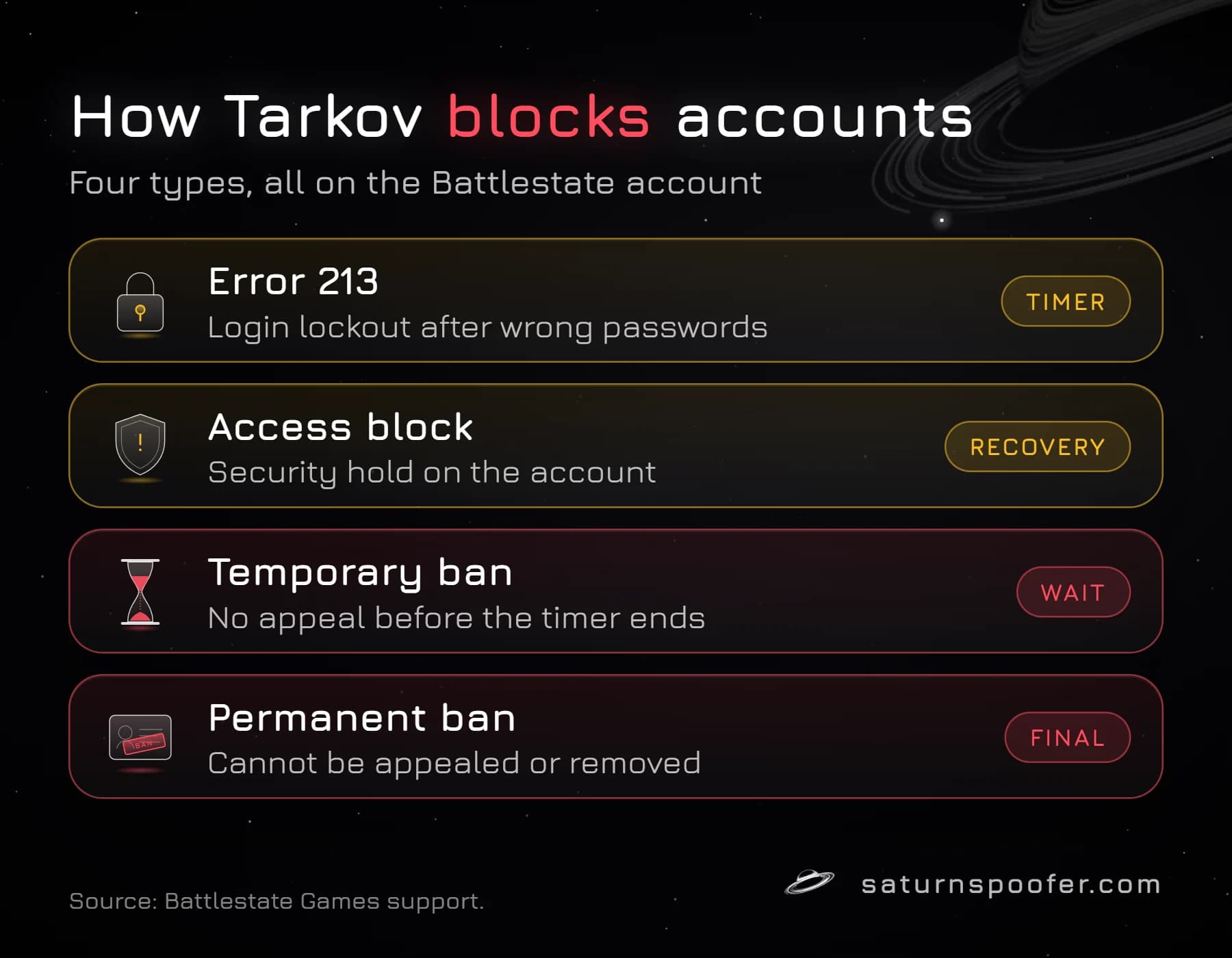
Battlestate's support article on blocked accounts sorts every Tarkov account block into four types, from a login timer to a permanent ban:
- Error 213, an authorization block. Too many wrong passwords trigger account protection, the launcher shows the waiting time on its Authorize button, and the timer grows with each new block. It is a lockout, not a penalty.
- A temporary access block. Battlestate can suspend access for security reasons, and the fix is an account recovery request to support.
- A temporary account ban, for less serious breaches of the License Agreement. Battlestate says it cannot be appealed or removed before the timer runs out, the account works again afterward, and repeat breaches can lead to a permanent block.
- A permanent account ban, for serious breaches such as running prohibited software. Battlestate says this one cannot be appealed or removed.
The Rules of the Game describe the same ladder in legal terms: a short suspension, a longer suspension, or closing the account and cancelling the license. Rule 3.2 gives a first, minor and fixable breach 14 calendar days to be put right before closure. Rule 3.3 adds that once an account is closed, Battlestate can also bar that person from using the game in the future, which is the closest any Battlestate document comes to a ban on the player rather than the account.
Battlestate Bans and BattlEye Global Bans
A Tarkov ban can come from two places, and they work differently. Battlestate issues account bans under its own documents. BattlEye Innovations, the German company behind the BattlEye anti-cheat Tarkov runs, issues global bans from its own system. Tarkov's Steam store page names BattlEye as its kernel-level anti-cheat and says the game needs a Battlestate account, which can be linked to Steam.
| Ban | Issued by | Tied to |
|---|---|---|
| Temporary or permanent ban | Battlestate Games | Battlestate account |
| Global ban | BattlEye | SteamID or game account |
| Hardware ban | Not published | Player reports only |
| IP ban | Not published | No official source |
BattlEye's support page is blunt about its own bans: global bans are permanent, no exceptions are made, BattlEye never reveals the evidence, and a ban caused by a stolen account or key will not be lifted. It also names things that never lead to a ban, such as overlays, recording tools, or playing in a match where a cheater was present.
How a Tarkov Ban Shows Up
A Tarkov ban shows up in the BSG launcher when you try to sign in. Battlestate's support article shows launcher examples for both the temporary and the permanent block, and the temporary version carries its own timer. A BattlEye global ban appears as a message with a number, which BattlEye writes as "Global Ban #ID", and that number matters later if you appeal.
Not every launcher error is a ban. Error 213 is the login lockout above. BattlEye can also refuse to start the game before any ban exists: Battlestate's anti-cheat support page lists messages such as "Windows Kernel modification detected" for a modified system, and a disconnect message when the anti-cheat server connection drops. Those are blocks on a session, and fixing the cause gets the game running again.
Players who reported a cheater also see the other side. A 2023 patch, 0.13.0.4, added in-game mail that tells you when someone you reported was banned.
What Gets a Tarkov Account Banned
Tarkov bans are mostly about cheating, but not only. The cheat families, BattlEye detection and Battlestate's quarterly figures are broken down in how cheating in Tarkov gets caught; the ban side looks like this. Of the 25,000-plus players banned in the first quarter of 2026, Battlestate counted 54% as cheaters. The other 46% were leveling bots, scripts that lower a player's kill-to-death ratio, other software the License Agreement forbids, and real-money trading.
Real-Money Trading and Bots
Real-money trading, known as RMT, covers selling or buying roubles, items or whole accounts for money outside the game, and the License Agreement bans it alongside paid leveling services. RMT sellers made up 16% of the quarter's bans. Buyers made up 6%, and Battlestate notes those bans hit repeat buyers. Bots that level an account automatically fall under the same clause as hacking the client.
PvE and Account Sharing
The License Agreement defines the game as Escape from Tarkov as a whole and makes no exception for the PvE mode, so banned software is banned there too. Battlestate's diary also lists ways honest-looking accounts get caught: letting someone who cheats use your account, cheat software installed for a different game, malware that behaves like a cheat, and accounts that had used a spoofer.
Does Tarkov Ban Your IP Address?
Battlestate does not document IP bans for Escape from Tarkov. Its blocked-account article covers login lockouts, security blocks and account bans, and none of the four types blocks an IP address. Some AI answers claim Battlestate's support page ties blocks to an IP, but the article they cite contains no such statement.
An IP address belongs to your connection, not your PC: it changes when you move house or switch networks, and a household shares one. That makes it a weak way to ban a person, unlike bans on a network card's MAC address, which identify one adapter. If a Tarkov account is banned, changing your IP address does nothing for it, because the ban is stored with the account.
How to Appeal a Tarkov Ban
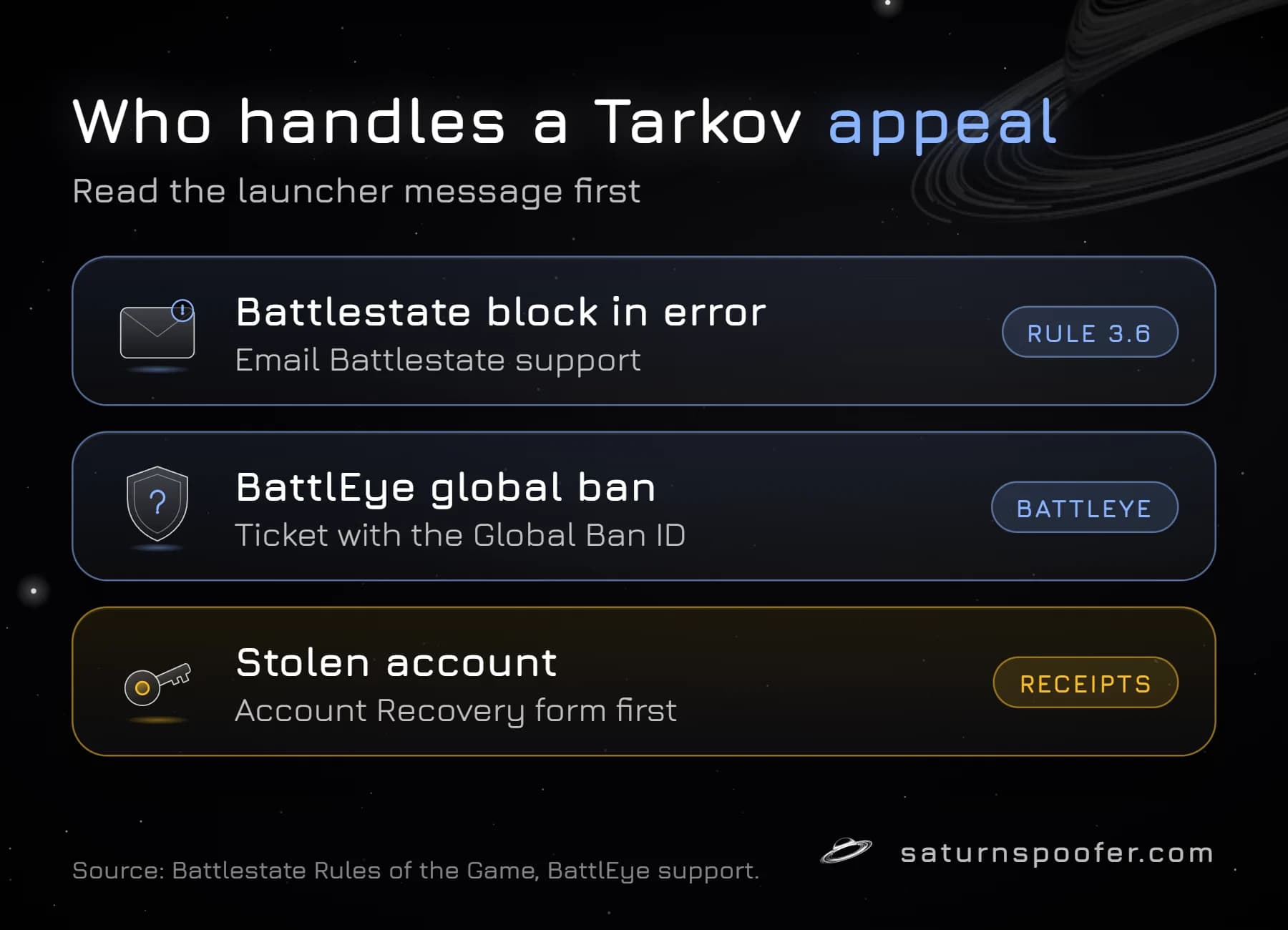
A Tarkov ban appeal goes to Battlestate or to BattlEye depending on who issued the ban. Battlestate's support article is clear about its own bans: a temporary ban cannot be appealed before its timer ends, and a permanent ban cannot be appealed at all. The Rules of the Game still give a contact for mistakes:
- Read the launcher message. A Battlestate block and a BattlEye global ban with an ID number need different routes.
- For a suspension or closure you believe Battlestate placed in error, email [email protected], as Rule 3.6 of the Rules of the Game directs, or use the contact form on the support site.
- For a BattlEye global ban, file a ban appeal ticket through BattlEye's contact page and include the exact Global Ban ID and the game's name, or your SteamID if no ID was shown.
- Send one appeal and wait. BattlEye says sending the same appeal again or to other addresses does not speed up the review.
Battlestate's article also notes that it does not have to show you the evidence behind a ban, and the BattlEye support page with its ban appeal rules says the same for global bans. An appeal is for a ban you can show was wrong, not for asking for a second chance.
If Your Account Was Stolen
A stolen Tarkov account that got banned is a recovery case first. Battlestate's account recovery form goes to [email protected] with the subject "Account Recovery" and asks for your login, every nickname used, the original email, the country and city of registration, and two kinds of payment proof: bank or payment screenshots showing Xsolla as the recipient, and the Xsolla email receipts. Be ready for the hard limit, though. Battlestate puts account security on the player, and BattlEye says it cannot lift a ban that came from account or key theft.
Where a Spoofer Fits After a Tarkov Ban
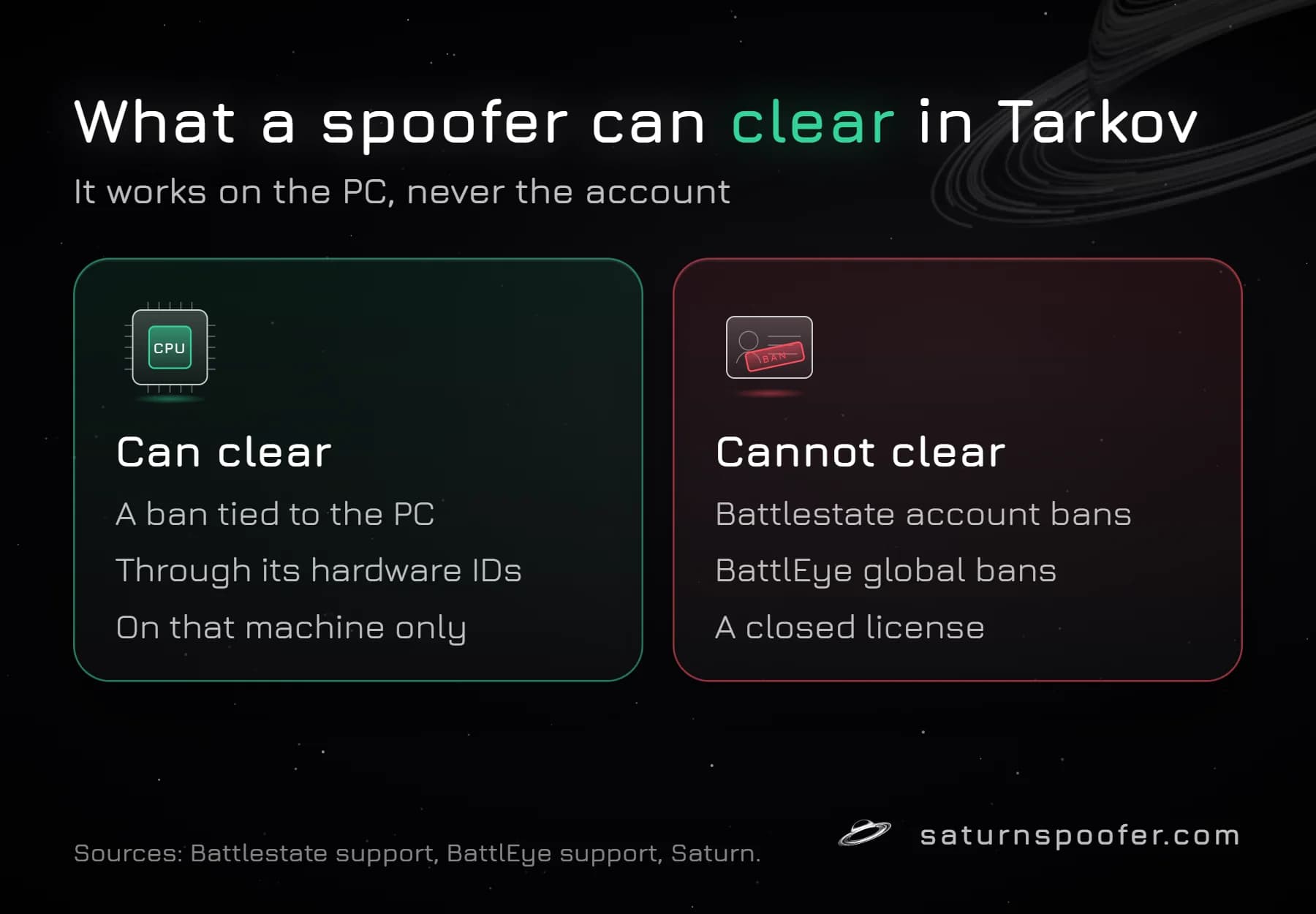
A spoofer only deals with bans attached to the PC it runs on, and nothing more. For Tarkov that limit matters, because the bans Battlestate and BattlEye document are account bans, and no spoofer changes an account's status on their servers.
Saturn is a Windows HWID spoofer that covers Escape from Tarkov, and it is not a cheat. If a ban does follow your machine, Saturn's Escape from Tarkov spoofer replaces the identifiers an anti-cheat can read: processor and TPM values, the motherboard and its SMBIOS records, memory module serials, each NVMe, SSD or hard drive, the GPU, the display's EDID data, connected USB devices, the network adapter's MAC address and the UEFI variables in firmware, along with dozens of other unique values. How a spoofer swaps those identifiers depends on the mode. Temporary mode keeps the new IDs while Saturn runs, the old ones return when it closes, and profiles are unlimited. Permanent mode writes a new set of IDs one time for a single profile, and the PC remains clear after that.
What Saturn will not do is just as important. It does not lift a Battlestate account ban, a BattlEye global ban or a closed license, it does not hide cheats, and it does not stop new bans; Battlestate's own diary counts spoofer users among the accounts it banned. A 24-hour Saturn trial is free, with an email sign-up and no card.
Tarkov HWID Ban FAQ
Does Escape from Tarkov hardware ban?
Battlestate has never confirmed it. The License Agreement, the Rules of the Game and the blocked-account article all describe account bans only, and BattlEye calls its global bans SteamID or account-based. Players report bans that follow a PC, but no Battlestate or BattlEye page backs them up.
Are BattlEye bans HWID bans?
BattlEye does not describe them that way. Its pages call global bans permanent and SteamID or account-based, and it does not publish how it handles hardware. Each publisher using BattlEye also sets its own account penalties on top.
Does Tarkov ban your IP address?
No official source says so. Battlestate's article on blocked accounts lists four block types, all on the account, and none mentions an IP address.
Can you appeal a Tarkov ban?
Partly. Battlestate says temporary bans cannot be appealed before the timer ends and permanent bans cannot be appealed, though its Rules of the Game give [email protected] for suspensions made in error. BattlEye global bans are appealed through BattlEye's contact page with the ban ID.
Does a new Tarkov account work after a ban?
Not if Battlestate closed your account and barred you from the game, which Rule 3.3 allows. BattlEye treats its global bans as permanent and can tie them to a SteamID, and BattlEye says it gives no support on buying a new game or key.
Does reinstalling Windows remove a Tarkov ban?
No. Tarkov bans sit on the Battlestate account or the BattlEye record, not on the Windows install. A fresh Windows install also leaves hardware serials unchanged, so it would not clear a ban on the machine either.
Can you get banned in Tarkov PvE?
Yes. The License Agreement's ban on cheats, bots and data-reading software covers the whole game with no carve-out for PvE, and a PvE ban lands on the same Battlestate account.