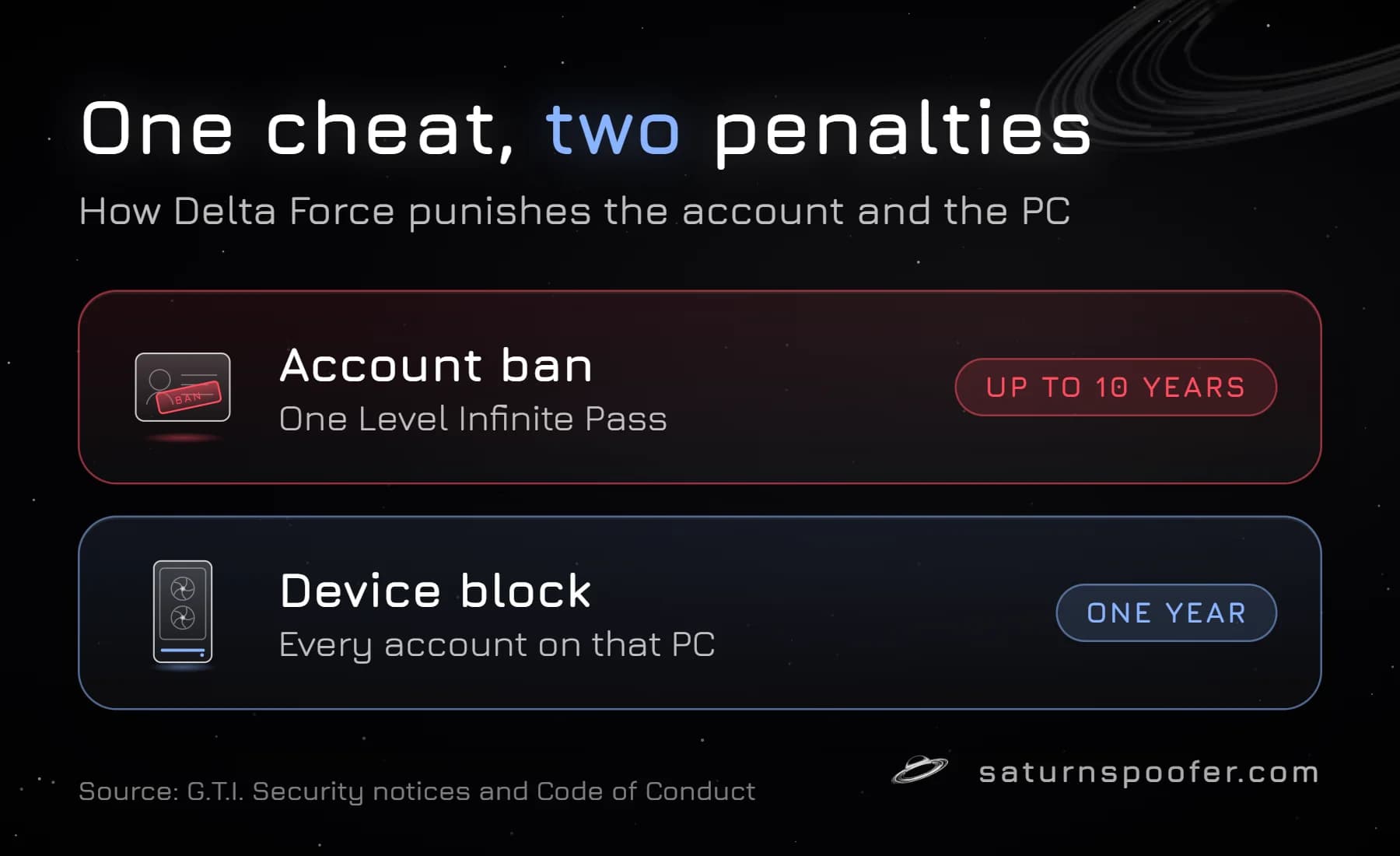
Delta Force hardware-bans PCs. G.T.I. Security, the game's anti-cheat team, blocks a cheater's device for one year and bans the account itself for up to 10 years, and it counts the two penalties separately. In the single week of September 21 to 27, 2026, the team handed 709 PC accounts a 10-year ban and, on a separate line of the same notice, put a one-year block on 10,573 devices.
That second number is the HWID ban, and it is the one a fresh account cannot get past.
Does Delta Force HWID Ban Players?
Yes. Delta Force bans devices as well as accounts, and G.T.I. Security has said so in writing since launch. The Security Code of Conduct it posted on Steam on December 3, 2024 lists the account ban ladder (1 hour, 3 hours, 1 day, 7 days, 30 days, 1 year and 10 years) and then adds "plus device bans." From mid-December 2024, the weekly penalty notices report a device figure next to the account figure.
A device block works on the machine, not the login. Once a PC is blocked, any Level Infinite Pass that signs in on it runs into the same block, which is how a hardware ban differs from an account ban in every game that uses one. A new email address or a fresh install of the game does not change the hardware the anti-cheat sees.
The anti-cheat doing the reading is Anti-Cheat Expert, Tencent's kernel-level anti-cheat. Delta Force's Steam store page puts ACE under kernel-level anti-cheat and requires a Level Infinite Pass to play. G.T.I. Security is the task force the Delta Force team set up together with ACE, and it handles detection, penalties and appeals.
How Long Does a Delta Force Device Ban Last?
A Delta Force device ban lasts one year. That is the length every G.T.I. Security weekly notice has given since the week of November 17 to 23, 2025, when the wording changed to "devices were blocked for one year."
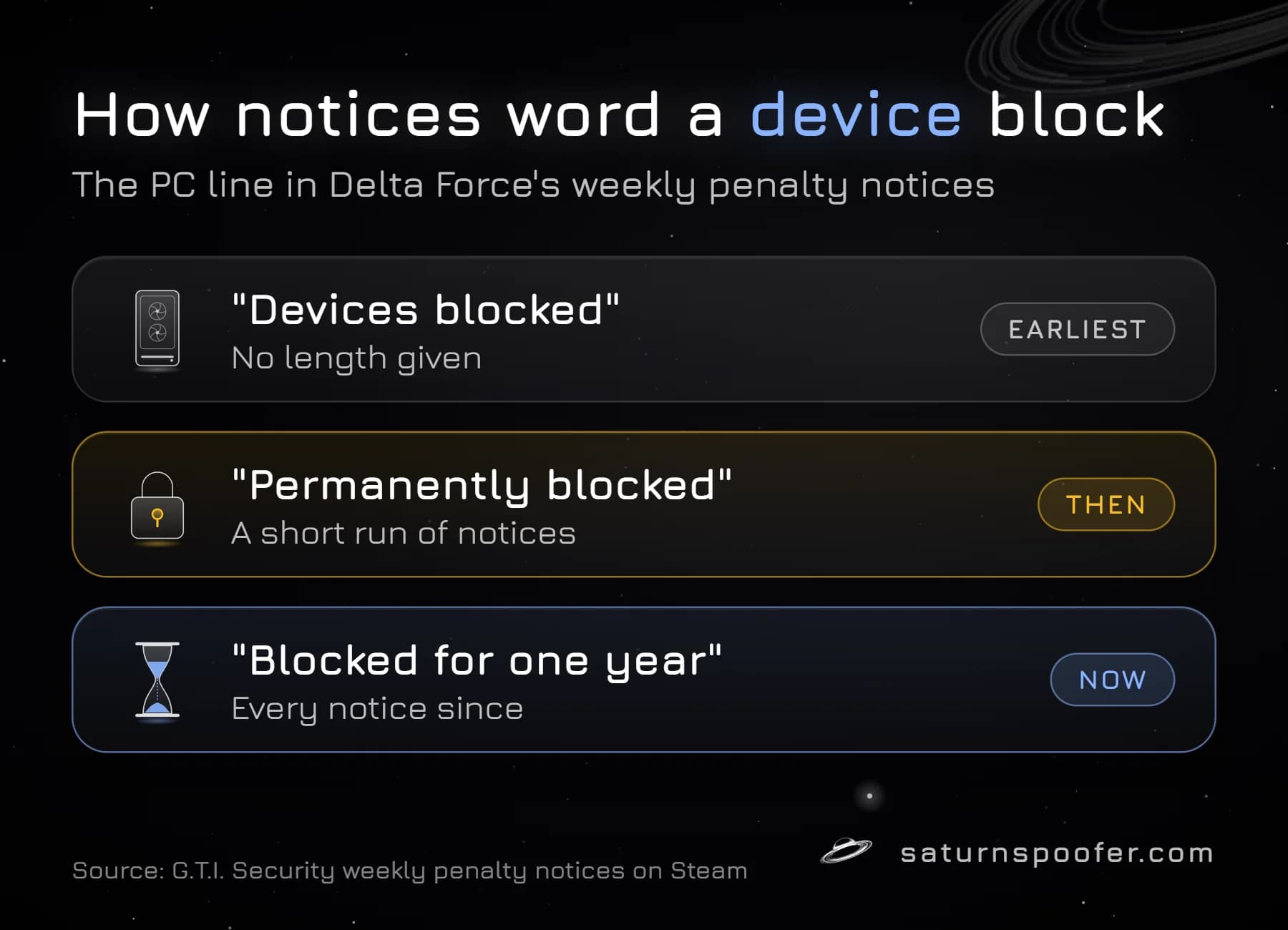
The notices did not always say that. We pulled all 86 "Notice of penalties" posts Delta Force has published on Steam and read the device line in each one:
| Notices posted | Device line says | Count |
|---|---|---|
| Dec 2024 to Aug 2025 | devices blocked | 35 |
| Sep to mid-Nov 2025 | permanently blocked | 8 |
| Nov 24, 2025 onward | blocked for one year | 36 |
The other 7 posts, all from 2024, carry no device line at all. So the early notices gave no length, a run of eight in autumn 2025 called device blocks permanent, and every notice since late November 2025 says one year. The weekly counts also jumped after that change: the notice for December 1 to 7, 2025 lists 45,316 devices, against 862 a fortnight earlier. The studio has not explained the jump. It came in the same weeks G.T.I. Security announced its Secure Boot and TPM 2.0 rollout, which its first security brief said would allow "significantly more accurate hardware bans," but that link is our reading, not something the studio has stated.
The account side is a different clock. Cheating bans on the account run up to 10 years under the published rules, and a device block of one year can sit on top of an account ban of 10.
Which Delta Force Ban Do You Have?
The quickest way to know which Delta Force penalty you have is to read it. The G.T.I. Security page on playdeltaforce.com has an Account Status panel that lists each penalty by type, duration, start date and end date once you sign in, and the in-game penalty pop-up opens the same record through Self-Service.
Some things look like a ban and are not. Delta Force's official guide to safety, reports and appeals, posted on September 18, 2026, says a DMA Shield, TPM 2.0 or Secure Boot prompt "is a PC security setup requirement, not a penalty notice." Those prompts block play until the setting is on, and they lift when you enable it.
| What you see | What it is | Lasts |
|---|---|---|
| Account ban notice | penalty on one account | 1 hour to 10 years |
| Device banned notice | penalty on the PC | one year |
| Restricted maps and squads | Operation Sentinel | observation period |
| Mode or chat restriction | feature penalty | 1 hour to 10 years |
| DMA Shield or TPM prompt | setup requirement | until enabled |
A useful test for a device block is what happens on a second account. If a different Level Infinite Pass is stopped on the same PC while your original account still works on another machine, the block sits on the hardware.
What Is a Delta Force Shadow Ban?
A Delta Force shadow ban is the restricted state G.T.I. Security calls Operation Sentinel, which went live in early June 2026. It is aimed at repeat offenders: when the system sees a device showing ban evasion, rapid account cycling or odd data signatures, the accounts tied to that device enter a restricted state instead of being banned outright.
In that state, according to the announcement on Steam:
- Operations mode is limited to Zero Dam and Layali Grove, so Space City and Tide Prison are off the table.
- Squad play is turned off and the account queues in a matchmaking pool kept apart from regular players.
- The account is visibly marked to other players in the session.
- Accounts confirmed as chronic offenders lose everything they gained unfairly, and accounts that profited through carry services face the same.
Operation Sentinel has an observation period. Normal play can lift the restrictions early, finishing the period without incident removes them automatically, and another anomaly extends or escalates them. Players call it a shadow ban because nothing tells them they are banned: the account still logs in and plays, only in a smaller game. Long queues on their own are not proof of it; the restriction to two Operations maps and the missing squad option are the signs that match what the studio published.
What Does ACE Read From Your PC?
ACE reads more of the PC than most players expect, and neither Team Jade nor Tencent publishes which items a Delta Force device block relies on. What is public is the data ACE collects. Tencent Cloud's privacy notice for the PC version of ACE lists hashed details of the machine (the MAC address, the CPU model, the motherboard, the disk and the graphics card, along with the device type), plus the OS version, running processes, driver signatures and registry scans.
Two newer layers matter for device bans:
- G.T.I. Security's first security brief, on November 28, 2025, said TPM 2.0 "allows for significantly more accurate hardware bans." Its third brief said the lobby check itself only records whether the two switches are on, and keeps that status for one week. TPM is the same chip behind bans tied to the TPM in other games.
- DMA Shield extends the Windows Kernel DMA Protection feature and targets DMA cheat cards, devices that plug into a PC and read game memory without the CPU checking the access. Some PCs are asked to enable it before they can play.
Because the identifiers are combined, swapping one part, such as an SSD or a network card, leaves most of the profile ACE recognizes in place.
How to Appeal a Delta Force Ban
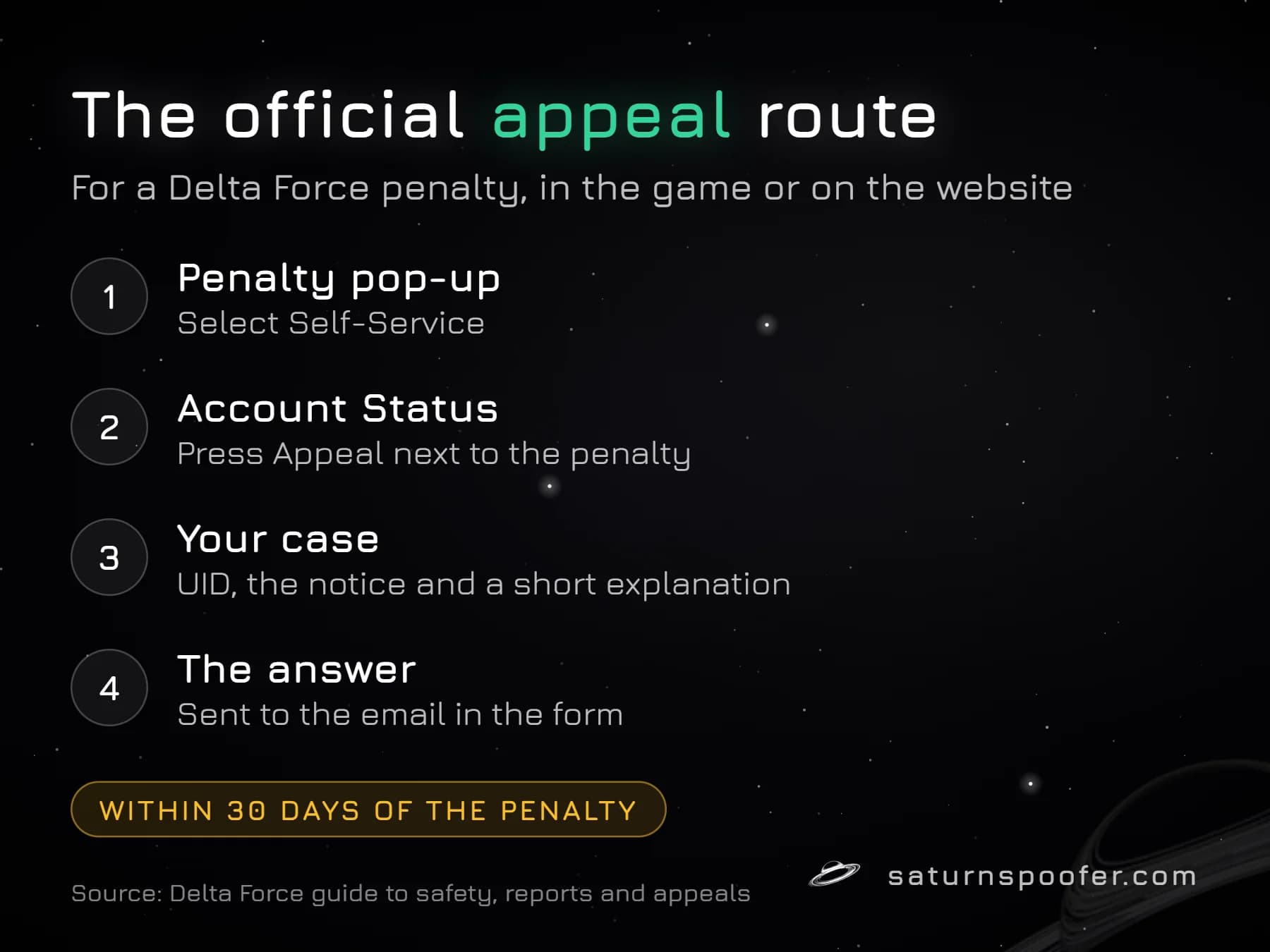
You appeal a Delta Force ban through Account Status, inside the game or on the website, within 30 days of the penalty. Delta Force's guide to reports and appeals sets out the route:
- In the penalty pop-up, select Self-Service, then Account Status.
- Find the penalty and press Appeal on the right. On the website, open the G.T.I. Security page, then Account Status, then Appeal.
- Give your UID and platform, the exact notice and any reference number, roughly when it appeared, and a short, factual explanation.
- Enter an email address you check. The final result is sent there.
Three rules in that guide decide most cases. Appeals close 30 days after the penalty is issued. If Account Status shows no Appeal button, that penalty type cannot be appealed through self-service. And the guide warns that third-party "unban" or "appeal" services cannot change a G.T.I. Security decision.
Expect firm answers on shared accounts. The 2024 Code of Conduct says a ban stays when you lent the account to a friend who cheated, because "penalties are applied to the account, not the individual," and it says spending on the account does not change the outcome. An appeal is worth filing when the penalty was a mistake, for example a stolen account or a PC you bought secondhand.
What Clears a Delta Force HWID Ban?
Three things clear a Delta Force device block, and reinstalling is not one of them. Reinstalling the game, or even Windows, leaves the firmware, disk and network identifiers ACE reads where they were.
- The year runs out. Under the current notices, a device block expires after one year.
- An appeal succeeds. If G.T.I. Security accepts that the penalty was wrong, it lifts it.
- The PC stops reporting the banned identifiers, either because the parts ACE reads were replaced or because an HWID spoofer changed what they report.
Saturn, a Windows HWID spoofer, covers the third option. Saturn's ACE HWID spoofer for Delta Force clears the hardware side of a Delta Force ban from your PC. It swaps the identifiers of the CPU, TPM, motherboard, RAM, drives, GPU, monitor, network adapter and USB devices for new ones. It does not touch the account: a banned Level Infinite Pass stays banned, so you continue on another account. You can run it as a temporary profile or a permanent one, and the free trial gives you 24 hours with no card, only an email address.
Be clear about the rules before you choose. Delta Force's appeals guide tells players not to get around a penalty by creating another account or changing devices, and Operation Sentinel exists to catch devices that keep coming back. Spoofing alters the identifiers the PC hands over. It does not alter the game's rules, and it is not a way to cheat.
Delta Force HWID Ban FAQ
Is a Delta Force device ban permanent?
No, not under the current rules. Every G.T.I. Security weekly notice since the week of November 17 to 23, 2025 lists device blocks as one year, while the eight notices before that, from September to mid-November 2025, called them permanent.
Does Delta Force ban your IP address?
It can. The G.T.I. Security page lists IP address bans and record sharing in other games among the additional measures it uses on top of bans of varying length.
Can a new account play on a PC with a Delta Force device ban?
No. The block is on the PC, so a new Level Infinite Pass signing in on that PC meets the same penalty. The official guide is blunt about the attempt: "Trying to bypass a restriction can create a separate problem."
Can a Delta Force ban affect other ACE games?
The G.T.I. Security page mentions record sharing in other games but names none. Each ACE game runs its own enforcement: Arena Breakout: Infinite, for one, pairs ten-year account bans with device bans under rules of its own.
How long does a Delta Force appeal take?
The official guide gives no deadline for the review. It says the Security Team starts reviewing once the appeal arrives and sends the final result to the email address in the form, and appeals have to be filed within 30 days of the penalty.
Does a security prompt mean my PC is banned?
No. A DMA Shield, TPM 2.0 or Secure Boot prompt is a setup requirement, and Delta Force's guide says it is not a penalty notice. Enable the setting, restart if asked, and the prompt clears.